
The surge in dining costs isn’t just inflation; it’s a fundamental restructuring of the restaurant industry’s business model and culinary philosophy.
- High-end dining is shifting towards “intentional experiences,” using unique culinary techniques and storytelling to justify costs beyond the ingredients.
- Persistent labour shortages and a critical push for ethical, sustainable workplaces are significantly driving up operational expenses for restaurants across Canada.
Recommendation: To find value, diners must become informed navigators of everything from wine lists to reservation systems, understanding the economic and cultural story behind the price on the menu.
If you’ve felt a sense of sticker shock looking at a menu in a major Canadian city recently, you are not alone. That $200 tasting menu in Toronto isn’t an isolated event; it’s a flashing signpost for a profound shift happening across the entire Canadian dining landscape. The easy answer, the one you hear everywhere, is “inflation.” And while rising food costs are certainly part of the equation, they are far from the whole story. The reality is much more complex, touching on everything from global labour shortages to a long-overdue cultural reckoning within professional kitchens.
Simply complaining about prices or retreating to fast food misses the point. The modern dining scene is undergoing a fundamental transformation in its very value proposition. Restaurants are no longer just selling food; they are selling curated experiences, technical mastery, and a distinct culinary identity. To navigate this new reality, a diner needs to become an industry analyst in their own right, capable of decoding the signals hidden in a wine list, a reservation policy, or the very design of the kitchen.
This guide moves beyond the surface-level shock. We will deconstruct the new economics of Canadian dining, from the contentious tipping debate in Vancouver to the rise of “New Canadian” cuisine in Toronto and the changing kitchen culture in Montreal. By understanding the forces reshaping the industry, you can move from being a passive consumer to an informed navigator, empowered to find exceptional value and meaning in your dining experiences, regardless of the price point.
This article provides a comprehensive analysis of the key factors driving change in the Canadian restaurant scene. Below, you will find a summary of the topics we will explore to help you become a more strategic and satisfied diner.
Summary: Decoding the New Canadian Dining Experience
- 18%, 20%, or 25%: What Is the New Standard Tip for Fine Dining in Vancouver?
- The Notification Hack That Gets You a Table at Joe Beef on a Saturday?
- How “New Canadian” Cuisine Is Blending Filipino and French Techniques?
- Why Open Kitchens Are Changing the Toxic Chef Culture in Montreal?
- How to Spot the Best Value Bottle on a marked-up Wine List?
- The 5 Kensington Market Food Stalls That Locals Keep Secret from Tourists
- Where to Eat in Old Montreal Without Paying “Tourist Tax” Prices?
- How to Make Friends in Canada When Locals Are “Polite but Distant”?
18%, 20%, or 25%: What Is the New Standard Tip for Fine Dining in Vancouver?
The awkward moment of decision when the payment terminal prompts for a tip—often starting at 18% and climbing to 25% or higher—is the most immediate symptom of the immense economic pressure on Canada’s restaurant industry. This “tip-flation” isn’t merely greed; it’s a direct consequence of a business model struggling with soaring labour costs and the need to offer competitive wages in a tight market. For many establishments, higher suggested tips are a way to supplement employee income without dramatically raising menu prices, which can deter customers even more.

However, this approach is creating significant friction. As Ronnie Yao, a Vancouver business owner, noted, this pressure is changing the nature of gratuity. In a discussion about evolving restaurant policies, he stated that for many customers, tipping has become a burden instead of an appreciation. This sentiment reflects a growing divide between the operational needs of the restaurant and the experience of the diner. Some Vancouver restaurants are experimenting with “hospitality included” pricing to eliminate tipping altogether, but this often translates to higher upfront menu costs. There is no simple answer, but understanding that the tip prompt reflects a deeper economic fragility is the first step in decoding the modern dining bill.
The Notification Hack That Gets You a Table at Joe Beef on a Saturday?
The difficulty of securing a reservation at a highly sought-after restaurant like Montreal’s Joe Beef is not just about popularity; it’s a function of a carefully managed “exclusivity economy.” Top-tier restaurants manage their limited seating as a scarce resource to maintain a high-quality experience and protect their brand. While there’s no single “hack,” informed diners can use strategic approaches that go beyond simply calling months in advance. The key is understanding the restaurant’s ecosystem and rhythm.
For Montreal’s most competitive tables, a multi-pronged strategy is most effective. Rather than focusing solely on the flagship restaurant, consider these tactics:
- Build a relationship by patronizing sister restaurants like Le Vin Papillon or Liverpool House, especially on weeknights.
- Avoid calling during peak demand periods for the city, such as the Grand Prix or Osheaga festival weekends.
- Target historically quiet periods, like a snowy Tuesday in February, when availability is naturally higher.
- When calling, using basic French pleasantries like “Bonjour” and “Merci” shows respect for the local culture and can be received warmly.
- Explore lunch service, which often features the same level of quality and culinary philosophy at a fraction of the dinner price and with better availability.
–
–
A Counter-Model: Richmond Station’s Focus on Accessibility
In contrast to the exclusivity model, some restaurants are actively working to become more accessible amidst economic pressures. Toronto’s Richmond Station, for example, made a conscious decision to lower its Chef’s Tasting Menu price. They slashed their tasting menu to $115 and adopted a shareable course format, allowing the final price to be more manageable for a group. This demonstrates an alternative philosophy, prioritizing accessibility over scarcity.
How “New Canadian” Cuisine Is Blending Filipino and French Techniques?
A significant portion of the rising cost of fine dining is an investment in culinary innovation. What you’re paying for isn’t just expensive ingredients, but the immense skill, research, and creativity that goes into creating a unique culinary identity. In cities like Toronto, this has given rise to “New Canadian” cuisine, a movement that goes beyond simple fusion to create something cohesive and original. It often involves applying rigorous, classic techniques to flavours and ingredients from a chef’s personal heritage.
This approach is exemplified by chefs who deconstruct traditional recipes and rebuild them with a new lens. As Chef Nick Liu of DaiLo in Toronto explains, his philosophy for “New Asian Cuisine” is that while it is rooted in Chinese traditions, it embraces French culinary techniques. This could mean using a classic French confit method on a protein typically used in a Filipino adobo, or incorporating a Southeast Asian flavour profile into a delicate custard. The result is a dish that is both familiar and entirely new, offering a complex, layered experience that justifies a higher price point.
Case in Point: Akin Restaurant’s Heritage-Driven Menu
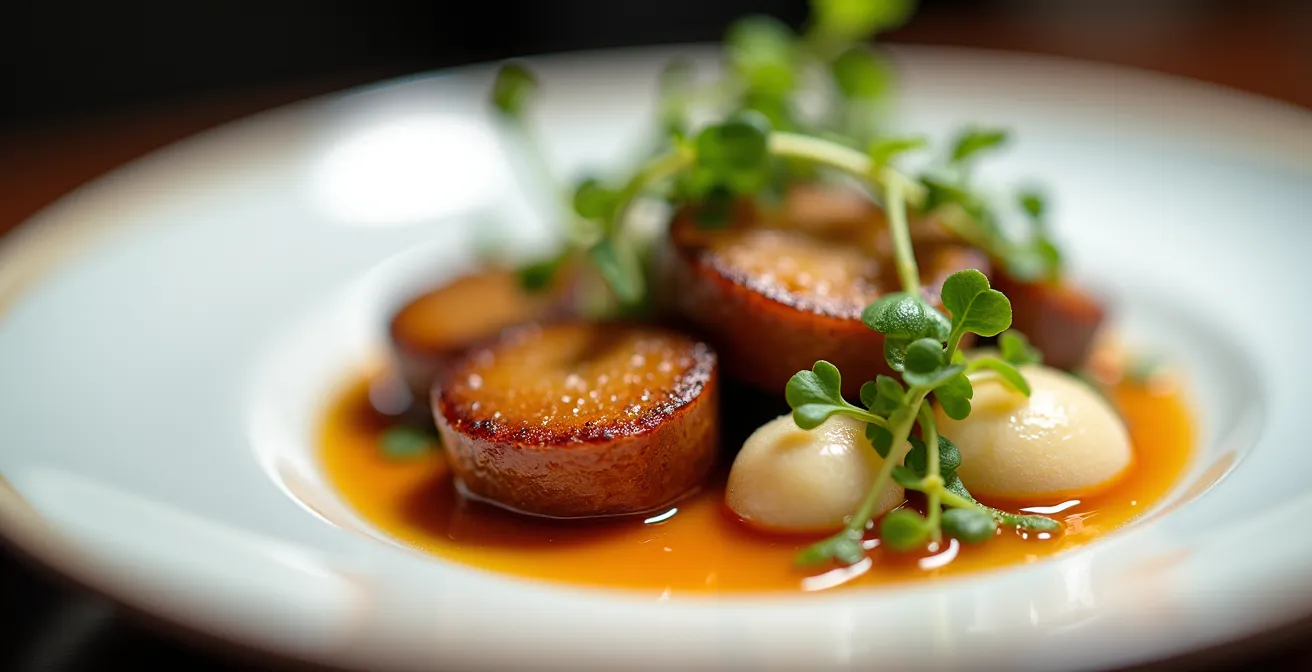
Akin in Toronto, a collaboration between three-star Michelin chef Alvin Leung and MasterChef Canada winner Eric Chong, is a prime example of this philosophy. Their 10-course blind tasting menu is described as a fusion of decades of culinary heritage. According to Foodism, their dishes feature layers of flavours from traditional Asian recipes but incorporate global techniques and premium ingredients like Hokkaido uni and Iberico pork. This is not just cooking; it is edible storytelling.
Why Open Kitchens Are Changing the Toxic Chef Culture in Montreal?
The design of a restaurant is increasingly part of its value proposition, and the trend of open kitchens is more than just “dinner and a show.” It represents a move toward economic transparency and a direct response to the industry’s severe labour crisis. For decades, the closed kitchen environment enabled a notoriously toxic “chef culture” of high stress and mistreatment. In today’s market, where skilled staff are incredibly scarce, restaurants can no longer afford to operate that way.
An open kitchen fundamentally changes the dynamic. It creates an environment of accountability where behaviour is visible to both customers and colleagues, naturally discouraging the yelling and hostility of the past. This improved work environment is a critical tool for staff retention. As Frédéric Dimanche, Director at the Ted Rogers School of Hospitality and Tourism Management, points out, the economic reality is forcing change. He states that many restaurants have had to increase wages not only to attract but also to retain staff. A positive, transparent work environment is as crucial as a competitive salary.
Therefore, when you dine at a restaurant with an open kitchen, part of what you’re paying for is a more ethical and sustainable business model. The higher menu price reflects the investment in creating a workplace that can attract and keep talented professionals, ensuring the long-term health of the establishment and the quality of your meal. It is a visible commitment to cultural change, driven by stark economic necessity.
How to Spot the Best Value Bottle on a marked-up Wine List?
Navigating a restaurant wine list can be one of the most intimidating aspects of fine dining, especially when tasting menus can come with optional wine pairings that add a significant cost, often $100-$200 for wine pairings at Michelin-starred restaurants in Toronto. The standard advice to “pick the second-cheapest bottle” is outdated and ineffective. True value isn’t about finding the cheapest option, but the best intersection of quality and price. This requires a strategy of informed navigation.
The markup on wine is a crucial part of a restaurant’s profit model, often subsidizing thin margins on food. However, not all bottles are marked up equally. Wines from lesser-known regions or grape varietals often carry a smaller percentage markup than famous “big name” bottles from Bordeaux or Napa. Furthermore, engaging the sommelier with the right questions can unlock hidden gems. Instead of asking “what’s good?”, which prompts a generic answer, ask “what are you most excited about on the list right now?” or “which bottle offers the best expression of its terroir for under $120?”. This shifts the conversation from price to passion.
Your Action Plan: Smart Wine Ordering Strategies in Canada
- Engage the Sommelier: Ask which wine is their personal passion project, rather than simply what’s ‘good’.
- Seek Terroir, Not Labels: Request bottles that offer the best expression of their region for under a specific price point (e.g., $120), ignoring big names.
- Go Local for Value: Look for top-tier wines from the Okanagan Valley or Niagara Peninsula, which often provide excellent value in their home provinces.
- Do Your Homework: Compare prices at provincial liquor stores (LCBO, SAQ, BCL) beforehand to identify restaurants with more reasonable markups.
- Prioritize Domestic: Consider that domestic Canadian wines avoid import duties and high transportation costs, often resulting in better value.
The 5 Kensington Market Food Stalls That Locals Keep Secret from Tourists
While the high end of the dining spectrum grapples with justifying its costs, another model for value thrives on a different principle: deep community integration. In Toronto’s Kensington Market, and similar enclaves across Canada, the best-kept secrets are often the small, owner-operated stalls that eschew expensive marketing and elaborate decor. Their value proposition is built on authenticity, consistency, and a direct relationship with their neighbourhood.
These establishments keep prices reasonable not by cutting corners on quality, but by maintaining low overhead and fostering a loyal, local customer base. They become neighbourhood hubs, places where the owner knows the regulars by name. This sense of belonging is a powerful draw. As Nathan Kim, owner of Aki Donburi, recalled about his opening, the community’s anticipation was palpable: “people would stop by while they were still opening and ask when they would open, showing how the neighbourhood welcomed them.” This organic connection creates a resilient business model that is less susceptible to the whims of tourism or fine-dining trends.
Case Study: Fantasy Kitchen’s Community-First Approach
Fantasy Kitchen on Harbord St. in Toronto is a perfect example of this philosophy. They actively strive to offer quality food at reasonable prices, focusing on community involvement rather than digital marketing. Their success is deeply rooted in local relationships; for instance, they sponsor the Toronto High Park football club, which practices and plays near their locations. This creates a virtuous cycle of support that insulates them from some of the inflationary pressures affecting larger, less personal establishments.
Where to Eat in Old Montreal Without Paying “Tourist Tax” Prices?
Dining in a historic, high-traffic area like Old Montreal presents a unique challenge: distinguishing authentic quality from the “tourist tax”—inflated prices for mediocre food that prey on transient visitors. To avoid this trap, an informed diner must apply the same analytical lens used for fine dining. The first step is acknowledging the real economic pressures all restaurants face. With food inflation hovering over 9% in recent years, even the most honest establishments have been forced to raise prices.
The key is to look for indicators of quality and local patronage. A restaurant with a menu in multiple languages and a host aggressively trying to pull people in from the street is often a red flag. Instead, look for smaller spots on side streets, listen for the sound of French being spoken among patrons, and check for menus that are concise and seasonal. A short, focused menu often indicates a kitchen that prioritizes fresh ingredients and careful preparation over a sprawling, frozen-food-dependent inventory. The price data from Toronto shows just how high the ceiling can be for high-end dining, making it even more important to be discerning in tourist zones.
This table illustrates the current price landscape for tasting menus in Toronto, providing a benchmark for what top-tier urban dining costs in Canada. When exploring Old Montreal, use this as a mental reference for what a premium, technique-driven experience might cost, and be critical of places charging similar prices without delivering comparable quality.
| Restaurant | Tasting Menu Options | Price Range | Wine Pairing |
|---|---|---|---|
| George Restaurant | 5, 7, or 10 courses | $140-$180 | $115-$140 |
| Canoe | 8 courses | $185 | $100-$200 |
| DaiLo | DaiLo’s Choice | $108-$130 | Optional |
| MSSM (Omakase) | 14 courses | $98 | N/A |
| Richmond Station | 7 courses | $140 | $89 |
Key Takeaways
- The high cost of dining is a complex issue driven by labour economics and cultural shifts, not just food inflation.
- True value can be found by becoming an “informed navigator”—understanding wine lists, reservation strategies, and different restaurant business models.
- The most rewarding dining experiences often come from “intentional dining”: choosing a restaurant for its specific story, technique, or philosophy, not just its menu.
How to Make Friends in Canada When Locals Are “Polite but Distant”?
The stereotype of Canadians being “polite but distant” can make forming deep social connections a challenge for newcomers. In this context, the shared experience of dining takes on a heightened importance. It can be a powerful tool for breaking through the polite surface and fostering genuine friendship. The key is to approach dining not as a mere transaction, but as a form of shared exploration. This is the essence of intentional dining.
Choosing a tasting menu, for instance, transforms a meal into a collaborative event. Instead of everyone being siloed in their own choices, the group embarks on a shared culinary journey. This is a philosophy many chefs consciously build into their menus. As Kayo Ito, co-owner of Radici Project, expressed to Toronto Life, “A tasting menu gives us control over rhythm, progression and contrast—we can guide the guest through a carefully considered experience.” This guided journey creates natural conversation points and a memorable, collective experience that can serve as the foundation for a new friendship.
Beyond formal tasting menus, consider food-centric activities that encourage repeat interaction: joining a community-supported agriculture (CSA) box program, taking a cooking class at a local market, or forming a small “dining club” to explore different neighbourhoods. These activities create a low-pressure social framework built around a common interest, allowing relationships to develop organically over time. The food becomes the catalyst, not just the subject, for connection.
Armed with this new understanding of the forces shaping Canadian restaurants, it’s time to rediscover your city’s dining scene not as a passive consumer, but as an informed connoisseur ready to find value and connection.
Frequently Asked Questions about Why Tasting Menus in Toronto Have Jumped to $200+ Per Person?
Why are tasting menus still popular despite rising costs?
Despite the cost-of-living crunch, tasting menus are thriving because people are going out less but want something thoughtful and special when they do. It’s a shift in consumer behaviour towards valuing meaning and unique experiences over frequency or excess. A tasting menu represents a complete, curated event.
How can food experiences help build social connections?
Food experiences build social connections by creating a framework for shared discovery and repeat interaction. Consider communal dining experiences like shared tasting menus, taking cooking classes at local markets, or joining neighbourhood food co-ops where regular, low-pressure interactions can foster organic friendships over a common interest.
What makes Toronto’s dining culture unique for newcomers?
Toronto’s dining scene is defined by being proudly Canadian and obsessively local. Many of the top restaurants focus on creating thoughtful, intentional experiences that elevate humble, local ingredients through sophisticated techniques. It’s a culture that values storytelling and a sense of place on the plate.