
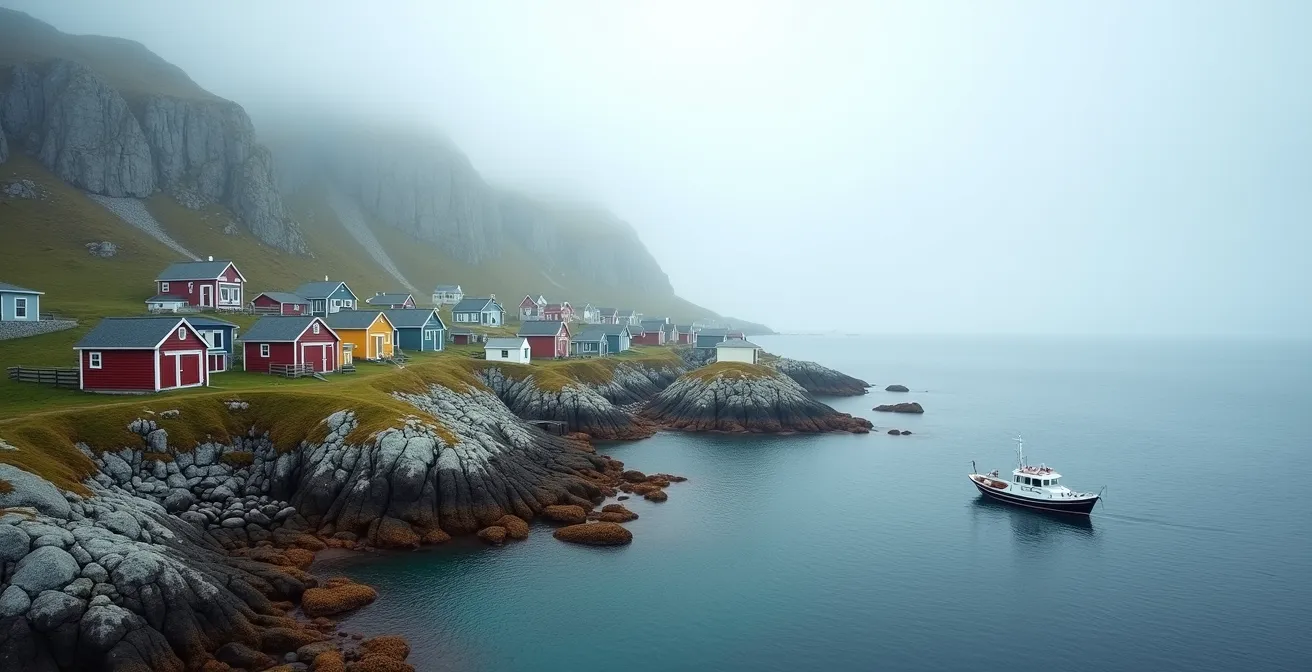
The high price of a remote Canadian retreat like Fogo Island is not for the amenities you receive, but for the profound mental reset you achieve through the intentional absence of convenience.
- True luxury is found in “purposeful friction”—the logistical challenges of isolation that force mindfulness and disconnect you from a life of frictionless ease.
- The value is measured in “Return on Experience” (ROE), where the investment yields a deeper sense of peace and perspective that a typical city vacation cannot offer.
Recommendation: Instead of asking “What do I get for the money?”, ask “Who will I become after the experience?”. The answer justifies the investment.
As a stressed executive, you’re accustomed to solving problems with efficiency and resources. So when you see the price tag for a digital detox on a remote Canadian island like Fogo, the math doesn’t seem to add up. For the cost of a few nights of stark landscapes and quiet reflection, you could have a week of five-star service in a bustling metropolis. The conventional wisdom suggests luxury is about abundance, ease, and instant gratification. You’re told to book a spa, hit the beach, or find a resort where every need is anticipated.
But what if that very convenience is the source of the problem? What if the constant, frictionless nature of modern life is what you truly need to escape? The premise of this article, and the core philosophy of destinations like the Fogo Island Inn, is that the greatest value lies not in what is provided, but in what is taken away. The real investment is in what we call purposeful friction: the intentional, character-building resistance that only true isolation can provide. This isn’t about paying more for less; it’s about investing in a different kind of wealth—a profound and lasting mental clarity.
This guide will deconstruct the value proposition of remote luxury. We will explore how the challenges of travel, local etiquette, essential preparations, and even the stark realities of island infrastructure are not drawbacks, but the very features you are paying for. By understanding this, you’ll see that the high cost is a direct investment in your own transformation, a concept we’ll explore through various iconic Canadian settings.
Summary: Why a Digital Detox on Fogo Island Costs More Than a City Vacation
- Ferry vs. Floatplane: How to Get to Haida Gwaii Without Getting Seasick?
- The “Come From Away” Etiquette: How to Respect Locals on Small Islands?
- Why You Need Wool, Not Cotton, for a Trip to Sable Island?
- How to Shop for Groceries on Grand Manan When the Ferry Is Cancelled?
- The Water Access Trap: Buying a Cottage on an Island Without a Public Dock?
- How to Plan a 3-Day Rockies Meditation Retreat for Under $600 CAD?
- Why a $100k Salary in Vancouver Feels Like $60k in Halifax?
- Sunshine Coast vs. Vancouver Island: Where to Retire for Better Healthcare Access?
Ferry vs. Floatplane: How to Get to Haida Gwaii Without Getting Seasick?
The journey to a place like Haida Gwaii, much like Fogo Island, is the first stage of the detox. It’s designed to be difficult. The choice between a long ferry ride across the notoriously rough Hecate Strait or a weather-dependent floatplane isn’t a simple matter of convenience; it is your first encounter with purposeful friction. This initial hurdle forces you to surrender control, to adapt to schedules dictated by tides and wind, not your own agenda. This is a feature, not a bug. It’s the process of shedding the urban mindset that demands instant, predictable travel.
Rather than trying to “hack” the system for maximum comfort, the value-oriented approach is to embrace the journey as part of the experience. The eight-hour ferry is not a delay; it’s an enforced period of reflection. The potential for a floatplane cancellation isn’t a risk; it’s a lesson in patience. To navigate this, a luxury travel consultant advises managing expectations, not avoiding the challenge. Consider these factors not as problems to solve, but as the first steps in your mental reset:
- Weather Patterns: Crossings are most reliable from May to September. Booking within this window isn’t about avoiding rough seas entirely, but about choosing a time when nature is more likely to be cooperative. It’s an act of alignment, not dominance.
- Backup Planning: Booking a floatplane with the ferry as a backup isn’t just about insurance; it’s an acknowledgement of nature’s supremacy. It builds flexibility and humility into your travel plan.
- Micro-Comforts: Choosing a port-side cabin on the ferry, which may offer a slightly calmer ride, isn’t about seeking luxury. It’s a small, mindful choice that shows you are engaging with the environment on its own terms.
This initial logistical challenge recalibrates your internal clock from the instant pace of the city to the more deliberate rhythm of the coast. The price you pay in time and potential discomfort is the down payment on the peace you seek.
The “Come From Away” Etiquette: How to Respect Locals on Small Islands?
Once you arrive, you’ll discover the cost of your stay is not just funding a hotel—it’s participating in a fragile ecosystem of culture and economy. On islands like Fogo or the Magdalen Islands, a “Come From Away” who arrives with a city mindset of transactional service misses the point entirely. The high price tag is, in part, a filter. It selects for visitors who understand they are guests in a living community, not just consumers in a resort. The value you receive is directly proportional to the respect you give. This principle of economic symbiosis is the heart of the experience.
Your investment directly sustains the local way of life, and in return, that community provides the very authenticity you traveled so far to find. It’s a closed loop. The Fogo Island Inn, for example, is a community asset where everything is sourced with a clear ethical hierarchy: first Fogo Island, then Newfoundland and Labrador, then Canada. This isn’t a marketing gimmick; it’s a business model that turns tourism into a tool for cultural preservation. When you eat at the inn, you are helping to support a local fisher. When you buy a quilt, you are funding an artisan’s guild.
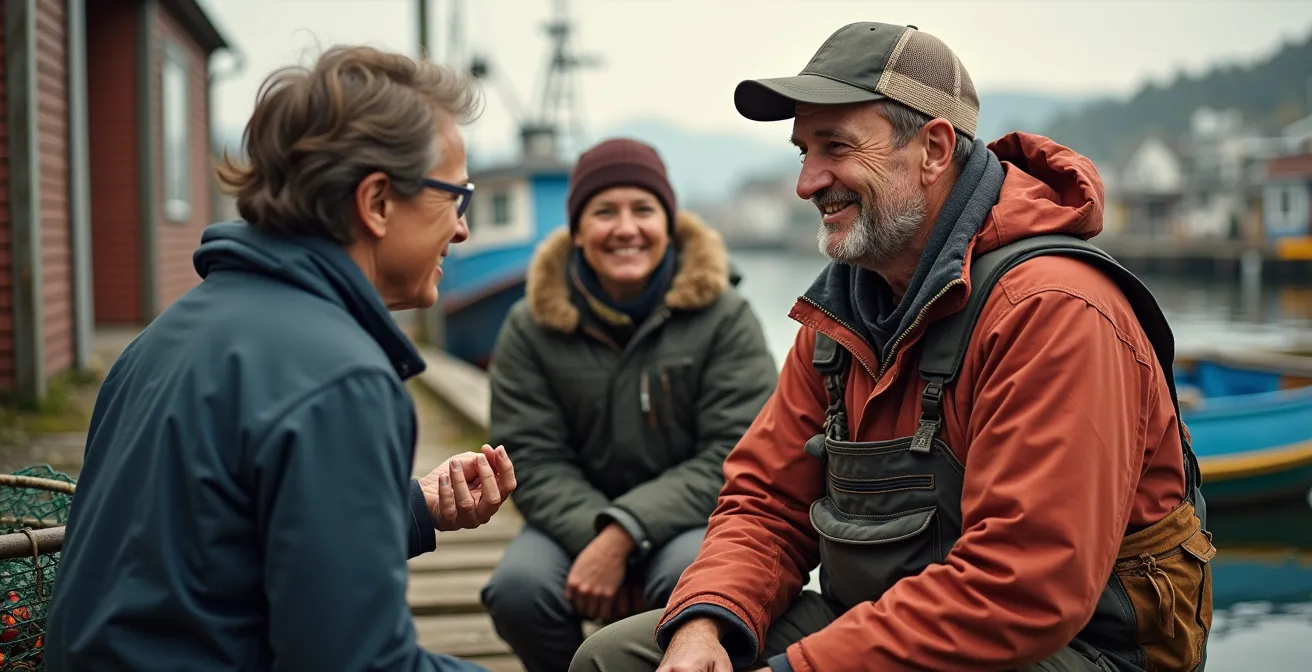
As the image above illustrates, the most valuable moments are not orchestrated luxuries but genuine human connections. The proper etiquette is one of quiet observation, genuine curiosity, and humility. Ask questions, listen to stories, and spend your money locally. Acknowledge that you are a temporary visitor in a place with deep roots. This shift from consumer to participant is a core component of the “Return on Experience.” You leave not just with memories, but with a sense of connection and the knowledge that your presence was supportive, not extractive.
Why You Need Wool, Not Cotton, for a Trip to Sable Island?
The decision to pack wool instead of cotton for a trip to a place like Sable Island may seem trivial, but it is a perfect metaphor for the philosophy of remote travel. It represents a fundamental shift from aesthetics to function, from city assumptions to environmental reality. On the mainland, we choose fabrics for style and comfort in climate-controlled environments. In Canada’s remote coastal regions, your clothing is a tool for survival. This is a direct confrontation with logistical fragility—the understanding that you are exposed and must be prepared.
The high cost of a guided trip to these locations includes the expertise that tells you this critical information. You’re not just paying for a boat ride; you’re paying for the wisdom that keeps you safe and allows you to appreciate the sublime beauty of a harsh environment. As a stark reminder from Environment Canada, these regions can face severe weather, with wintry conditions that can include temperatures of -20°C and up to 25 centimeters of snow even in shoulder seasons. In this context, the performance of your gear is paramount.
This table breaks down why a simple choice like fabric is a critical decision, not a stylistic one. It’s a practical example of the local knowledge that your investment secures.
| Factor | Merino Wool | Cotton | Safety Impact |
|---|---|---|---|
| Insulation When Wet | Retains 80% warmth | Loses all insulation | Critical for hypothermia prevention |
| Drying Time (maritime conditions) | 4-6 hours | 12-24 hours | Reduces exposure risk |
| Wind Resistance | Natural wind barrier | Wind penetrates easily | Essential in 90km/h coastal gusts |
| Odor Resistance | 7-10 days wear | 1-2 days maximum | Important for limited laundry access |
Choosing wool is an act of respect for the environment and an acceptance of your vulnerability within it. It’s an understanding that in true wilderness, luxury is not a soft robe, but a dry layer of merino that insulates you from the biting wind. This is the value: practical, life-sustaining wisdom that allows you to experience the raw power of nature safely.
How to Shop for Groceries on Grand Manan When the Ferry Is Cancelled?
Nothing illustrates “purposeful friction” more clearly than the challenge of securing daily supplies. On Grand Manan Island in New Brunswick, as in many remote communities, a cancelled ferry is not a mere inconvenience; it’s a rupture in the supply chain. This reality is a shock to the urban visitor accustomed to 24/7 grocery delivery and fully stocked shelves. The case study is simple: when the weather turns, the ferry, which is the primary mode of transport for goods and essential services, stops running. Suddenly, the availability of fresh milk or vegetables is not guaranteed.
From a consultant’s perspective, this is where the true detox begins. You are forced to abandon the mindset of endless choice and adopt one of resourcefulness and community reliance. This isn’t a flaw in the destination; it is the destination’s most powerful teaching tool. It forces you to plan, to be mindful of what you consume, and to connect with local systems. The value proposition here is a forced lesson in gratitude and ingenuity. An effective strategy involves foresight and local integration:
- Pre-Stocking: Arrive with a two-week supply of non-perishable essentials. This act of planning is the first step in acknowledging the island’s logistical reality.
- Local Networks: Upon arrival, your first task should be to connect with the local food network. Visiting the Fishermen’s Union stores or building a rapport with a local farmer isn’t just for charm; it’s a practical necessity.
- Embrace Tradition: Maintaining a reserve of “storm chips” is a classic Maritime tradition. It’s a cultural practice born of necessity, representing a lighthearted acceptance of nature’s power to disrupt plans.
The empty shelf on the grocery store is a more powerful meditative tool than any guided app. It teaches you the difference between what you want and what you need. That lesson in perspective is a significant part of the high “Return on Experience” you’re investing in.
The Water Access Trap: Buying a Cottage on an Island Without a Public Dock?
For the executive mind, the ultimate solution to the “friction” of remoteness might seem to be ownership: buying a piece of that isolation. However, this is where the cost-benefit analysis becomes most stark. The impulse to replicate mainland convenience by, for example, building a private dock for a water-access-only property, is a costly trap. It’s an attempt to conquer the very isolation you supposedly seek, and it comes with a staggering price tag that goes far beyond the initial purchase.
Building your own infrastructure is the antithesis of the remote detox philosophy. It’s a fight against the environment, not an immersion within it. The financial costs are significant; you can expect to pay anywhere from $15,000 to $50,000 for basic dock construction, plus the recurring headache and expense of annual permits and storm-damage repairs. This figure doesn’t even account for the cost of a boat, fuel, and maintenance—all just to replicate the convenience of a road you chose to leave behind.
The real luxury, and the smarter investment, is to buy into a community with existing, shared infrastructure. Using a public dock, relying on a water taxi, or being part of a cottage association that shares these costs is not a compromise. It is a deeper form of buy-in to the community and a smarter way to manage the logistical fragility of island life. It fosters interdependence and connection, the very things that are often scarce in a hyper-individualized urban existence. The value is not in creating a private kingdom, but in learning to live within the elegant constraints of a shared, remote reality.
How to Plan a 3-Day Rockies Meditation Retreat for Under $600 CAD?
While Fogo Island represents the pinnacle of curated, high-cost isolation, the underlying principles of “purposeful friction” and the “luxury of scarcity” can be achieved on a more accessible budget. A self-guided meditation retreat in the Canadian Rockies offers a different path to the same goal. Here, the investment is less financial and more personal—measured in physical effort and a willingness to embrace rustic simplicity. The “luxury” is the profound silence of an alpine meadow at dawn, a reward earned by carrying your own supplies and forgoing modern amenities.
The key is leveraging networks like the Alpine Club of Canada (ACC), whose backcountry huts provide a framework for profound disconnection. A stay in one of these huts, as detailed in their resources, offers a shared, rustic experience. You get a foam mattress and access to cooking utensils, but the rest is up to you. This is the essence of scarcity as a feature: the absence of service, Wi-Fi, and even private rooms forces self-reliance and a heightened awareness of your surroundings.
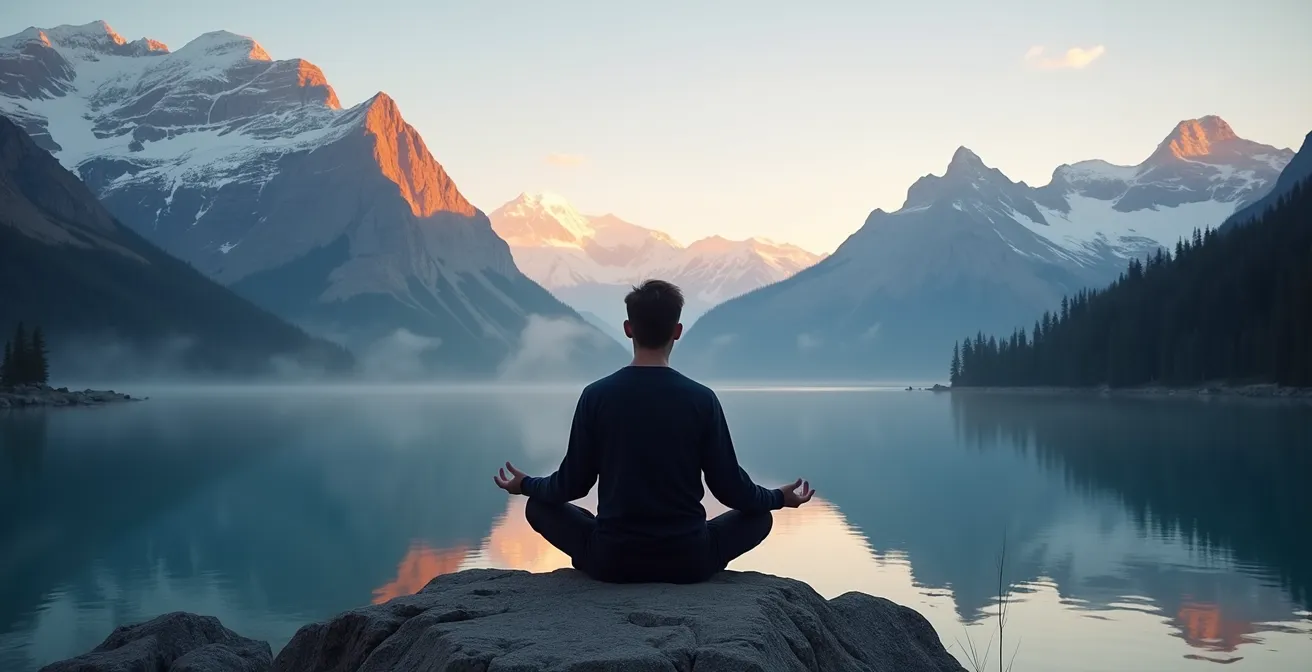
Achieving this transformative experience for under $600 is entirely feasible with careful planning. Consider this a blueprint for earning your peace:
- Accommodation (3 nights): An ACC hut like the Elizabeth Parker Hut can cost as little as $35/night for members, accessible via a stunning 11km hike.
- Transportation: A round trip from Calgary to the trailhead and a Parks Canada pass can be managed for approximately $230.
- Food: A $150 budget for lightweight, dehydrated backpacking meals minimizes your carry weight, another form of “purposeful friction” that demands minimalist planning.
Your Pre-Retreat Action Plan: Auditing Your Personal Stress Signals
- Points of Contact: List every channel that sends you a notification (email, Slack, news alerts, social media). This is the “noise” you plan to escape.
- Data Collection: For three days, inventory every non-essential digital interaction. Note the time and your emotional state. This reveals your patterns.
- Coherence Check: Confront this data with your stated values (e.g., “family time,” “deep work”). Where are the glaring inconsistencies between your actions and your goals?
- Emotional Resonance: Identify the one or two digital habits that cause the most anxiety versus those that bring genuine connection. Distinguish the signal from the noise.
- Integration Plan: Create a simple “off-boarding” plan. What one app can you delete? What one notification can you turn off permanently when you return?
Why a $100k Salary in Vancouver Feels Like $60k in Halifax?
To fully grasp the concept of “Return on Experience,” it helps to draw a parallel from the world of finance and career planning. For a stressed executive, a $100,000 salary in Vancouver sounds objectively better than a $60,000 salary in Halifax. But this nominal view ignores the most crucial factor: disposable income and quality of life. The high cost of living in a city like Vancouver can negate the benefit of a higher salary, a phenomenon confirmed by cost of living comparison data that shows you need significantly more income in Vancouver to maintain the same standard of living as in Halifax.
This is the perfect financial analogy for the Fogo Island dilemma. The “price” of Fogo Island is high, but the “value” it delivers—in terms of mental space, perspective, and a true disconnect—is arguably far greater than a less expensive but more distracting city vacation. You are escaping the very environment represented by Vancouver’s high-burn, high-cost lifestyle. The following table provides a stark breakdown of how a higher salary doesn’t always translate to more financial freedom, just as a higher-priced trip isn’t always a better value.
| Financial Factor | Vancouver ($100k salary) | Halifax ($60k salary) |
|---|---|---|
| Average 1-bedroom rent | $2,800/month | $1,600/month |
| Monthly transit pass | $185 | $90 |
| After-tax income (approx) | $72,000/year | $45,000/year |
| Housing as % of net income | 47% | 43% |
| Discretionary income after essentials | $1,800/month | $1,400/month |
As the data shows, despite a 40% lower gross salary, the individual in Halifax has a comparable percentage of their income consumed by housing and only slightly less discretionary income. When you factor in non-monetary elements like shorter commutes and less daily stress, the “value” of the Halifax lifestyle could be considered much higher. Applying this logic to your vacation, a remote detox is the “Halifax” option: it may seem like a step down in nominal features, but the quality of the experience delivered is far superior.
Key Takeaways
- Embrace Purposeful Friction: The inconveniences of remote travel—like unpredictable ferries and limited supplies—are not flaws but essential features that force a mental reset.
- Seek Return on Experience (ROE): The true measure of a luxury detox is not the price, but the transformative impact on your perspective and well-being.
- Respect Economic Symbiosis: Your investment should support the local culture and economy, which in turn provides the authentic experience you are seeking.
Sunshine Coast vs. Vancouver Island: Where to Retire for Better Healthcare Access?
Our discussion has focused on the temporary, restorative value of isolation. But for some, the pull of this lifestyle is so strong it becomes a permanent goal, particularly for retirement. This is the ultimate test of the value proposition, where the “purposeful friction” of a remote location meets the non-negotiable needs of long-term health. The choice between two seemingly similar B.C. retirement havens, the Sunshine Coast and Vancouver Island, brings this into sharp focus. The deciding factor often isn’t the view or the community, but the stark reality of healthcare access.
While both offer stunning natural beauty, Vancouver Island has larger service centers like Victoria, Nanaimo, and Campbell River with major hospitals. The Sunshine Coast, beautiful as it is, relies on smaller facilities and often requires a ferry trip—subject to all the logistical fragilities we’ve discussed—for specialist care. This isn’t a minor detail; it’s a critical lifestyle consideration. In Canada, even with universal healthcare, access is not uniform. Data on wait times reveals significant regional disparities. For instance, the national median wait time can be considerable, with an analysis showing a median of 15 weeks from a GP referral to seeing a specialist, followed by another 15 weeks to receive treatment. These waits can be exacerbated in more remote communities.
This final point brings our consultation to a crucial conclusion. The “luxury of scarcity” is a powerful tool for a temporary detox. However, when considering a permanent move, you must soberly assess which frictions are “purposeful” and which are simply liabilities. A cancelled ferry is a lesson in patience when you’re on vacation; it’s a life-threatening crisis when you’re having a medical emergency. The ultimate value is found in striking the right balance—finding a location that offers the peace you crave without sacrificing the essential services you need.
Therefore, the final step is to assess your personal threshold for friction against your non-negotiable needs. A successful digital detox or lifestyle change isn’t about finding the most isolated place, but the right place for you. Begin by evaluating what you truly need to thrive, and you will discover the unique destination that offers the highest possible “Return on Experience.”