
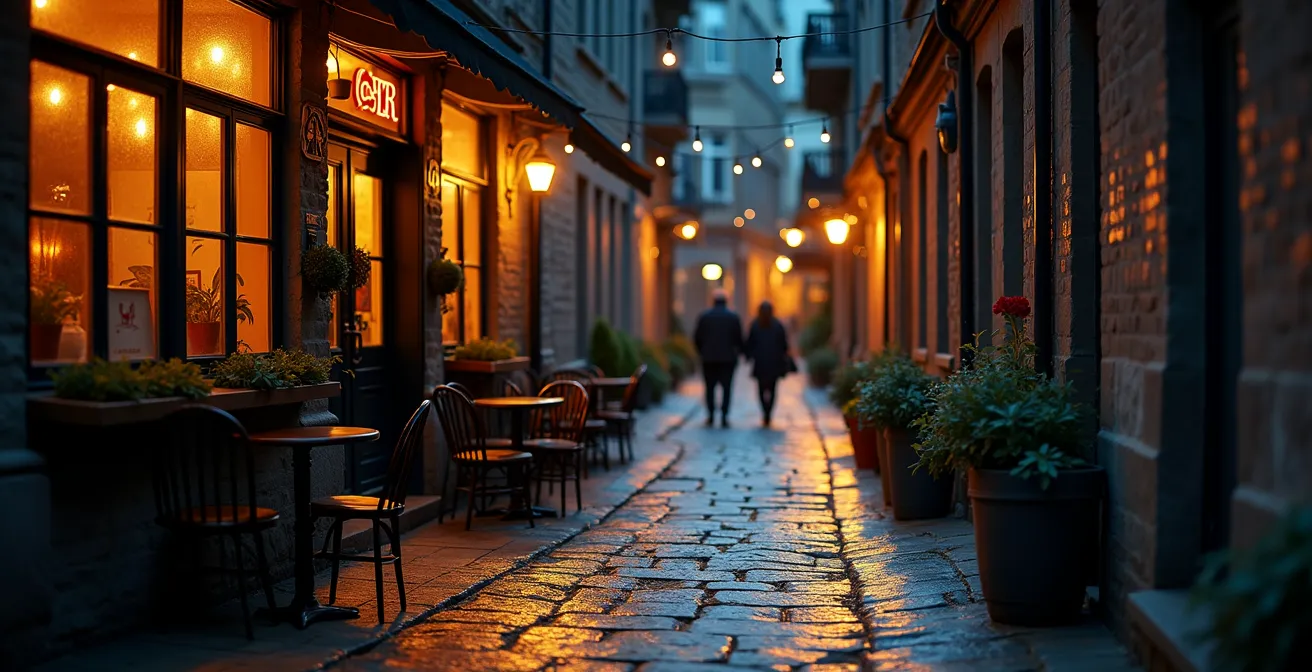
The key to eating well in Old Montreal isn’t a secret list of restaurants; it’s learning to decode the signals of a “tourist trap” and applying a few simple rules.
- Most “great” restaurants in the tourist core charge a premium—a “tourist tax”—for location, not for quality.
- Authenticity and value are often found by applying strategic timing and the “500-Meter Rule”—walking just a few blocks away from the crowds.
Recommendation: Instead of searching for specific names, learn to audit menus, locations, and atmospheres. This skill will serve you in any historic district in the world.
There’s a familiar scene in Old Montreal. A visitor, captivated by the cobblestone streets and 18th-century architecture, gets hungry. They see a charming terrasse on Place Jacques-Cartier, a menu in three languages by the door, and a friendly host beckoning them in. An hour later, they’re $70 poorer, nursing a mediocre glass of wine and eating a forgettable poutine that was clearly microwaved. They’ve just paid the “Tourist Tax”—the unspoken premium for convenience and location that has little to do with the quality of the food on the plate.
Most guides will give you a list of “top restaurants.” The problem? Today’s hidden gem is tomorrow’s tourist hotspot. The advice to “go where the locals go” is equally useless without a map. This guide is different. Forget lists. We’re not going to tell you *where* to eat. We’re going to teach you *how* to see. It’s about shifting your mindset from a passive tourist to an active food critic.
The real secret isn’t about finding a specific restaurant; it’s about learning to decode the signals that scream “tourist trap” versus those that whisper “authenticity.” It’s about understanding the subtle strategies—from strategic timing to the power of a five-minute walk—that separate a disappointing meal from a memorable one. This isn’t just about Old Montreal; it’s a lesson in culinary navigation that applies to every historic district, from Quebec City to Vancouver’s Gastown.
Throughout this article, we’ll use examples from across Canada’s historic districts to illustrate a core set of principles. By the end, you’ll have a new framework for finding great food, not just a list of places that will be outdated by next season.
Summary: Decoding Canada’s Historic Dining Scenes
- The Footwear Mistake That Ruins a Day in Quebec City’s Lower Town?
- How to Park in Toronto’s Distillery District for Under $20?
- When to Visit Gastown to Capture the Steam Clock Without 50 People?
- Why You Can’t Change the Windows on Your Cabbagetown Heritage Home?
- Which Historic Districts in Halifax Are Actually Wheelchair Accessible?
- The 5 Kensington Market Food Stalls That Locals Keep Secret from Tourists
- The 5-Table Restaurant in Lower Town Perfect for a Proposal?
- How to Plan a Romantic Winter Weekend in Old Quebec for Under $1,000?
The Footwear Mistake That Ruins a Day in Quebec City’s Lower Town?
The single biggest mistake visitors make in Old Quebec has nothing to do with food. It’s wearing the wrong shoes. The city is built on a cliff, and the 60-meter elevation difference between Upper and Lower Town requires serious walking on uneven, centuries-old cobblestones. A tourist in stylish but unforgiving shoes is a tourist in pain. By midday, they’re desperate and will stumble into the first, most convenient restaurant they see—inevitably an overpriced trap in the heart of Petit Champlain.
This is a perfect metaphor for dining. Being unprepared makes you a captive audience. The savvy traveler chooses practical, rubber-soled shoes with good traction, not smooth leather soles that look good but slip on wet stone. They prioritize function over flash. The savvy diner does the same. They don’t fall for the “flash” of a prime location or a beautiful patio. They look for the “traction”—the substance, the quality, the evidence of a well-run kitchen that doesn’t rely on its view to sell plates.
Just as you’d plan 45-minute walking segments with rest breaks, you should plan your dining with the same foresight. Don’t wait until you’re starving. Being prepared isn’t just about footwear; it’s a state of mind. A comfortable visitor is a patient, observant diner. A pained visitor is a tourist trap’s next customer.
How to Park in Toronto’s Distillery District for Under $20?
The Distillery District in Toronto is another masterclass in the tourist tax, and it starts before you even think about food: parking. The on-site lots are convenient and prominently advertised. They are also significantly more expensive than the alternatives just a short walk away. The insider’s move is to ignore the official lots and head for the city-run Green P parking facilities nearby.
For example, several Green P lots, like those at 100 Cooperage Street or 40 Rolling Mills Road, offer dramatically better rates. According to visitor reports, Green P lots can offer rates like $14 CAD for 8 hours, a fraction of what you might pay for prime, on-site convenience. What does this have to do with food? Everything. The willingness to walk five extra minutes to save on parking is the exact same muscle you need to flex to find a better meal. The restaurant right at the main entrance pays the highest rent and passes that cost to you. The one on a side street, 500 meters away, survives on quality and value, not just foot traffic.

The principle is what I call the “500-Meter Rule.” In any tourist zone, walking 500 meters—less than 10 minutes—in any direction away from the absolute epicentre will almost always lead to better food at a lower price. The parking “hack” is just the first step in applying this rule. You trade a tiny bit of convenience for a significant increase in value. Apply that same logic to your restaurant choice, and you’ve cracked the code.
When to Visit Gastown to Capture the Steam Clock Without 50 People?
Vancouver’s Gastown Steam Clock is a classic tourist magnet. At noon, it’s swarmed. A photo without a stranger in the background is impossible. The savvy photographer knows the secret: go at 7 AM on a Tuesday. The light is better, and the street is empty. This isn’t just a photography tip; it’s a powerful dining strategy. The best time for photos is often the best time for food.
The same logic applies to dining. Trying to get a walk-in table at a popular Old Montreal spot at 7:30 PM on a Saturday is a fool’s errand. You’ll end up at the place with 10 empty tables for a reason. The insider move is to leverage “strategic timing.” For example, the early evening “5 à 7” (happy hour) is a cherished Quebec tradition. Between 4 and 6 PM, bars and restaurants that are otherwise pricey offer fantastic deals on drinks and appetizers. This is when locals unwind, and the tourist crowds are thinning out, transitioning between afternoon activities and dinner.
This time window is the sweet spot. You get to experience a place at its most authentic, surrounded by locals, and you pay a fraction of the peak-hour price. The same goes for lunch. Many high-end restaurants offer “prix fixe” lunch menus that give you a taste of their quality for a much lower cost than their dinner service. Don’t follow the tourist herd’s schedule. Eat when they aren’t. Your wallet and your palate will thank you.
Why You Can’t Change the Windows on Your Cabbagetown Heritage Home?
In historic districts like Toronto’s Cabbagetown, heritage preservation laws are strict. You can’t just rip out 19th-century windows and replace them with modern vinyl. You must preserve the architectural soul of the building. This provides a powerful metaphor for finding authentic food. As one cultural observer noted, “Just as Cabbagetown preserves its architectural soul, you should seek out restaurants that preserve their culinary soul.” This means finding kitchens that aren’t just copy-pasting a generic “tourist” menu.
How do you spot a restaurant that has “changed its windows”? Look for these signs:
- The “International” Menu: A menu that features poutine, pizza, spaghetti carbonara, and a club sandwich is a kitchen with an identity crisis. It’s trying to be everything to everyone and excels at nothing.
- Laminated, Picture-Heavy Menus: A menu designed to withstand spills and transcend language barriers is a menu designed for high-volume, low-expectation tourists. A restaurant that respects its food prints its menu daily or weekly on simple paper.
- Aggressive Hosts: A great restaurant doesn’t need someone on the sidewalk to beg you to come in. Its reputation and the quality of its food are the only invitations required.
Seek out places with a clear point of view. A short, focused menu is a sign of confidence. It shows a chef who knows what they do well and isn’t trying to please the masses. Look for the culinary equivalent of a heritage home—a place with character, history, and an unwavering commitment to its original identity.
Which Historic Districts in Halifax Are Actually Wheelchair Accessible?
On the surface, a district’s wheelchair accessibility might seem unrelated to its food quality. But it’s a surprisingly powerful indicator of value. Think about it: a business that invests in true accessibility—installing proper ramps, maintaining clean and spacious washrooms—is a business that cares about the details of guest experience. This mindset rarely exists in isolation.
A restaurant owner who ensures a person in a wheelchair can navigate their establishment comfortably is also likely to be the owner who ensures their ingredients are fresh, their kitchen is clean, and their staff is well-trained. In contrast, a tourist-focused venue with minimal accessibility is signaling that it’s cutting corners. It’s focused on quick turnover, not on creating a welcoming environment for everyone. Their primary goal is extracting money from a transient crowd, not building a loyal local following.
This table illustrates the correlation between investment in guest experience and the value you’re likely to receive.
| District Feature | Accessibility Investment | Value Indicator |
|---|---|---|
| True accessibility (ramps + washrooms) | High | Better overall service quality |
| Tourist-focused venues | Low to minimal | Higher prices, less authentic |
| Local-focused restaurants | Moderate to high | Better value, welcoming atmosphere |
When you see a business that has gone the extra mile for accessibility, as this analysis of service indicators suggests, it’s a strong signal of a deeper commitment to quality. Service-oriented businesses offer better value. They are playing the long game of reputation, not the short game of the tourist tax.
The 5 Kensington Market Food Stalls That Locals Keep Secret from Tourists
To understand what you’re missing in Old Montreal, you need a baseline for what “value” looks like. Toronto’s Kensington Market is that baseline. It’s a chaotic, vibrant, and fiercely independent neighborhood where the tourist tax doesn’t exist. It’s a place built on authenticity and affordability, a perfect contrast to the curated historic districts.
Here, you’re not paying for a view or a white tablecloth. You’re paying for the food, period. As a result, local food stall prices remain incredibly affordable, with items like pupusas for $3 or fresh tacos for $5. It’s a showcase of “value-density,” where dozens of high-quality, owner-operated stalls compete on taste, not on marketing. The experience is about the human connection, the exchange with the person who made your food.
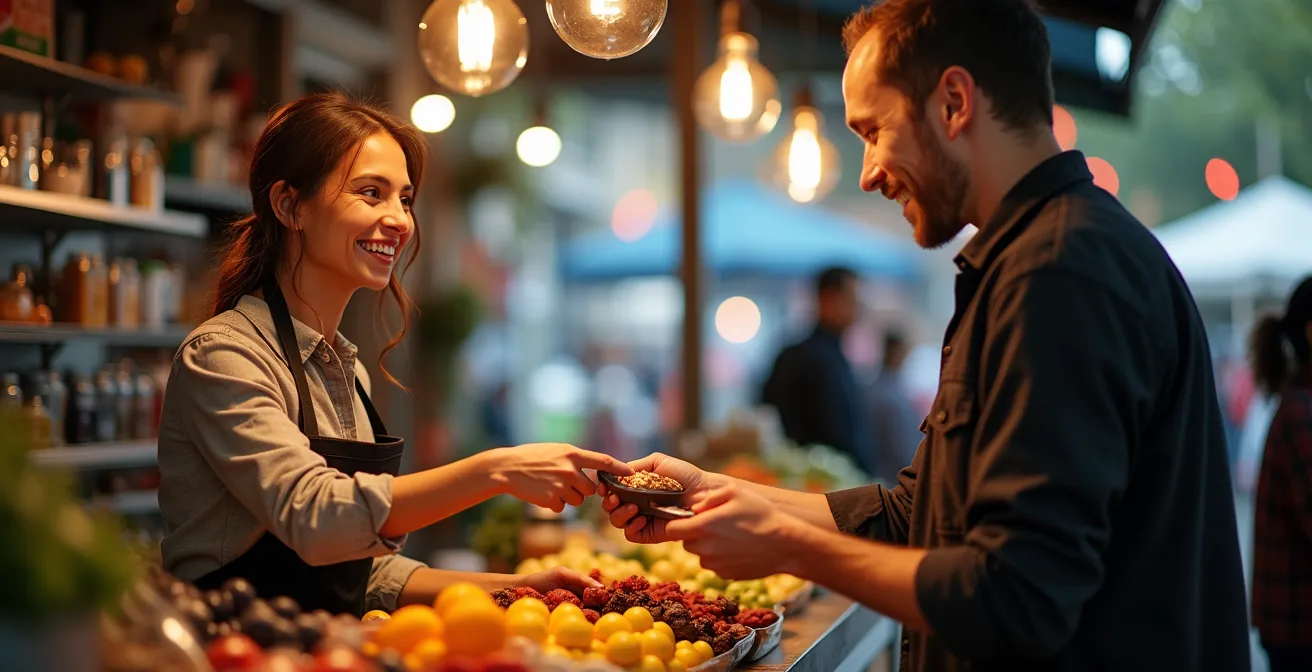
A local’s testimonial highlights the area’s spirit: on the last Sunday of the month from May to October, the streets close to traffic for Pedestrian Sundays, creating a bustling festival atmosphere with live music and street performers. This isn’t a corporate-sponsored event; it’s the organic soul of the neighborhood on full display. When you experience this, you understand what’s missing from most tourist-trap restaurants: joy, passion, and a fair price. While you won’t find this exact environment in Old Montreal, it serves as a powerful reminder of what to look for: small, owner-operated places with a clear passion for their product.
Action Plan: Your 5-Point Menu Audit
- Language Count: How many languages is the menu in? More than two is a red flag. A confident, local-focused spot uses the local language(s) and assumes its clientele can manage.
- Material & Photos: Is it laminated, sticky, or filled with glossy, faded photos? A real kitchen has a changing menu printed on simple paper. Lamination is for high-volume, low-care environments.
- The “Global Buffet” Test: Does it offer dishes from three or more continents (e.g., pasta, curry, and burgers)? This signals a lack of focus and a reliance on frozen, pre-made ingredients.
- Price-to-Complexity Ratio: Look at the simplest item, like a basic salad or soup. Is the price absurdly high? If they’re overcharging for the basics, the rest of the menu is pure profit margin.
- Vague Descriptions: “Catch of the Day” with no specifics? “Seasonal Vegetables” in January? A kitchen proud of its ingredients will name them. Vagueness hides a lack of freshness.
The 5-Table Restaurant in Lower Town Perfect for a Proposal?
People are always searching for “the spot”—that tiny, perfect, secret restaurant. In Old Montreal, a name that often comes up is Olive et Gourmando. It gained fame for a reason. As one guide from Local Food Tours puts it, it’s a place “where sandwiches feel like gourmet fair, without actually being all that fancy. They’re just downright scrumptious and made with equal parts love and quality ingredients.”
The praise is earned. But here’s the blunt truth from a local critic: Olive et Gourmando, and places like it, are no longer secrets. They are fantastic, but they are also the *default* choice for every tourist who has done a bit of research. You’ll wait in line, and you’ll be surrounded by other visitors clutching the same guidebook as you.
The goal isn’t to find the place everyone else has already discovered. The goal is to use the skills from this guide to find *your own* Olive et Gourmando. The real romance, the truly perfect proposal spot, isn’t the famous one. It’s the one you discover together. It’s the 5-table bistro you stumble upon after applying the 500-Meter Rule. It’s the place with the short, handwritten menu you found after decoding the signals. Don’t chase yesterday’s hidden gems. Use your new knowledge to find tomorrow’s.
Olive et Gourmando, the place where sandwiches feel like gourmet fair, without actually being all that fancy. They’re just downright scrumptious and made with equal parts love and quality ingredients.
– Local Food Tours, Old Montreal Restaurant Guide
Key Takeaways
- The “Tourist Tax” is the premium you pay for location and convenience, not food quality.
- Authenticity is found by decoding signals: short menus, lack of aggressive hosts, and a clear culinary identity.
- Apply the “500-Meter Rule” and “Strategic Timing” (like 4-6 PM happy hours) to find better value and a more local experience.
How to Plan a Romantic Winter Weekend in Old Quebec for Under $1,000?
So, how do all these principles come together in practice? Let’s take the challenge of a romantic weekend in Old Quebec, a place where tourist traps thrive, especially in winter. The goal: have a fantastic time for under $1,000. It’s entirely possible, if you ditch the tourist mindset. While the average traveler might spend around $149 CAD per day, the tourist tax can easily double that if you’re not careful.
First, apply Strategic Timing. Go during the shoulder season (like January, after the holidays) when hotels are cheaper. A savvy planner knows many of the city’s museums are free on the first Sunday of every month. That’s a high-value, low-cost date.
Next, apply the value-hacking principles. Instead of three expensive restaurant meals a day, mix it up. Look for high-end restaurants offering prix fixe lunch specials. For one meal, create your own. As travel experts suggest, go to a local bakery like Paillard for a fresh baguette, pick up some amazing Quebec cheese and charcuterie from a market like J.A. Moisan (the oldest grocery store in North America), and have a romantic picnic back in your hotel room. You’ve just had a more authentic—and delicious—meal for a quarter of the price of a restaurant.
Finally, use your Signal Decoding skills for your one big dinner splurge. Walk the 500 meters away from the Château Frontenac. Find the side street. Look for the small, confident menu. This entire approach is about being an active, intelligent participant in your travel, not a passive consumer. You’re not just saving money; you’re creating a richer, more authentic experience.
Apply these strategies on your next visit to Old Montreal, or any historic city. Stop being a target for the tourist tax and start being a detective of deliciousness. The best meal in town is waiting for you, probably just around the corner from where everyone else is looking.