
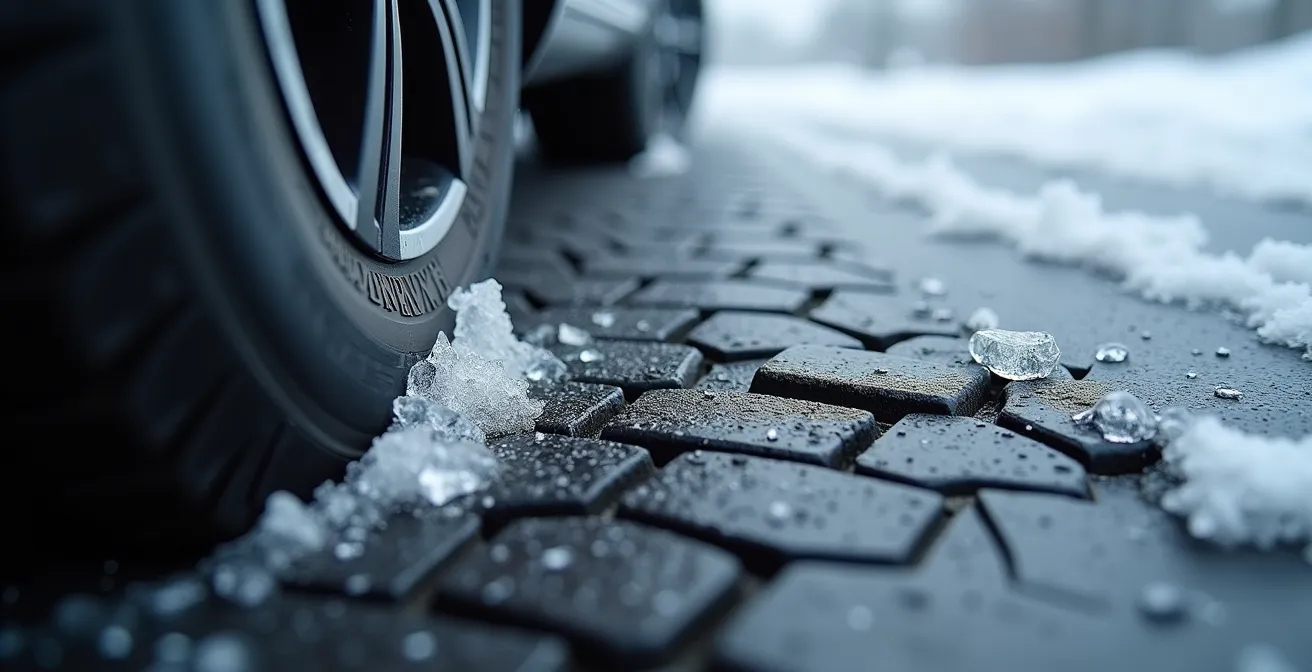
Procrastinating on winter tires until the first snow is a dangerous and costly gamble based on a fundamental misunderstanding of tire engineering.
- Below 7°C, all-season tire compounds undergo a “glass transition,” hardening like a hockey puck and drastically reducing their adhesion coefficient, even on dry pavement.
- Provincial laws (like Quebec’s mandatory tire period) and insurance policies are based on consistent low temperatures, not just snow cover, creating immediate legal and financial liability.
Recommendation: To maintain vehicle safety and compliance, install tires bearing the 3-Peak Mountain Snowflake (3PMSF) symbol as soon as ambient temperatures consistently drop below 7°C, regardless of snowfall.
The first crisp autumn day arrives. The air is clear, the roads are dry, and the thought of swapping to winter tires feels like a problem for another day. Many Canadian drivers fall into this pattern of procrastination, assuming the real danger begins only with the first snowflake. This assumption is a critical engineering miscalculation. The decision to switch to winter tires is not about snow; it’s about temperature. It’s a matter of physics, chemistry, and non-negotiable safety parameters.
The common advice to change tires at 7°C is often repeated but rarely explained. This isn’t an arbitrary number; it’s a scientifically determined threshold. Below this point, the rubber compounds in all-season or summer tires enter what engineers call their glass transition temperature (Tg). The flexible, grippy material begins to harden, losing its ability to conform to the micro-surfaces of the road. This ‘compound compromise’ turns your primary safety system into a liability, dramatically increasing stopping distances and reducing cornering grip on cold pavement, whether it’s wet or perfectly dry.
Waiting for snow is operating your vehicle at a predictable failure point. This article is not another gentle reminder. It is an authoritative breakdown of the data, the legal requirements, the financial implications, and the physics that govern tire performance in Canadian winters. We will dissect the difference between a simple “M+S” marking and the true winter-rated 3-Peak Mountain Snowflake symbol, explore the tangible costs of procrastination, and demonstrate why matching your tires to the temperature is the only sound engineering decision.
This guide provides a structured analysis of every critical aspect of winter tire strategy in Canada. From legal compliance in Quebec to the specific needs of Northern Ontario drivers, each section is designed to arm you with the data necessary to make an informed, timely decision and abandon the risky habit of waiting for the first snowfall.
Summary: A Data-Driven Analysis of the 7°C Winter Tire Rule in Canada
- M+S vs. 3-Peak Mountain Snowflake: Which Is Legal in Quebec?
- Studded Tires: Are They Worth the Noise for Northern Ontario Driving?
- Why Buying Smaller Rims for Winter Tires Saves You Money and Pothole Damage?
- Bagged or Stacked: How to Store Winter Tires to Prevent Dry Rot?
- Why Driving Winter Tires in July Increases Your Stopping Distance by 30%?
- TTC Streetcars vs. Walking: Which Is Faster for a 2km Commute in Winter?
- Skates, Skis, or Snowshoes: Which Gear Should You Rent Before Buying?
- How Connected Provincial Systems Are Finally Making EV Road Trips Across Canada Possible?
M+S vs. 3-Peak Mountain Snowflake: Which Is Legal in Quebec?
One of the most critical, yet commonly misunderstood, aspects of winter tire selection is the iconography on the sidewall. Not all “winter” tires are created equal from a legal or performance engineering standpoint. The “M+S” (Mud and Snow) designation is an older standard, indicating a tire has a tread pattern designed to provide some improvement in those conditions over a summer tire. However, it makes no guarantee about the rubber compound’s performance in the cold. An M+S tire can still harden and lose grip below 7°C.
The true standard for severe snow service is the 3-Peak Mountain Snowflake (3PMSF) symbol. This emblem certifies that a tire has met specific, rigorous testing requirements for acceleration on medium-packed snow. More importantly, tires with the 3PMSF symbol are engineered with specialized rubber compounds that remain flexible and effective at low temperatures. This is the critical difference and the one recognized by law in certain jurisdictions.
In Canada, Quebec leads with the strictest legislation. Since 2014, only tires bearing the 3PMSF symbol are considered legal winter tires for passenger vehicles registered in the province during the mandatory period (December 1 to March 15). Driving without them is not just a safety risk; it’s a direct violation that can result in fines ranging from $200 to $300. In contrast, British Columbia allows either M+S or 3PMSF tires with a minimum 3.5mm tread depth on its designated winter routes. This cross-Canada compliance trap highlights the necessity of checking the symbol, not just the name, and understanding that the 3PMSF is the definitive mark of a true winter tire.
Studded Tires: Are They Worth the Noise for Northern Ontario Driving?
For drivers in regions like Northern Ontario, where highways can turn into sheer ice for extended periods, even 3PMSF studless tires may not provide sufficient grip. This is where studded tires enter the equation. These are winter tires with small metal studs embedded in the tread, designed to physically dig into ice, providing an unmatched level of control and braking performance in the most severe icy conditions. This technology offers a significant increase in the adhesion coefficient on glare ice, a scenario where even the best studless compounds have limitations.
This enhanced performance, however, comes with significant trade-offs. Studded tires are noticeably louder on dry pavement and can cause increased road wear. Consequently, their use is tightly regulated across Canada. While they are a vital safety tool in some areas, they are prohibited in others, particularly in Southern Ontario, where road damage concerns outweigh the benefits. For procrastinators, this isn’t just a choice of equipment but a matter of legal compliance that varies by geography.
This split view of an icy Northern Ontario highway demonstrates the difference in traction. The tracks from studded tires are crisp and defined, indicating a secure bite into the ice, while the studless tracks are slightly less pronounced, relying solely on compound grip.

Understanding the specific regulations for your area of operation is non-negotiable. The following data from industry analysis summarizes the legal status across several key regions. Choosing studs where they are prohibited can lead to significant fines, while foregoing them in areas like Thunder Bay or Sudbury could be a critical safety compromise.
| Region | Studded Tire Dates | Legal Status | Fine for Violation |
|---|---|---|---|
| Northern Ontario | Oct 1 – Apr 30 | Permitted | N/A |
| Southern Ontario | N/A | Prohibited | Up to $1,000 |
| Quebec | Oct 15 – May 1 | Permitted | N/A |
| British Columbia | Oct 1 – Apr 30 | Permitted on designated routes | $121 |
Why Buying Smaller Rims for Winter Tires Saves You Money and Pothole Damage?
A common mistake when purchasing winter tires is mounting them on the large, stylish alloy wheels that came with the vehicle. From an engineering and financial perspective, this is often a suboptimal strategy. The practice of “minus sizing” or “downsizing” offers significant, quantifiable benefits for winter driving in Canada. This involves using a smaller diameter wheel (rim) paired with a narrower but taller tire, ensuring the overall rolling diameter remains nearly identical to the factory setup.
The first advantage is cost. A dedicated set of winter wheels, typically made of steel, is far more economical. Analysis shows that steel rims can cost 40-60% less than their alloy counterparts. This initial saving is compounded by reduced costs for mounting and balancing each season, as you are simply swapping entire wheel assemblies. But the engineering benefits are even more compelling.
A taller tire sidewall, which is a direct result of using a smaller rim, provides a crucial buffer against winter’s most notorious hazard: potholes. The increased volume of air and flexible rubber acts as a superior shock absorber, significantly reducing the risk of impact damage to both the tire and the rim itself. In cities like Montreal, notorious for their post-thaw “pothole season,” this can be the difference between a smooth commute and a costly repair. Furthermore, a narrower tire has a higher ground pressure, allowing it to cut through slush and snow more effectively to find grip on the pavement below, rather than “floating” on top.
Bagged or Stacked: How to Store Winter Tires to Prevent Dry Rot?
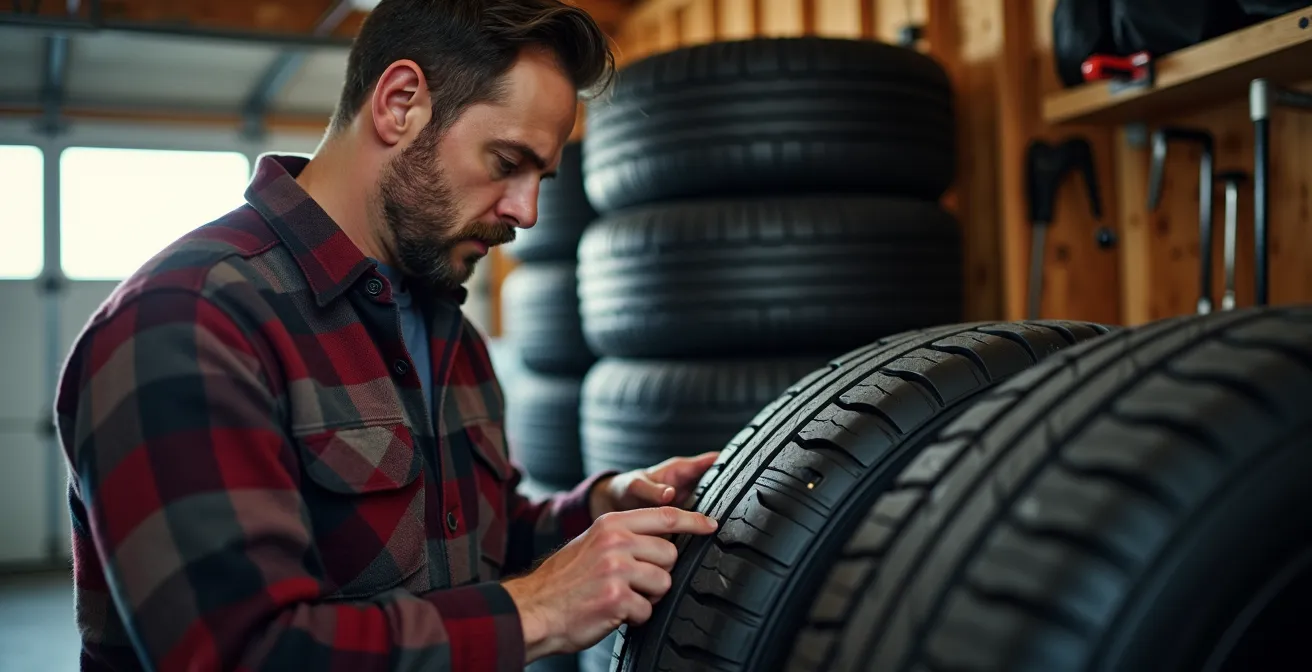
The investment in a quality set of winter tires is compromised if they are not stored correctly during the off-season. Improper storage accelerates the aging process, leading to dry rot—a condition where the rubber becomes brittle, cracks, and loses its essential elastic properties. This is not merely a cosmetic issue; it’s a critical degradation of the tire’s structural integrity. A key part of tire engineering is ensuring longevity, and proper storage is the owner’s responsibility in this equation.
This homeowner is carefully inspecting a tire before storage, a crucial step in the seasonal maintenance cycle. The organized stacking and bagging in the background demonstrate best practices for preserving tire life.
The primary enemies of a stored tire are ozone, UV light, extreme temperatures, and moisture. Storing tires in a cool, dry, dark location away from electric motors (which produce ozone) is paramount. Before storage, each tire and wheel must be cleaned thoroughly to remove road salt and brake dust, which are highly corrosive. According to tire safety experts, even with perfect storage, it’s critical to monitor the manufacturing date. As a rule, you should plan to replace tires after 10 years from their manufacture date, regardless of remaining tread depth, as the rubber compounds will have aged out of their effective service life.
To maximize the lifespan of your investment, follow these best practices derived from manufacturer guidelines:
- Clean Thoroughly: Wash tires and wheels with soap and water to remove corrosive road salt and brake dust before storing.
- Bag Them: Use opaque, airtight tire storage bags to protect the rubber from UV light and dry air.
- Store Cool and Dry: A basement or climate-controlled garage is ideal. Avoid attics or outdoor sheds with extreme temperature fluctuations.
- Position Correctly: If tires are mounted on rims, stack them horizontally. If they are unmounted, stand them vertically to prevent flat spots.
- Avoid Chemical Exposure: Keep tires away from solvents, fuels, and ozone sources like electric motors or furnaces.
Your 5-Point Winter Tire Storage Audit Plan
- Inspection Points: Check all four tires for visible cracks, bulging, or embedded objects on the tread and sidewalls. Check the DOT code to verify age.
- Pre-Storage Inventory: Gather your cleaning supplies (soap, water, brush) and proper tire storage bags. Confirm you have a designated cool, dry storage space.
- Compound Integrity Check: After cleaning, feel the rubber. Is it still pliable, or does it feel hard and brittle? Compare its condition to the manufacturer’s guidelines for tire life.
- Storage Configuration Analysis: Determine if your tires are on rims or unmounted. Prepare your storage area to stack them horizontally (on rims) or stand them vertically (unmounted).
- Environmental Integration Plan: Identify and remove any ozone sources (electric motors) or chemical contaminants from the immediate storage area. Plan to block any direct sunlight.
Why Driving Winter Tires in July Increases Your Stopping Distance by 30%?
The same engineering that makes winter tires life-saving in the cold makes them a liability in the heat. Procrastinating on the spring changeover is just as dangerous as delaying the fall one. The soft, flexible rubber compounds in winter tires, designed to stay pliable below 7°C, become overly soft and “squirmy” at summer temperatures. This has a direct and alarming effect on vehicle dynamics.
On warm, dry pavement, this excessive flexibility leads to a vague steering feel and significantly reduced stability during emergency maneuvers. Most critically, it dramatically increases braking distances. The tread blocks, designed to bite into snow, deform and overheat under hard braking on hot asphalt, reducing the effective contact patch with the road. Ontario Provincial Police (OPP) winter tire safety tests have shown that braking with the wrong seasonal tire can be a critical failure, and data consistently shows a 30-40% longer stopping distance when using winter tires in summer conditions. This is a massive, quantifiable reduction in your primary safety system.
Furthermore, the soft compound wears down at an accelerated rate on hot pavement, destroying a costly investment in a single season. To make an informed decision, it’s crucial to understand the three main categories of tires available in the Canadian market, as outlined in this comparative analysis.
| Tire Type | Temperature Range | 3PMSF Symbol | Best Use Case |
|---|---|---|---|
| Winter Tires | Below 7°C | Yes | Severe snow, ice, and cold conditions (most of Canada). |
| All-Weather | Year-round | Yes (some models) | Milder winter regions like Metro Vancouver or for drivers with low winter mileage. |
| All-Season | Above 7°C | No (M+S only) | Spring, summer, and fall only. Unsafe in winter. |
The “All-Weather” tire is an important distinction—it’s a hybrid design that carries the 3PMSF symbol and can be used year-round in milder climates. However, for the majority of Canadian drivers facing severe winter, a dedicated set of winter tires remains the only sound engineering choice.
TTC Streetcars vs. Walking: Which Is Faster for a 2km Commute in Winter?
For an urban procrastinator, choosing the right tire is analogous to choosing the right mode of transport during a Toronto snowstorm. On a clear day, a TTC streetcar is objectively faster than walking. But when heavy snow falls, streetcars can become blocked, delayed, or short-turned, making the seemingly slower option—walking—the more reliable and ultimately faster way to reach your destination. This is the perfect metaphor for the all-season vs. winter tire debate.
Your all-season tires are the streetcar: fast and efficient in ideal conditions (above 7°C). But once the temperature drops and conditions deteriorate, their performance becomes unpredictable. They are a gamble. Their hardened rubber compound and less aggressive tread design can leave you stuck, sliding, and unable to cope with the environment. You are relying on a system that is operating outside of its designed parameters.
A dedicated winter tire is like a good pair of winter boots for walking. They might feel slightly less efficient on a perfectly clear, warm day (like the increased wear on summer pavement), but they provide predictable, reliable, and safe performance when conditions are at their worst. You are choosing the tool engineered specifically for the task at hand. This mindset is becoming the standard, not the exception. In fact, a 2021 survey found that over 70% of Canadian motorists now use winter tires, recognizing them as a necessary piece of safety equipment. Those who procrastinate are now in the shrinking minority, taking an unnecessary risk that the majority of drivers have already engineered out of their commute.
Skates, Skis, or Snowshoes: Which Gear Should You Rent Before Buying?
Thinking about winter tires can be simplified by comparing them to winter sports equipment. You would never use skis to cross a frozen lake or snowshoes on an ice rink. Each piece of gear is an engineered solution for a specific type of terrain. The same logic applies directly to the different categories of winter tires. Your choice should be a deliberate match between the “gear” (the tire) and the “terrain” (your most common winter driving conditions).
This isn’t just a loose analogy; modern tire sipe design—the tiny slits in the tread that provide biting edges for grip—was directly inspired by the technology of ski edges. An engineer views this not as a choice, but as a system-matching problem. The procrastinator who drives on all-seasons is effectively trying to ski in snowshoes: it’s clumsy, inefficient, and dangerous.
Matching your tire’s engineered purpose to your environment is critical. Here’s how the equipment analogy translates directly to tire selection for Canadian road conditions:
- Ice Skates = Studless Ice-Performance Tires: These tires use extremely soft, specialized compounds and intricate sipe patterns to achieve maximum grip on hard, slick ice surfaces, just as a skate blade focuses force onto a narrow edge.
- Downhill Skis = Performance Winter Tires: These offer a versatile balance, engineered for high-speed stability on packed snow and cleared highways, while still providing reliable grip on intermittent ice patches, much like a ski is designed for varied mountain conditions.
- Snowshoes = Aggressive Truck Snow Tires: With deep, wide tread blocks and high void ratios, these tires are designed to “float” and paddle through deep, unplowed snow, similar to how a snowshoe distributes weight to prevent sinking.
By reframing the decision in this way, it becomes clear that “all-season” tires are the equivalent of “no gear” at all—unsuitable for any specific winter challenge.
Key Takeaways
- The 7°C rule is not about snow; it’s a scientific threshold where all-season tire compounds harden (glass transition), critically reducing grip on all surfaces.
- The 3-Peak Mountain Snowflake (3PMSF) symbol is the only government-recognized standard for a true winter tire in Canada, legally mandatory in Quebec during winter.
- Using the wrong seasonal tire carries quantifiable risks: driving winter tires in summer can increase stopping distances by over 30%, while all-seasons in winter present a similar danger.
How Connected Provincial Systems Are Finally Making EV Road Trips Across Canada Possible?
The shift to electric vehicles (EVs) introduces new variables into the winter driving equation, but it doesn’t change the fundamental physics of grip. In fact, it makes the consequences of poor tire choice even more visible. While connected charging networks are solving the problem of long-distance EV travel across Canada, the environment itself remains the biggest challenge, and your tires are the first line of defense.
An EV’s performance is measured in kilowatt-hours and range, and winter has a direct, negative impact on both. The cold reduces battery efficiency, and running cabin heat consumes significant energy. Comprehensive testing confirms this, showing a 14% to 39% reduction in range during Canadian winter conditions. This is a hard data point that an EV driver sees on their dashboard every day.
Winter tires are a necessary part of this equation. While essential for safety, their higher rolling resistance compared to low-resistance summer EV tires can contribute a small additional decrease to the total range. Some drivers might be tempted to stick with all-seasons to preserve every kilometer of range—this is a dangerous and flawed calculation. The marginal range saved is not worth the catastrophic loss of grip. The instant torque of an EV can easily overwhelm an all-season tire on a cold or icy surface, leading to a complete loss of control. For an EV driver, a proper 3PMSF winter tire is not a choice; it’s a mandatory component for a safe and functional winter mobility system.
To ensure your vehicle operates within its designed safety parameters this winter, the next logical step is a professional tire inspection. Assess your current tires against the 3PMSF standard and local regulations before the temperature drops permanently.