

In summary:
- The key to enjoying winter skiing is not skill, but “comfort engineering”—mastering your warmth and preventing failure points before they happen.
- Start your ski slightly cold. Aggressive layering leads to sweat, which is the primary cause of getting dangerously cold.
- Rent gear from a provincial park or local club first. Focus on modern, user-friendly “skin” or “waxless” skis.
- A 5-minute dynamic warm-up in the parking lot is non-negotiable to prevent muscle pulls on cold, icy trails.
- Your best beginner trails are often hidden in plain sight, like municipal golf courses, offering solitude away from crowded centres.
The thought of embracing the long Canadian winter in your 40s often comes with a mix of ambition and dread. You see people gliding gracefully through snowy parks and think, “I should be more active.” But then, the reality of the cold, the effort, and the potential for looking completely lost on two skinny sticks sets in. For the sedentary adult, the barrier to entry for a sport like cross-country skiing seems immense. It’s not just about learning a new skill; it’s about battling the hostile environment of a -15°C day.
Most beginner advice focuses on the basics: “wear layers,” “start slow.” While true, this advice ignores the fundamental reason most people quit: they have a miserable first experience. They either overdress and end up soaked in freezing sweat, or they pull a muscle within the first ten minutes. They choose a trail that’s too crowded or icy, leading to frustration and a vow to never try again. The fear of the cold and the sheer effort involved are valid concerns that generic tips fail to address.
But what if the secret wasn’t about mastering the perfect glide on day one? What if it was about mastering your personal microclimate and pre-empting every point of failure before you even leave the car? This guide is built on a different philosophy: you don’t have to love the sport immediately, but you absolutely must not hate the experience. By focusing on comfort engineering and failure-proofing your first few outings, you create the space to actually discover the joy of the sport.
We’ll break down the practical strategies to manage your body temperature, select the right gear without buyer’s remorse, warm up effectively to prevent injury, and find the perfect, uncrowded trails to build your confidence. This is your blueprint for a successful and, yes, even enjoyable entry into the world of winter fitness.
For those who prefer a visual format, the following video demonstrates a specific strength drill that is fundamental to building the core power needed for efficient skiing. It’s a great example of the targeted exercises that make a real difference.
To help you navigate these critical first steps, this guide is structured to tackle each potential “failure point” in a logical order. The following summary outlines the key areas we will cover, from managing your body heat to finding those peaceful trails that make the effort worthwhile.
Summary: Your Guide to a Successful Start in Cross-Country Skiing
- The “Be Bold, Start Cold” Rule That Prevents Sweat Freezing?
- Skates, Skis, or Snowshoes: Which Gear Should You Rent Before Buying?
- The Warm-Up Routine That Stops Hamstrings from Snapping on Icy Trails?
- Where to Find the Best Natural Ice Rinks in Your City That Aren’t Crowded?
- How to Keep Kids Outside for 2 Hours in January Without Complaints?
- Why Your Gym Routine Isn’t Enough for a 2,000m Elevation Hike?
- The “Green Flag” Rule: How to Know if the Rideau Canal Skateway Is Actually Open?
- Where to Find Solitude in Banff National Park During the Peak July Season?
The “Be Bold, Start Cold” Rule That Prevents Sweat Freezing?
The single biggest mistake beginners make is over-layering. You’re afraid of the cold, so you bundle up like you’re about to summit Everest. The problem? Cross-country skiing is a surprisingly high-output activity. Within ten minutes, your body heat skyrockets, and you begin to sweat profusely under all those layers. Once you stop or slow down, that moisture turns into a chilling, clammy layer against your skin. This is the fast track to hypothermia and a miserable day. The golden rule is to be bold and start cold. You should feel slightly chilled, even uncomfortable, for the first 5-10 minutes in the parking lot. This is your assurance that you won’t overheat once you start moving.
Effective microclimate management isn’t about the *quantity* of layers, but the *quality* and *function* of each. Your system should consist of three main parts: a wicking base layer, an insulating mid-layer (optional, depending on temperature), and a protective shell. The base layer’s only job is to pull sweat away from your skin. Field tests consistently show that modern merino wool outperforms synthetics in variable conditions, as it continues to wick moisture even when damp, maintaining warmth in a way many synthetics cannot. This is crucial on Canadian trails where you might move from a sunny field to a shaded, colder forest in minutes.
Your layering strategy must also be specific to your local Canadian climate, as a damp -2°C in Vancouver requires a different approach than a dry, deep freeze of -20°C in Winnipeg. A good protocol is to wear only your base layer during the drive to the trail, then add your other layers while doing your dynamic warm-up in the parking lot. Have a light, puffy vest or jacket that you wear for the first ten minutes of skiing and then strip off and stuff in a small pack. This allows your body to generate its initial heat without immediately starting to sweat through your main layers. This proactive temperature regulation is the cornerstone of winter comfort.
Skates, Skis, or Snowshoes: Which Gear Should You Rent Before Buying?
Faced with a wall of gear, it’s easy to feel overwhelmed. While snowshoeing and skating have their merits, cross-country skiing offers the best blend of workout and scenic exploration. For beginners, the choice is simple: start with “classic” skiing, which uses a forward-and-back gliding motion similar to walking. The more athletic “skate” technique can come later. Modern classic skis have made the sport more accessible than ever, thanks to “waxless” technology. Forget the complicated waxes of the past; today’s skis use a “fish-scale” pattern or a mohair-like “skin” in the middle of the ski to provide grip for pushing off, while allowing the tips and tails to glide.
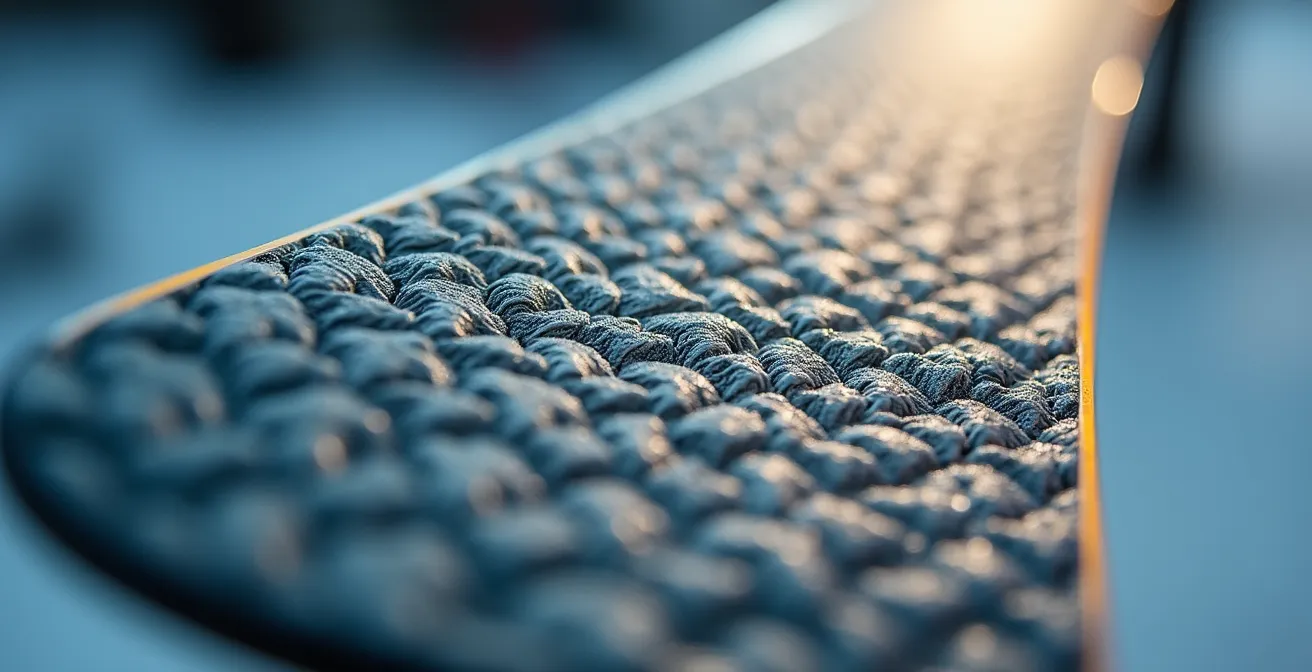
As you can see from this close-up, the textured grip zone is what makes modern skis so user-friendly. Before you even think of buying, you must rent. This isn’t just about saving money; it’s about finding the right fit and type of gear for you. A common and critical question for first-timers is “how do I stop?” The most basic and important technique to ask the rental shop to show you is the “wedge” or “snowplow” stop. By pointing the tips of your skis inward and pushing your heels out, you create a wedge shape that uses friction to slow you down. Mastering this simple move on a gentle slope will give you a massive confidence boost.
Navigating the rental-to-purchase pathway in Canada involves a few distinct options, each with its own pros and cons. Renting for a day from a provincial park is ideal for your very first time, while a season-long lease from a local ski club or retail shop is a great next step if you’re committed. The following table breaks down these pathways to help you make an informed decision based on your budget and commitment level.
This comparison, based on an analysis of beginner-friendly options, outlines the typical costs and benefits you’ll find across Canada.
| Rental Option | Cost (CAD) | Pros | Cons | Best For |
|---|---|---|---|---|
| Provincial Parks | $20-30/day | Convenient, quality gear, on-site help | Limited availability peak times | First-timers testing the sport |
| Local Ski Clubs | $150-200/season | Season-long access, community support | May require membership | Committed beginners |
| Retail Shop Lease | $300-400/season | Latest equipment, upgrade options | Higher cost | Serious learners |
| Used Purchase | $200-400 total | Own equipment, best value | Risk of poor fit/condition | Budget-conscious regulars |
The Warm-Up Routine That Stops Hamstrings from Snapping on Icy Trails?
Jumping out of a warm car into the cold and immediately starting a strenuous activity is a recipe for a pulled muscle, especially for a body accustomed to a desk job. Your muscles, tendons, and ligaments are less pliable in the cold, and a sudden, powerful movement can easily lead to injury. A static stretch (holding a position) is the wrong approach here, as it can actually decrease power output. What you need is a dynamic warm-up: a series of controlled movements that increase blood flow, raise your core temperature, and activate the specific muscles you’re about to use for skiing—namely your glutes, hamstrings, core, and shoulders.
For the 40+ “desk jockey,” years of sitting have likely led to tight hip flexors and underactive glutes. Your body is not prepped for the demands of skiing. A targeted pre-habilitation program started weeks before the season can make a huge difference. For instance, a program focusing on exercises that counter prolonged sitting has been shown to be highly effective. One guide for winter sports preparation found that participants who followed a 6-8 week core strengthening routine reported 73% fewer lower back complaints during their first season. Even if you haven’t prepped for weeks, a 5-minute routine in the parking lot is your non-negotiable insurance policy against injury.
This warm-up should be done after you get out of your car, right before you click into your skis. It gets your body ready for the specific movements of skiing and helps you mentally prepare for the activity ahead. It’s the most important five minutes of your day.
Your 5-Minute Parking Lot Dynamic Warm-Up
- Leg Swings (Front-to-Back): Hold onto your car for balance, especially in an icy lot. Swing one leg forward and back in a smooth, controlled motion. Do 10 repetitions for each leg to open up the hips.
- Walking Lunges with Trunk Rotation: Take a step forward into a lunge, keeping your front knee aligned over your ankle. As you lunge, rotate your torso toward your front leg. This activates your core and hip flexors. Do 8 reps on each side.
- Arm Circles: Start with small circles and progressively make them larger. Do 20 circles forward and 20 backward to prepare your shoulders for the poling motion.
- Single-Leg Glute Bridges: Lean your upper back against your car’s bumper and place one foot flat on the ground. Lift the other leg. Push through your grounded heel to lift your hips. This fires up your posterior chain. Do 10 reps per side.
- Dynamic Calf Raises: Raise up onto the balls of your feet, then slowly lower. Follow with a few steps on your toes. Repeat 20 times to prepare your calf muscles for the push-off phase of the ski stride.
Where to Find the Best Natural Ice Rinks in Your City That Aren’t Crowded?
The title is a bit of a misnomer. While skating on a natural rink is a classic Canadian pastime, for a beginner cross-country skier, the ideal “rink” isn’t a sheet of ice at all. It’s a wide, gently rolling, and perfectly groomed trail with set tracks that guide your skis. The problem is that the most well-known Nordic centres can be packed on weekends, creating a high-pressure environment for a novice. The secret is to look for the vast, underutilized winter spaces hidden within your own city: municipal golf courses.
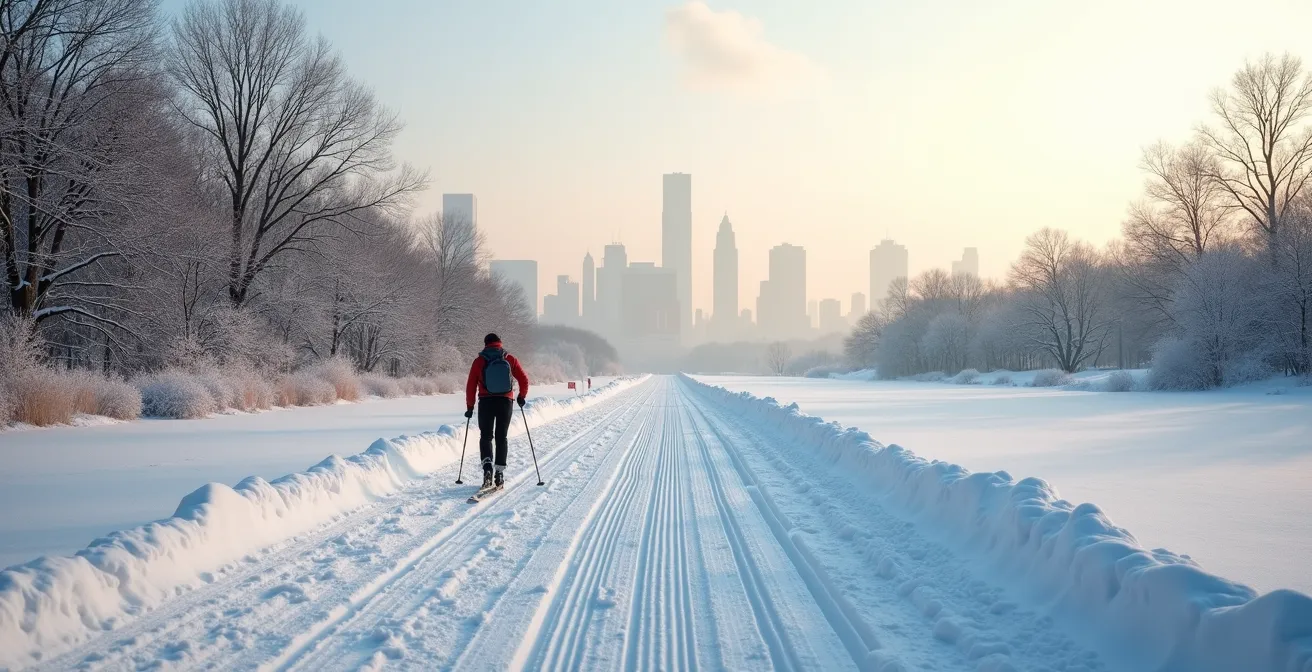
In winter, these manicured landscapes transform into perfect beginner ski parks. They offer varied but gentle terrain, wide-open spaces to practice without fear of collision, and, best of all, a surprising level of solitude. Many Canadian municipalities have discovered this, and as an investigation into hidden Nordic trails by the Trans Canada Trail network reveals, courses like Toronto’s Don Valley, Calgary’s Confederation Park, and Vancouver’s Fraserview all offer kilometres of groomed trails with minimal crowds. They provide the perfect low-stress environment to build skills and confidence.
Finding these and other “hidden gem” trails requires a bit of digital reconnaissance. Your mission is to move beyond the obvious search for “best ski trails” and become a more strategic trail-finder. The following techniques will help you uncover the quiet corridors and local secrets that don’t always show up on the first page of Google:
- Use Trail Apps with Filters: Apps like AllTrails are powerful tools. Enable the “Cross-Country Skiing” and “Snow” filters to reveal user-generated trail reports you might otherwise miss.
- Scout with Satellite Maps: Open Google Maps and switch to the satellite view. Look for large green corridors, river valleys, and conservation areas near you. A quick cross-reference with a local trail app can confirm if they are used in winter.
- Check Municipal Websites: Go directly to the source. Your city or regional district’s parks and recreation website often has a “winter trail conditions” page that lists officially maintained trails, including golf courses.
- Join Local Social Media Groups: Search Facebook for groups like “[Your City] Cross-Country Skiing.” This is where you’ll get real-time, insider tips on trail conditions and newly discovered spots from a passionate local community.
How to Keep Kids Outside for 2 Hours in January Without Complaints?
For many people in their 40s, getting active isn’t a solo mission; it involves the entire family. The challenge is that a child’s tolerance for cold and effort is far lower than an adult’s. A successful family outing isn’t about endurance; it’s about strategic fun management. The secret to keeping kids engaged for two hours in the cold has less to do with the skiing itself and more to do with the destination’s amenities. You’re not looking for the longest or most challenging trail system. You’re looking for a place built for family success.
The key features of a family-friendly Nordic destination are simple but critical. First, a heated day lodge or warming hut is non-negotiable. It’s the home base where cold fingers can be warmed and morale can be restored. Second, the promise of a reward, like hot chocolate, is an incredibly powerful motivator. Finally, the trail system itself should be designed with families in mind. This means having very short, easy loops (1-3km) located right next to longer, more challenging trails. This allows parents to take turns skiing a more difficult loop while the other parent stays with the kids on the easier terrain.
Several Canadian parks have perfected this model. Arrowhead Provincial Park in Ontario is a prime example. Its famous “Fire and Ice” lit trail offers a magical evening experience for families, located right beside a larger network of 33km of trails and a cozy day lodge. Similarly, Mont-Sainte-Anne in Quebec features dedicated learning zones and family loops directly adjacent to its world-class championship courses. Choosing a destination with this kind of thoughtful infrastructure transforms the outing from a test of endurance into a fun-filled adventure. The goal is to have the kids asking to go back, not complaining that they want to go home.
Why Your Gym Routine Isn’t Enough for a 2,000m Elevation Hike?
While the title references a hike, the principle is directly applicable to cross-country skiing: general fitness does not always equal sport-specific fitness. You might be able to spend an hour on the elliptical or lift weights, but you’ll likely feel surprisingly sore after your first 30 minutes of skiing. This is because Nordic skiing is a true full-body workout that engages muscles in ways that most gym routines don’t. It demands a unique combination of cardiovascular endurance, lateral stability, and rotational core power.
The classic ski motion, while seemingly simple, relies on a constant transfer of weight from one leg to the other. This requires strong hip abductor and adductor muscles to keep you stable and prevent your hips from dropping side-to-side. The poling motion isn’t just an arm exercise; it’s a powerful crunch that engages your lats, obliques, and entire core to propel you forward. If your gym routine consists mainly of exercises that move in a straight line (like running, cycling, or squats), you’re missing the crucial rotational and stabilizing components needed for skiing.
To prepare your body effectively and avoid post-skiing soreness, you should supplement your existing routine with exercises that mimic the demands of the sport. Adding just a few targeted movements can build the necessary stability and power, making your time on the snow much more efficient and enjoyable. Here are three key exercises to incorporate:
- Lateral Band Walks: Place a resistance band around your ankles or knees. With a slight bend in your knees, take slow, controlled steps sideways. This directly strengthens the hip muscles responsible for stability during the glide phase. Aim for 3 sets of 20 steps in each direction.
- Cable Wood Chops: Set a cable machine to a high position. Standing sideways to the machine, grab the handle with both hands and pull it down and across your body in a diagonal “chopping” motion, rotating your torso. This builds the rotational core power essential for strong poling. Do 3 sets of 12 reps on each side.
- Single-Leg Romanian Deadlifts (RDLs): Standing on one leg, hinge at your hips to lower your torso toward the floor while extending the other leg straight back behind you. This trains balance, hamstring strength, and glute activation on each leg independently, which is critical for a powerful ski stride. Aim for 3 sets of 10 reps per leg.
The “Green Flag” Rule: How to Know if the Rideau Canal Skateway Is Actually Open?
Again, let’s generalize this excellent question. The real issue for a beginner isn’t just about one specific location like the Rideau Canal, but about a universal principle: how do you know if *any* trail is in good condition for skiing *before* you drive all the way there? Showing up to find an icy, windswept, or un-groomed trail is a major source of frustration. This is where the “Green Flag” rule comes in. It’s a simple mental checklist to run through before you commit to an outing, ensuring the conditions are safe and enjoyable for a beginner.
A key part of this checklist involves learning to decipher trail grooming reports, which are often posted on the websites of local ski clubs or provincial parks. The terminology can be confusing, but it contains vital information. A report that says “freshly packed powder” is a huge green flag—it means the snow is soft and forgiving. Conversely, a report mentioning an “icy base” or “granular” snow is a red flag for beginners, indicating challenging, fast conditions that require more skill to navigate. The most important phrase to look for is “classic tracks set.” This confirms that the parallel grooves that guide your skis have been freshly cut, which is essential for helping a novice maintain balance and practice technique.
Your personal “Green Flag” checklist combines these external reports with environmental factors. It’s your go/no-go decision tool that prioritizes safety and enjoyment over simply getting out at any cost. Before you head out for a solo ski or your first few outings, run through these points:
- Temperature Check: Is the temperature between -2°C and -10°C? This is the optimal range for both grip and glide with waxless skis. Colder can be difficult, and warmer means sticky snow.
- Grooming Report: Has the trail been groomed within the last 48 hours? Check the club or park website. Fresh grooming is a beginner’s best friend.
- Wind Speed: Is the wind under 20 km/h? Strong winds can create a significant wind chill, making it feel much colder, and can also challenge your balance.
- Daylight Buffer: Do you have at least 2 hours of daylight remaining? This provides a safety buffer in case your ski takes longer than expected.
- Classic Tracks Visible: Does the grooming report confirm that classic tracks are set? This is your key to an easier, more controlled experience.
Key takeaways
- Your primary goal is not performance, but comfort. Master your warmth, and the fun will follow.
- Modern waxless skis and a rental-first approach are the smartest, most cost-effective ways to start.
- Never skip the 5-minute dynamic warm-up. It’s your single best defense against the most common beginner injuries.
Where to Find Solitude in Banff National Park During the Peak July Season?
While Banff in July is the definition of a crowd, the winter landscape offers a completely different opportunity for solitude, if you know where to look. Once you’ve built confidence on your local golf course and are ready to graduate, the next step is finding true wilderness immersion without the crowds. The key is to avoid the famous, easily accessible Nordic centres on peak weekends and instead explore the less-travelled provincial parks and national parks that are just slightly further afield. Canada is vast, and world-class skiing can be found in places that fly under the popular radar.
A CBC Life feature on beginner-friendly destinations highlights several of these hidden gems. For example, Duck Mountain Provincial Park on the Manitoba-Saskatchewan border offers 50km of pristine wilderness trails where you might not see another soul all day. In Quebec, Parc national des Monts-Valin is famous for its “snow ghosts” (snow-caked trees) and backcountry hut-to-hut skiing that feels a world away from civilization. On the east coast, New Brunswick’s Kouchibouguac National Park provides a unique experience of skiing through coastal forests to deserted winter beaches. These destinations offer the solitude you crave with the infrastructure you need.
Even if you’re sticking closer to home, you can still find solitude by being strategic with your timing. The masses tend to operate on a predictable schedule. By simply shifting your ski time outside of the 11 a.m. to 3 p.m. weekend rush, you can often have the trails almost to yourself. This is about working smarter, not harder, to find your peace.
- The 9 a.m. Advantage: Be the first on the trail. Start your ski early and aim to be finished by 11 a.m., just as the parking lot starts to fill up.
- The Weekday Lunch-Hour Ski: If your schedule allows, taking an extended lunch break from 11:30 a.m. to 1:30 p.m. on a weekday offers the ultimate in empty trails.
- The Super Bowl Sunday Strategy: Skiing during major televised sports events like the Super Bowl or a big hockey game is a time-tested trick for guaranteed solitude.
- Target Mid-Week January/February: This is the sweet spot. The holiday crowds are gone, the snow conditions are typically at their best, and visitor numbers are at their lowest.
Start your journey by embracing the philosophy of comfort engineering. By proactively managing your warmth, gear, and physical readiness, you transform cross-country skiing from a daunting challenge into an accessible and deeply rewarding winter activity. Begin with a rental, find a quiet local trail, and focus on enjoying the process.