
Stacking federal and Quebec EV rebates for a massive discount is possible, but it’s a game of precision where small mistakes on trim level or lease terms can cost you thousands.
- The vehicle’s base model MSRP and the final trim price must both fall under strict, separate federal thresholds to qualify.
- Leasing an eligible EV for less than 48 months will prorate and significantly reduce your federal rebate amount.
Recommendation: Before signing any purchase or lease agreement, verify every line item against the latest iZEV and Roulez vert eligibility criteria. The final responsibility for qualification rests with you, not the dealer.
The promise of stacking government incentives to slash the price of a new electric vehicle is a powerful motivator for many Quebecers. Combining the federal Incentives for Zero-Emission Vehicles (iZEV) program with Quebec’s provincial Roulez vert grant can, in theory, lead to savings of up to $12,000. Many potential buyers approach this with simple arithmetic: federal rebate + provincial rebate = total discount. However, this simplistic view is a costly mistake.
The reality is a complex regulatory landscape filled with critical thresholds, prorated calculations, and specific conditions that are often overlooked. This isn’t a straightforward discount; it’s a game of strategic navigation. A seemingly minor decision, like choosing a higher trim level with more options or opting for a shorter lease term, can unexpectedly disqualify you from thousands of dollars in federal funding, even if the provincial portion remains intact. True maximization of these grants requires a mathematical and savvy approach that goes far beyond the sticker price.
This guide abandons the simple addition and instead provides a navigator’s map through the intricate rules. We will dissect the critical MSRP caps that trip up buyers, the mathematical trap of leasing, and the specific ways businesses must account for these funds. By understanding the precise mechanics of each program, you can confidently secure the maximum possible rebate and get the absolute lowest price on your next EV.
To help you navigate this process with precision, this article breaks down each critical component of stacking EV rebates in Quebec. The following sections detail the specific rules and potential pitfalls you need to master.
Summary: How to Maximize Your Quebec EV Rebates
- Why Choosing the Top Trim Might Cost You the Entire $5,000 Rebate?
- Which Provinces Offer Rebates for Used EVs and How to Claim Them?
- The 48-Month Trap: Why a 3-Year Lease Reduces Your Federal Rebate?
- Is the Government EV Rebate Considered Taxable Income for Businesses?
- How to Get Extra Cash by Scrapping Your Gas Clunker via “Scrap-It” Programs?
- The Greener Homes Grant Mistake That Delays Reimbursement by 6 Months
- How Federal Grants Impact the Stock Value of Clean Tech Firms?
- How the EV Shift Is Changing the Skill Set Required for Canadian Mechanics?
Why Choosing the Top Trim Might Cost You the Entire $5,000 Rebate?
The single most common and costly error when claiming the federal iZEV rebate lies in misunderstanding the Manufacturer’s Suggested Retail Price (MSRP) thresholds. It’s not one limit, but a two-tiered system that you must navigate. A vehicle model may be on the government’s eligible list, but the specific version you choose could disqualify you, costing you the full $5,000 federal incentive.
The first rule applies to the base model of the vehicle. For a passenger car, the base model’s MSRP must be under $55,000. For an SUV, pickup, or minivan, that base threshold is $60,000. If the entry-level version of the car you want is priced above this, no version of that car is eligible. However, clearing this first hurdle doesn’t guarantee your rebate. The second rule applies to the higher trim level you actually purchase. For cars, the final MSRP, including options, cannot exceed $65,000. For SUVs, that ceiling is $70,000.
This creates a “danger zone” where a base model qualifies, but adding a larger battery, a premium sound system, or a technology package pushes your chosen trim just over the secondary limit. For example, a base model EV sedan at $54,000 is eligible. But if the long-range trim with options you want comes to $65,500, your $5,000 federal rebate vanishes. It’s a binary outcome; there is no partial credit. According to Transport Canada’s official requirements, a vehicle is either fully eligible or not at all based on these precise MSRP thresholds for iZEV program eligibility.
This system is designed to subsidize the adoption of mass-market EVs, not high-end luxury configurations. Therefore, the financial onus is on you, the buyer, to verify both the base model MSRP and your final trim’s all-in price before signing. Do not assume the dealer’s advertised “after-rebate” price is accurate for the specific car on the lot.
Which Provinces Offer Rebates for Used EVs and How to Claim Them?
While the federal iZEV program is exclusively for new vehicles, a number of provinces have stepped in to encourage the secondary EV market. For Quebec residents, this represents a significant opportunity. Quebec is a leader in this area, offering a substantial rebate for qualifying used electric vehicles through its Roulez vert program, making the transition to electric more accessible.
The key to claiming this incentive is understanding the strict criteria. The program specifically targets used battery electric vehicles (BEVs) that are between one and four years old. Crucially, the vehicle must be purchased from a licensed Quebec dealership, and a check must be done to ensure no previous owner has already claimed a Quebec EV rebate on that specific vehicle’s VIN. Finally, the vehicle must be registered in Quebec and meet certain price caps to qualify for the full amount. According to current provincial program data, you can receive up to $3,500 for a qualifying used EV in Quebec, a figure that dramatically changes the cost-benefit analysis of buying used.
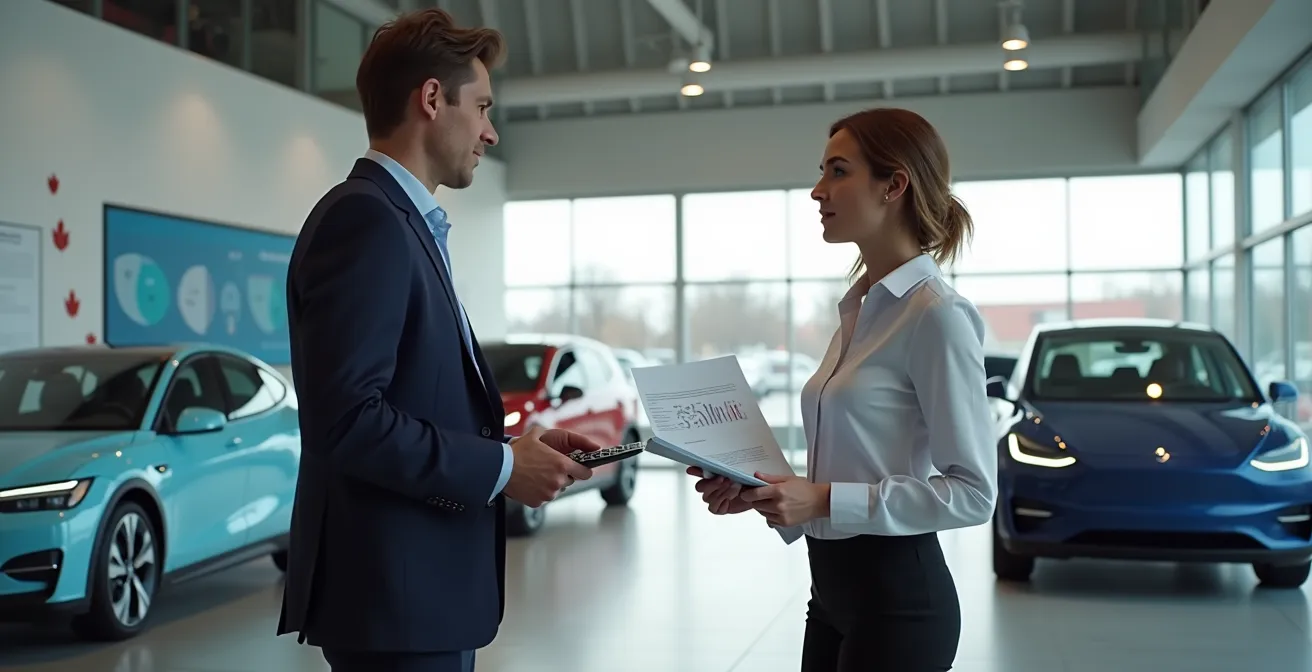
This paragraph introduces a concept complex. To understand it, it’s helpful to visualize its key components. The illustration below breaks down this verification process.

As this scene suggests, the process involves careful document review. Both the customer and the dealer must work together to confirm the vehicle’s history and its eligibility under the Roulez vert program. A successful claim hinges on this due diligence, transforming a standard used car purchase into a strategic financial decision.
The 48-Month Trap: Why a 3-Year Lease Reduces Your Federal Rebate?
For buyers who prefer leasing, the federal iZEV rebate includes a critical clause that is often misunderstood: the incentive is prorated based on the length of the lease. Many assume that if they lease an eligible vehicle, they will automatically receive the full $5,000 benefit applied to their lease payments. This is incorrect and can lead to a significant reduction in expected savings. The government’s logic is that the subsidy should correspond to the duration of the vehicle’s use.
The full incentive is only available for lease terms of 48 months or longer. If you opt for a shorter term, the rebate amount is reduced proportionally. A 36-month (3-year) lease, a very common choice, only qualifies for 75% of the rebate, reducing your benefit from $5,000 to $3,750. If you choose a 24-month lease, the rebate is halved to just $2,500. This mathematical detail is non-negotiable and is a core component of the program’s structure.
This is explicitly stated by the federal government. As Transport Canada clarifies in its iZEV Program Overview:
A 48-month lease is eligible for the full incentive, while a vehicle with a 24-month lease will be eligible for half the incentive.
– Transport Canada, iZEV Program Overview
The following table from a recent analysis of the iZEV program clearly illustrates the financial impact of your lease term decision. It is essential to perform this calculation before agreeing to a lease, as a shorter term might not be worth the lost rebate money.
| Lease Term | Rebate Percentage | Amount on $5,000 Eligible Vehicle |
|---|---|---|
| 48 months | 100% | $5,000 |
| 36 months | 75% | $3,750 |
| 24 months | 50% | $2,500 |
Is the Government EV Rebate Considered Taxable Income for Businesses?
For businesses in Quebec purchasing electric vehicles, the government incentives function differently from how they do for individuals. A common misconception is that the rebate is treated as taxable income. This is not the case. Instead, the rebate must be used to reduce the capital cost of the vehicle for tax purposes. This has significant implications for how a business calculates its Capital Cost Allowance (CCA), the depreciation expense it can claim annually.
This creates a strategic choice. A business can claim the iZEV rebate, which lowers the vehicle’s initial capital cost. For example, if a business buys a $56,500 EV and receives the $5,000 iZEV rebate, the adjusted capital cost for CCA purposes becomes $51,500. Alternatively, businesses can choose to *forgo* the iZEV rebate and instead take advantage of an enhanced first-year CCA write-off for zero-emission vehicles. Federal tax rules do not permit claiming both. An analysis of business tax treatments for ZEVs shows that this decision depends on the company’s overall tax strategy and cash flow needs.
Case Study: The Rebate vs. CCA Deduction Choice
Consider a Quebec-based delivery company. It can purchase 10 eligible electric vans (the maximum allowed per business per year under the iZEV program) and receive a $50,000 rebate, immediately lowering its capital outlay. However, its accounting firm might calculate that forgoing this rebate and instead claiming the 100% enhanced CCA write-off in the first year would result in a larger tax shield, providing greater long-term value. The optimal choice is purely mathematical.
This paragraph introduces a complex business decision. The illustration below visualizes the calculation involved.

As depicted, the decision involves careful financial modeling. The immediate cash-in-hand from the rebate must be weighed against the future tax savings from a larger depreciation claim. For any business operating a fleet in Quebec, consulting with a tax professional is not just recommended; it’s essential for maximizing financial efficiency.
How to Get Extra Cash by Scrapping Your Gas Clunker via “Scrap-It” Programs?
Beyond the primary rebates for purchasing an EV, Quebec offers another powerful financial lever: a scrappage incentive. The “Programme Roulez vert – volet mise au rencart” provides a cash incentive for taking an older, high-emission gasoline vehicle off the road when you purchase a new or used EV. This is not just an environmental initiative; it is a direct financial strategy to further reduce the net cost of your electric vehicle.
This program is essentially a “bounty” on your old car, often providing more value than a standard trade-in, especially for vehicles that are nearing the end of their life. To qualify, your old vehicle must meet several criteria: it typically must be a model year 2011 or older, be registered in your name for at least a year, and be roadworthy and insured at the time of application. The process requires careful coordination, as the application must be tied to the purchase of an eligible new or used EV or plug-in hybrid.
By successfully stacking this scrappage bonus with the provincial and federal rebates, the total savings can become substantial. For instance, while the federal iZEV program has evolved, past configurations demonstrated that combining all available grants was highly lucrative. The updated Roulez vert program still offers a significant base rebate, and when combined with the federal grant and a potential scrappage bonus, the total discount remains one of the most generous in North America. An analysis of the Quebec EV rebate program shows its continued strength in promoting EV adoption. Maximizing this requires auditing your old vehicle’s eligibility with the same rigour as you vet your new one.
Action Plan: Auditing Your Vehicle for Scrappage Eligibility
- Verify Model Year and Ownership: Confirm your vehicle is model year 2011 or older and check registration documents to prove you have owned and registered it for at least the last 12 consecutive months.
- Assess Roadworthiness: Inventory the vehicle’s operational status. Does it run? Is it currently insured? Collect proof of insurance and a recent safety inspection if available.
- Confront Program Rules: Review the latest eligibility criteria on the official Programme Roulez vert website. Check for any recent changes to model years or required documentation.
- Identify Value Gaps: Get a trade-in quote from a dealership and compare it to the fixed scrappage incentive amount. Is the government program offering a better financial return for your specific vehicle?
- Create an Integration Plan: Map out the timeline. You must apply for the scrappage program in coordination with your new or used EV purchase. Determine the ideal point to surrender the old vehicle to avoid any period without transportation.
The Greener Homes Grant Mistake That Delays Reimbursement by 6 Months
For many new EV owners in Quebec, installing a Level 2 home charging station is the next logical step. Both the federal government (through the Canada Greener Homes Grant) and Hydro-Quebec offer rebates to offset this cost. However, a critical sequencing mistake can lead to ineligibility or a reimbursement delay of over six months. The most common error is purchasing and installing the charger *before* applying for the grants.
The Canada Greener Homes Grant is not a retroactive program. To be eligible for reimbursement for an EV charger, it must be included as a recommended upgrade in your pre-retrofit EnerGuide evaluation. This evaluation must be performed by a registered energy advisor *before* you undertake any work. If you install the charger first and then have the evaluation, that expense will be rejected. You must follow the sequence: 1) Apply for Greener Homes, 2) Have the pre-retrofit evaluation, 3) Install the charger and other upgrades, 4) Have the post-retrofit evaluation, 5) Receive reimbursement.
Furthermore, you must coordinate this with the provincial rebate. The Quebec Roulez vert program provides up to $600 for a home charging station, and its application process is separate. To maximize your return, you must navigate both application streams correctly. The entire process, from the initial evaluation to receiving the final federal reimbursement cheque, can take 6-8 months even when done perfectly. A sequencing mistake can reset that clock or nullify the grant entirely, making a disciplined, step-by-step approach essential.
How Federal Grants Impact the Stock Value of Clean Tech Firms?
While individual buyers focus on the direct savings from EV rebates, these government programs have a much broader, systemic impact on the Canadian economy, particularly on the financial health of clean technology firms. Programs like the federal iZEV grant create a stable and predictable source of consumer demand, which is a critical factor for companies in the EV supply chain and for the investors who back them.
This government-stimulated demand helps de-risk investment in the sector. When investors see a long-term government commitment, such as the $1.7 billion allocated in a previous federal budget for the iZEV program, it signals market stability. This encourages capital to flow into Canadian companies involved in battery technology, charging infrastructure, and vehicle manufacturing. The predictable sales volume allows these firms to scale up production, invest in R&D, and create jobs, all of which are positive signals for the stock market.
This sentiment is echoed by market analysts who see a direct link between policy and corporate valuation. As noted in a recent market analysis by Electric Autonomy Canada:
The consistent demand created by programs like iZEV provides revenue stability for Canadian EV-related companies, which is a key metric for institutional investors evaluating the long-term viability of the sector.
– Electric Autonomy Canada, EV Market Analysis 2025
Ultimately, a consumer’s decision to use a rebate in Quebec is a single data point in a massive economic engine. The sum of these decisions, driven by government policy, directly contributes to the investment appeal and stock performance of Canada’s growing clean tech industry, creating a feedback loop where consumer adoption fuels corporate growth.
Key Takeaways
- MSRP is a two-part test: the base model and your final trim must both be under separate price caps to qualify for the federal rebate.
- The full $5,000 federal lease rebate is only available for 48-month terms; shorter leases receive a proportionally smaller amount.
- For businesses, EV rebates are not income but a reduction in the vehicle’s capital cost, forcing a strategic choice between the rebate and enhanced tax write-offs.
How the EV Shift Is Changing the Skill Set Required for Canadian Mechanics?
The rapid adoption of electric vehicles, accelerated by programs like iZEV and Roulez vert, is causing a fundamental shift in the Canadian automotive service industry. The traditional mechanical skills that have defined the trade for a century—expertise in internal combustion engines, exhaust systems, and fuel lines—are becoming less relevant. In their place, a new set of competencies centered on high-voltage electronics, battery diagnostics, and software management is now in high demand, especially in a mature market like Quebec.
This skills gap presents both a challenge and an opportunity. For EV owners, finding a qualified technician who can service their vehicle beyond simple tire changes can be difficult. It is no longer enough to be a “good mechanic”; technicians must now be certified to handle high-voltage systems safely and possess the diagnostic tools and training specific to different EV manufacturers. In response, Quebec has been proactive in establishing specialized training initiatives. As detailed in a case study on EV fleet adoption, the province has partnered with technical colleges and manufacturers to create EV technician training programs that address battery health, thermal management, and software troubleshooting. This ensures a service infrastructure can develop alongside the growing fleet of EVs on Quebec roads.
For consumers, this means due diligence extends beyond the purchase to the service plan. Before buying an EV, it’s savvy to identify qualified service centres. Look for certifications like the “Programme de qualification des techniciens de véhicules électriques” or check CAA-Quebec’s list of recommended providers. Verifying that a dealership’s service department has manufacturer-specific EV training and the necessary diagnostic equipment is a critical step to ensure your vehicle can be properly maintained throughout its lifespan.
The final step in maximizing your EV investment is ensuring you are fully prepared before you even start shopping. The next logical step is to build your own eligibility checklist based on these rules. Your savings depend entirely on your preparation, not on the salesperson’s promises.
Frequently Asked Questions About EV & Home Energy Rebates
Can I install an EV charger first and then apply for the grant?
No, the charger must be included in your initial pre-retrofit EnerGuide evaluation to be eligible for reimbursement under the Canada Greener Homes Grant. Any work done before the evaluation is not eligible.
What’s the correct sequence for claiming both federal and Hydro-Quebec rebates?
You must apply for and complete the federal Greener Homes evaluation process first. Once you have the report, you can then coordinate with Hydro-Quebec’s separate charging station rebate program.
How long does the complete evaluation and reimbursement process take?
If all steps are followed correctly, the process from the initial EnerGuide evaluation to receiving the final reimbursement cheque typically takes between 6 to 8 months.