

A simple payback calculation for solar panels in British Columbia is dangerously misleading; a true ROI analysis must factor in volatile grant programs, significant net-metering advantages, and long-term system resilience.
- The financial return isn’t just about bill savings; it’s a stack of values including a proven increase in home equity and energy independence.
- Navigating the specifics of BC Hydro’s net-metering and federal grants is more critical to your payback period than raw sunlight hours.
Recommendation: Shift your focus from a simple “years-to-break-even” mindset to a holistic risk assessment of the 25-year investment, prioritizing system quality and correct grant application.
For any homeowner in British Columbia, the thought process around solar panels is a familiar mix of optimism and skepticism. You see the rising BC Hydro rates and dream of energy independence, but then you look outside at the legendary coastal rain or the Okanagan clouds and wonder, “Is it really worth it here?” The common advice is to look at government rebates and calculate a simple payback period. But this approach, often touted by aggressive sales teams, misses the critical nuances that define a successful long-term investment in BC’s unique energy landscape.
Calculating the true Return on Investment (ROI) of a solar installation is not a simple division problem. It’s an engineering and financial analysis that must de-risk the upfront cost against decades of performance. A holistic ROI goes beyond basic savings to account for the bureaucratic friction of grants, the specific financial advantages of BC’s net-metering program, the tangible increase in your home’s market value, and the strategies required to ensure your system doesn’t just survive, but thrives through 25 years of Canadian weather. This is about transforming a major expense into a resilient and profitable home asset.
This guide provides a pragmatic, data-driven framework for evaluating a solar investment in British Columbia. We will dissect the common pitfalls that can derail your finances, explore the interdependent technologies that maximize your returns, and provide the tools to determine when your investment will truly pay for itself.
Summary: A Realistic ROI Calculation for Solar Panels in BC
- The Greener Homes Grant Mistake That Delays Reimbursement by 6 Months
- Air Source vs. Geothermal: Which Heat Pump Survives a -30°C Prairie Winter?
- How to Lower Your Water Bill by 40% With Smart Leak Detectors?
- Do Solar Panels Actually Increase Home Value in the GTA Market?
- When to Service Your Heat Pump to Avoid Mid-Winter Failure?
- Vehicle-to-Home: Can Your Electric Car Power Your House During a Blackout?
- When Will Your $10,000 Insulation Upgrade Finally Pay for Itself?
- Why Triple-Glazed Windows Are Mandatory for Lowering Heating Bills by 30%?
The Greener Homes Grant Mistake That Delays Reimbursement by 6 Months
One of the biggest variables in your solar ROI calculation is the successful acquisition of government grants. While the Canada Greener Homes Grant has stopped accepting new applicants, thousands of BC homeowners are still in the process of completing their retrofits. The most common and costly mistake is a mismatch between paperwork and the actual work done. A simple scope change or a discrepancy in a contractor’s GST number can send an application back to the queue, delaying a crucial reimbursement by months and wrecking your initial financial projections. For those still in the program, diligence is paramount, especially with the December 31, 2025 deadline for existing participants to complete their post-retrofit evaluation.
Success hinges on treating the grant process not as a simple rebate, but as a strict audit. Every document, from the initial EnerGuide evaluation to the final invoice, must align perfectly. Any deviation, however minor, introduces bureaucratic friction that can significantly impact your cash flow and the overall financial viability of the project. Ensuring every ‘i’ is dotted and ‘t’ is crossed is the first step in de-risking your solar investment.
Action plan: Critical documentation checklist for NRCan grant approval
- Verify your pre-retrofit EnerGuide evaluation was completed between April 1, 2020 and February 19, 2024.
- Ensure all retrofits match the initial EnerGuide recommendations exactly – no scope creep allowed.
- Confirm contractor’s GST/HST number matches the NRCan-registered company name precisely.
- Check your NRCan online portal regularly for official communications and specific deadlines.
- Complete your post-retrofit evaluation before the December 31, 2025 cutoff.
Air Source vs. Geothermal: Which Heat Pump Survives a -30°C Prairie Winter?
While solar panels manage your electricity production, heat pumps manage your largest electricity consumption: heating and cooling. Integrating a heat pump is a key strategy for maximizing the value of your solar array. In Canada, the debate often centers on air source versus geothermal systems, especially when facing extreme cold. Geothermal systems, which draw heat from the ground, are largely immune to air temperature, providing consistent efficiency even at -30°C. However, their high installation cost (often over $30,000) makes for a very long ROI period.
Modern cold-climate air source heat pumps (ASHPs), on the other hand, have made remarkable technological leaps. Models rated for the Canadian prairies can now operate efficiently down to -25°C or even -30°C, often using a supplemental electric resistance heater for the absolute coldest days. This makes them a more financially viable option for most homeowners, providing a much faster payback period compared to geothermal, without sacrificing comfort during the vast majority of a Canadian winter. For many, the switch is economically undeniable.
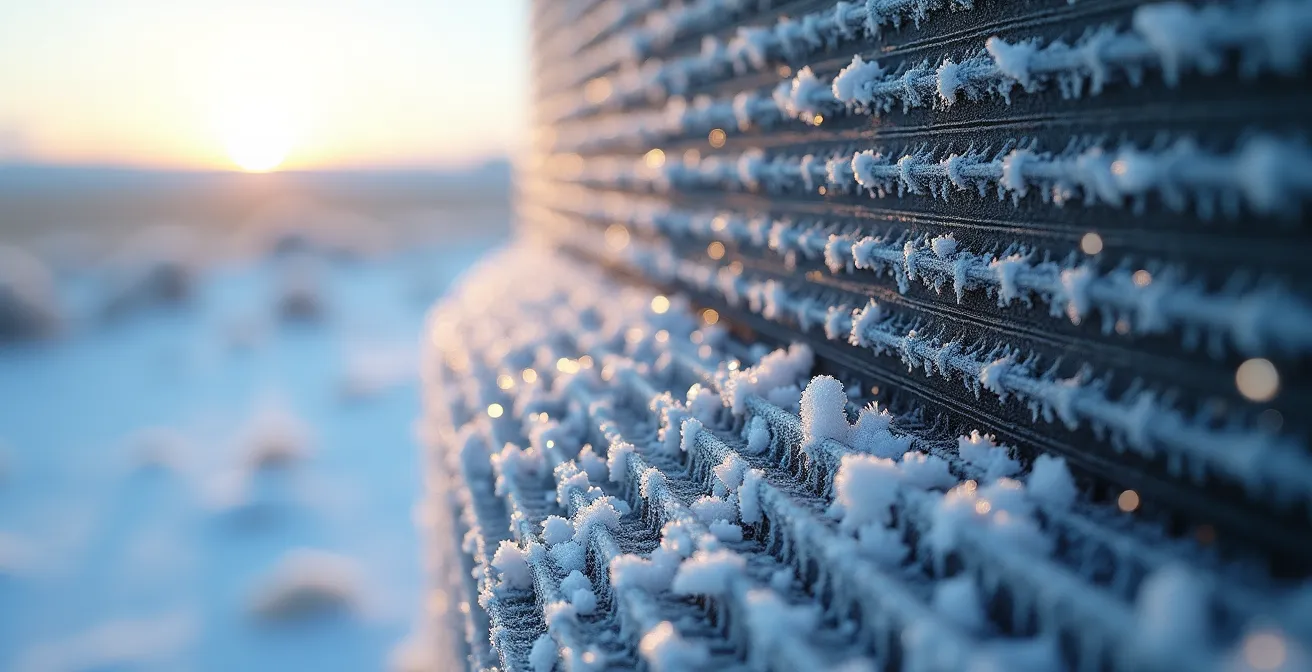
The visual of a frost-covered unit highlights the harsh conditions these machines must endure. The decision between geothermal and a cold-climate ASHP comes down to a balance between upfront capital and long-term operating costs, a calculation every homeowner in a cold climate must undertake.
Case Study: Saskatchewan Homeowner’s Switch from Oil to Heat Pump
To illustrate the economic power of this switch, consider the case of Jake Dingman from Saltcoats, Saskatchewan. Facing annual oil heating bills of nearly $4,000, he investigated his options. Extending a natural gas line was quoted at an astronomical $100,000. Instead, he opted for a modern heat pump system in the fall of 2023. This example, detailed in a report on heat pump adoption in the Prairies, shows how for many rural Canadians, heat pumps are not just an environmental choice, but the most economically sound decision for home heating.
How to Lower Your Water Bill by 40% With Smart Leak Detectors?
A truly resilient and cost-effective home strategy extends beyond energy. Water damage is one of the most common and expensive threats to Canadian homeowners, capable of erasing years of energy savings in a single incident. The Insurance Bureau of Canada reports the average cost of $43,000 for flooded basement repairs, a figure that makes a compelling case for proactive water management as a core part of your home’s financial de-risking strategy. A 40% reduction in water bills is often achievable not just through conservation, but by eliminating hidden leaks that go undetected for months.
Smart leak detectors have evolved from simple audible alarms to sophisticated systems that monitor your entire home. These devices can identify not only catastrophic pipe bursts but also slow drips from a toilet or faucet, which can waste thousands of litres of water per year. The most advanced systems integrate with your home’s water main, allowing you to shut off the water supply remotely from your smartphone the moment a leak is detected, preventing a costly disaster. Investing a few hundred dollars in this technology provides a powerful ROI, measured both in lower monthly bills and in the avoidance of catastrophic repair costs.
This table from Travelers Canada provides a clear breakdown of the available technologies, helping you choose the right level of protection for your budget and home.
| System Type | Price Range | Key Features | Installation |
|---|---|---|---|
| Basic Leak Sensors | $50-200 | Wi-Fi alerts, battery powered | DIY placement |
| Flow Monitors | $200-500 | Tracks water usage patterns | Attaches to water meter |
| Flow Interrupter Systems | $500-1,000 | Auto water shutoff capability | Professional recommended |
Do Solar Panels Actually Increase Home Value in the GTA Market?
A critical component of a holistic ROI calculation—and one that is often ignored—is the impact on your home’s resale value. This is a key element of “value-stacking,” where the return is not just from utility savings but also from increased property equity. While the question specifies the Greater Toronto Area (GTA) market, the principle holds true across Canada, including British Columbia. A home equipped with a fully owned solar panel system is a more valuable asset. It offers prospective buyers lower, more predictable operating costs and immunity from future electricity rate hikes.
Market studies consistently show that this added value is real and quantifiable. Buyers are willing to pay a premium for a home that has already made the investment in energy independence. This isn’t just a perception; it’s a tangible financial benefit that you can realize when you sell your home. This equity gain should be factored into any serious ROI calculation, as it can significantly shorten your net payback period.
According to extensive market analysis, homes with solar panels typically see a 3-5% increase in home sale price compared to similar homes without them. For a $1 million home in the Vancouver area, that represents an immediate equity boost of $30,000 to $50,000, an amount that can often cover the entire net cost of the solar installation itself. This demonstrates that solar is not just an expense; it’s an upgrade that enhances the fundamental value of your property.
When to Service Your Heat Pump to Avoid Mid-Winter Failure?
System resilience is the bedrock of a strong ROI. A high-efficiency system that fails prematurely offers a terrible return. For a heat pump operating in the demanding Canadian climate, a reactive approach to maintenance is a recipe for disaster. Waiting for a problem to arise before calling for service almost guarantees it will happen during a -20°C cold snap, leading to emergency call-out fees, potential parts shortages, and extreme discomfort. Proactive, seasonal maintenance is non-negotiable for ensuring both the longevity and efficiency of your unit.
An effective service schedule is timed to prepare the system for the stresses ahead and to recover from the ones it just endured. A pre-winter check-up in the fall is crucial to ensure it’s ready for the heating season, while a post-winter inspection in the spring can identify any damage caused by ice and snow. This regular servicing, particularly the annual professional inspection, is often a condition for maintaining the manufacturer’s 10-year warranty, making it an essential part of protecting your investment. Neglecting this schedule is a direct threat to your system’s long-term financial performance.

A seasonal maintenance plan isn’t a cost; it’s insurance on your investment’s performance. The small annual expense of a professional tune-up pales in comparison to the cost of a mid-winter emergency repair or a premature system replacement.
- October (Pre-Winter): Check refrigerant lines for any signs of frost build-up, clean the outdoor unit of leaves and debris, and listen for any unusual compressor noises.
- Coastal BC Focus: During winter, monthly cleaning of coils is recommended to prevent salt and moisture accumulation, which can lead to corrosion.
- Prairie/Ontario Focus: Before extreme cold hits, verify that the auxiliary heat strip is functioning correctly. This is your backup during the coldest days.
- Spring Service: A professional inspection is recommended after the winter stress to check for any ice damage to fins or fan blades.
- Annual Professional Service: This is required by most manufacturers to keep the 10-year parts warranty valid.
Vehicle-to-Home: Can Your Electric Car Power Your House During a Blackout?
The concept of “Vehicle-to-Home” (V2H) technology is rapidly moving from science fiction to a practical reality for Canadian homeowners. It represents the ultimate in personal energy resilience. V2H enables a bidirectional flow of energy, allowing your electric vehicle’s large battery to act as a home backup generator during a power outage. For a province like British Columbia, which is prone to outages from winter storms or summer wildfires, this capability adds a powerful new dimension to the value of owning an EV and a solar system.
While a standard generator requires fuel, maintenance, and produces noise and emissions, a V2H system is silent, emission-free, and powered by the sun (via your solar panels). The average EV battery can power a typical home’s essential circuits for several days. This synergy between solar panels, an EV, and a bidirectional charger creates a self-sufficient microgrid. While British Columbia’s energy profile shows that 89% of its power already comes from clean hydroelectric sources, V2H provides personal grid independence when that centralized grid fails.
Furthermore, BC’s outstanding net-metering program enhances this synergy. The province offers “full” or “1-to-1” net metering, meaning BC Hydro credits you for the solar power you export to the grid at the same retail rate you pay for electricity. This allows homeowners to generate credits at $0.11 to $0.14 per kWh, a rate nearly double what is offered in provinces with less favourable policies. This powerful financial incentive accelerates the ROI of your solar panels, making the addition of an EV and V2H capability an even more logical next step in achieving total energy and financial independence.
When Will Your $10,000 Insulation Upgrade Finally Pay for Itself?
Homeowners often view energy upgrades, like a $10,000 insulation project or a solar installation, through the narrow lens of a simple payback period. But the real answer to “when will it pay for itself?” is deeply tied to local energy costs, available rebates, and the quality of the installation. For solar panels in British Columbia, the payback equation is more favourable than many believe, thanks to a combination of high electricity rates and strong incentive programs. Calculating this period accurately is the cornerstone of a confident investment decision.
The total cost of the system is the first variable. This includes panels, inverters, mounting hardware, and labour. From there, you subtract federal and provincial rebates to find your net upfront cost. The other side of the equation is your annual savings, which is the electricity you no longer have to buy from BC Hydro, plus the credits you earn from exporting surplus power through the net-metering program. The payback period is simply the net cost divided by these annual savings. Thanks to BC’s supportive policies, most BC homeowners achieve solar payback within 6 to 10 years, a relatively short period for an asset designed to last over 25 years.
The table below gives a realistic overview of solar installation costs in BC after the primary BC Hydro rebate is applied, showing how the net cost varies by system size.
| System Size | Cost Range | BC Hydro Rebate | Net Cost After Rebate |
|---|---|---|---|
| 5 kW | $13,000-$16,350 | $5,000 | $8,000-$11,350 |
| 7 kW | $18,200-$22,890 | $5,000 | $13,200-$17,890 |
| 10 kW | $26,000-$32,700 | $5,000 | $21,000-$27,700 |
Key takeaways
- A true solar ROI in BC must include home value increase and risk mitigation, not just bill savings.
- Navigating the fine print of grant programs like the Greener Homes Initiative is critical to avoid costly reimbursement delays.
- BC Hydro’s 1-to-1 net-metering program is a powerful financial accelerator, nearly doubling the value of exported solar power compared to other provinces.
Why Triple-Glazed Windows Are Mandatory for Lowering Heating Bills by 30%?
A holistic energy strategy is about both supply (generating power with solar) and demand (reducing your home’s energy consumption). High-performance components like triple-glazed windows are crucial on the demand side. By dramatically reducing heat loss in the winter and heat gain in the summer, they lower your overall energy needs. This makes your home more comfortable, but it also has a direct impact on the ROI of your solar system. A home that requires less energy to heat and cool allows a smaller, less expensive solar array to cover a larger percentage of your needs, accelerating your payback period.
Think of it as a symbiotic relationship: efficient windows reduce the workload, and solar panels handle that reduced load for free. The upfront cost of these upgrades is mitigated by programs designed to encourage self-generation. For instance, BC Hydro provides rebates of $1,000 per kW of solar installed, up to a maximum of $5,000. This directly lowers the net cost of the “supply” side of your energy equation. By tackling both supply and demand, you create the most financially and environmentally efficient household possible.
Ultimately, this integrated approach is about achieving a greater degree of control and predictability over one of your largest household expenses. It’s about building a resilient asset that protects you from the volatility of future energy markets.
Installing solar energy in your home will help you lock in a stable and predictable source of energy for years to come. It gives your home greater energy independence and long-term protection from fluctuating utility costs.
– Janani Venkatesh, Average Cost of Solar Panels in British Columbia (2025)
To apply these principles to your own property, the logical next step is to get a detailed, customized assessment of your home’s solar potential and a transparent breakdown of costs and projected savings.