

In summary:
- Treat the process as a legal proceeding, not a friendly negotiation. Document every interaction.
- Proactively solve the board’s primary objections (cost, safety, capacity) with a formal, professional proposal.
- Use load management technology to neutralize arguments about electrical capacity.
- Insist on a hardwired installation by a certified Master Electrician to satisfy safety and insurance requirements.
- Frame your application around the board’s procedural obligations and the legal standard of reasonableness to make a refusal indefensible.
Your condo board or strata council has likely told you “no.” They may have cited concerns about electricity costs, building capacity, safety, or simply stated that it’s against the bylaws. This initial refusal is not a final verdict; it is a procedural starting point. As a condo owner in Canada, you have rights and leverage that most boards hope you are unaware of. The key to success is to stop treating this as a request for a favour and start treating it as a formal process where you systematically dismantle their objections and corner them into an approval.
The typical advice—”just talk to them” or “mention the environment”—is naive and ineffective. A board’s primary function is to mitigate risk and cost for the corporation, not to be forward-thinking. Therefore, your approach must be rooted in the language they understand: legal obligation, liability mitigation, and procedural correctness. You will build a record, present an irrefutable case, and make it clear that an unreasonable refusal will expose them to a successful challenge at a provincial tribunal, like the Condominium Authority Tribunal in Ontario or the appropriate body in your jurisdiction.
This guide is your playbook. It will provide the legal and technical arguments to counter every common objection. We will move beyond platitudes and focus on the actionable strategies that compel a board to act. By presenting a professional, turnkey solution that addresses all their legitimate concerns upfront, you shift the burden of proof. Their “no” becomes legally and practically untenable. The goal is not to ask for permission, but to present an approval-ready package that they would be unreasonable to deny.
This article provides a detailed roadmap for navigating this conflict. It will equip you with the technical solutions, procedural steps, and strategic arguments needed to secure your EV charger installation. Explore the sections below to build your case.
Summary: Your Battle Plan for EV Charger Approval
- The Billing Solution That Stops Neighbors from Fighting Over Condo Electricity?
- Hardwired vs. Plug-In: Which Level 2 Charger Setup Is Safer for Your Garage?
- Flo vs. ChargePoint: Which Network Offers Better Reliability in Quebec?
- The 80% Rule: Why Charging to 100% at a Fast Charger Is Rude and Slow?
- Can You Airbnb Your Home Charger to Make Extra Cash?
- Vehicle-to-Home: Can Your Electric Car Power Your House During a Blackout?
- Why Your Smart Bulbs Keep Disconnecting in Your High-Rise Condo?
- How to Stack Federal and Quebec Rebates to Save $12,000 on an EV?
The Billing Solution That Stops Neighbors from Fighting Over Condo Electricity?
The board’s most common and predictable objection is cost: “Who pays for the electricity?” Presenting this as an unsolved problem is a rookie mistake. You must present the solution pre-packaged, making their objection moot. The answer is not to tap into the building’s general “house power”; the answer is a networked charger with integrated metering and billing. Modern EVSE (Electric Vehicle Supply Equipment) platforms like SWTCH, FLO, or ChargePoint handle this automatically. Each user has an account tied to their credit card. They activate the charger, and are billed directly for their exact consumption, plus a small administrative fee that can be directed to the condo corporation’s operating fund.
This transforms the charger from a drain on common resources into a self-funding, user-pay amenity. You must also proactively address the argument of insufficient demand. Boards often claim, “No one else is asking for it.” This is irrelevant and short-sighted. The demand is coming, and being unprepared is a failure of governance. A powerful precedent to cite is a Toronto condo that successfully installed 57 charging stations with only 3 current EV owners. They understood that EV-readiness is an investment in the building’s future property value.
Your proposal must include a quote from a certified provider demonstrating a turnkey billing solution. Furthermore, you must counter the “not enough electrical capacity” argument. This is where load management technology is your critical weapon. Systems like SWTCH Control dynamically monitor the building’s total electrical load and adjust the charging speed of all connected EVs in real-time. This allows dozens of cars to charge on infrastructure that could previously only support a few, often eliminating the need for expensive service upgrades. By presenting a solution that manages both billing and load, you neutralize the board’s two biggest financial arguments before they can even make them.
Hardwired vs. Plug-In: Which Level 2 Charger Setup Is Safer for Your Garage?
After cost, the board’s next line of defense is safety and liability. They will envision fire hazards and uncertified work. You will counter this by specifying a hardwired installation performed by a licensed Master Electrician, and by demonstrating why this is vastly superior to a simple plug-in outlet. While a NEMA 14-50 outlet (the kind used for an electric stove) might seem cheaper, it is a liability trap for a condo corporation. These outlets are not designed for the repeated plugging and unplugging cycle of daily EV charging, leading to wear and potential overheating. Furthermore, a plug-in charger is considered an appliance and can be unplugged or stolen, creating security issues.
A hardwired charger, by contrast, is a permanent fixture. It is classified as a capital improvement to the building, which is preferred by insurers. The connection is direct, secure, and protected within a junction box, eliminating the risk of outlet degradation. This is the professional standard, and it is the only standard you should propose. Your application to the board must include a quote from a certified Master Electrician that explicitly states the installation will be hardwired and will include an electrical permit from the relevant provincial safety authority (like the Electrical Safety Authority in Ontario). This demonstrates that the installation will be fully compliant with the Canadian Electrical Code (CEC) and professionally vetted.
This image illustrates the professional standard of installation you must insist upon, ensuring all connections are secure and code-compliant.
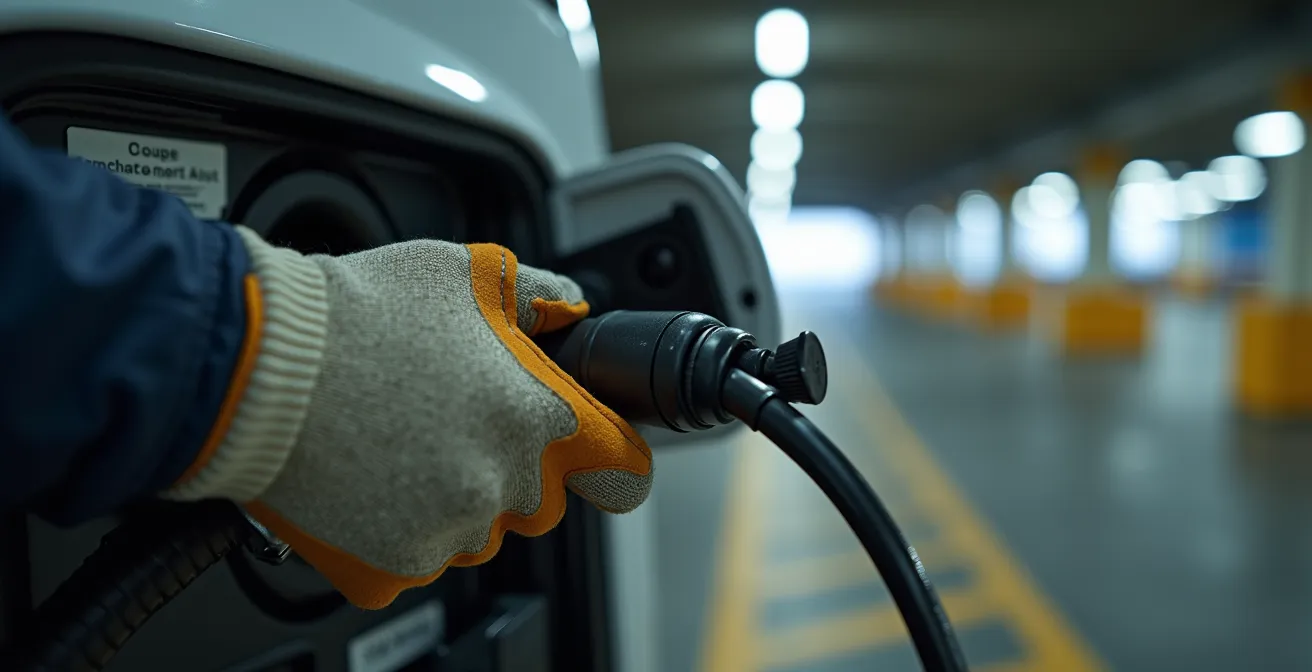
By specifying this higher standard, you are not just ensuring your own safety; you are providing the board with a key piece of documentation to appease their insurance provider. You are solving their liability problem for them. The marginal extra cost of a hardwired setup is a powerful investment in making your proposal undeniable.
The following table, based on guidance from electrical safety authorities, definitively shows why a hardwired installation is the only responsible choice for a multi-unit residential building.
This comparison, drawing from standards outlined by bodies like the Electrical Safety Authority (ESA) for multi-residential properties, leaves no room for debate.
| Factor | Hardwired Installation | NEMA 14-50 Plug-in |
|---|---|---|
| Insurance Preference | Preferred by insurers | May raise liability concerns |
| Code Compliance | Meets all CEC requirements | Limited by outlet rating |
| Tamper-proofing | Permanent, secure installation | Can be unplugged/stolen |
| Long-term Durability | No wear on connections | Outlet degradation over time |
| Installation Cost | $200-400 higher | Lower initial cost |
| Asset Classification | Capital improvement | Removable equipment |
Flo vs. ChargePoint: Which Network Offers Better Reliability in Quebec?
Once you’ve neutralized the core objections of cost and safety, the discussion moves to implementation. Choosing the right charging network is crucial, especially in a market with specific regional players. In Quebec, while international networks like ChargePoint (from California) are present, the homegrown option, FLO, headquartered in Quebec City, offers distinct advantages. The most obvious is native French-language support, not just in the app interface but across their entire customer and technical support structure. This is a significant factor for many Quebec condo corporations and residents.
Beyond language, it’s about compliance and philosophy. FLO chargers are Open Charge Point Protocol (OCPP) compliant, meaning the condo corporation isn’t locked into a single vendor’s proprietary hardware and software ecosystem. This provides long-term flexibility. In contrast, some networks may use more proprietary systems. However, other Canadian players like Toronto-based SWTCH are also gaining significant traction by focusing specifically on the multi-family residential market. Their core offering is dynamic load management, which can be more advanced than basic offerings from larger public networks. A case study of a Toronto condo showed that using SWTCH’s system saved the building $24,000 in electrical infrastructure upgrades by maximizing the existing capacity.
The decision is not just about the charger on the wall; it’s about the intelligence behind it. A robust network ensures uptime, accurate billing, and efficient use of the building’s power.
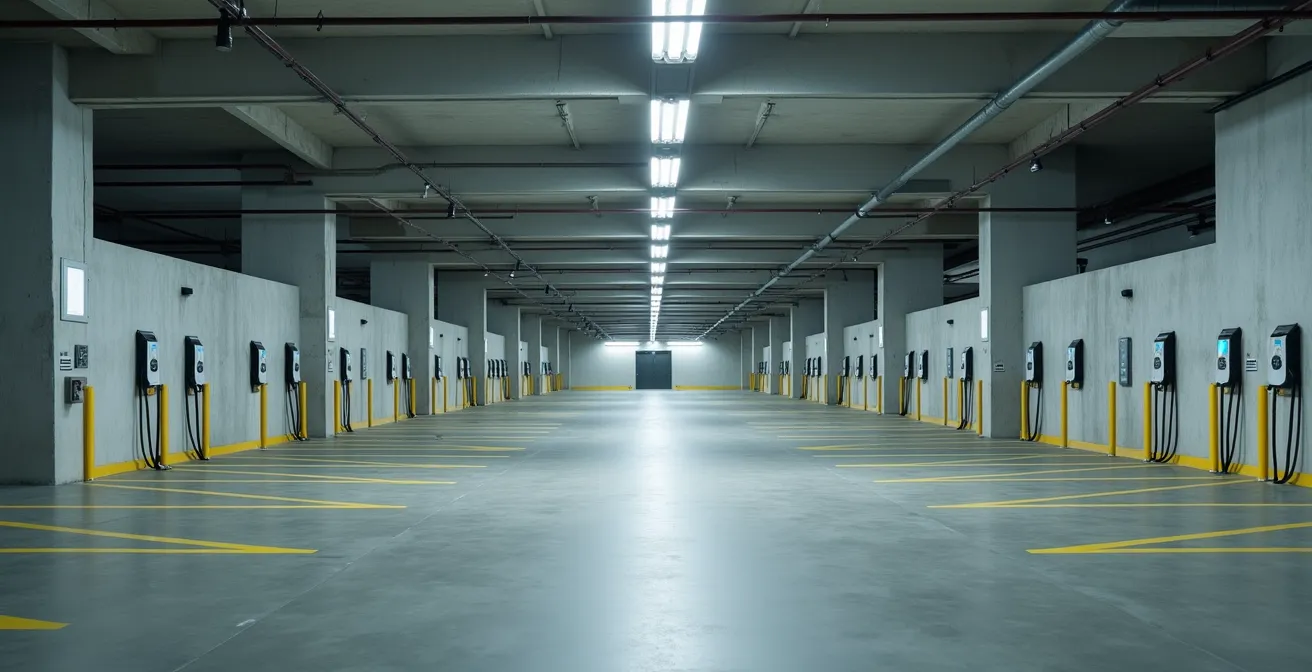
Ultimately, your proposal to the board should recommend a network based on a clear set of criteria: reliability, local support, robust load management capabilities, and non-proprietary hardware. This table compares key features for the Quebec condo context.
| Feature | FLO | ChargePoint | SWTCH |
|---|---|---|---|
| Headquarters | Quebec City | California | Toronto |
| French Support | Native French | Available | Available |
| Load Management | Basic | Advanced | Dynamic Control |
| Installation Network | Quebec-wide | Limited | Partner network |
| Monthly Fees | Per charger | Per charger | Building subscription |
| OCPP Compliant | Yes | Proprietary | Yes |
The 80% Rule: Why Charging to 100% at a Fast Charger Is Rude and Slow?
While your primary battle is with the condo board for a Level 2 home charger, understanding charging etiquette is crucial for every EV owner. The “80% Rule” applies mainly to public DC Fast Chargers (Level 3), but the principle of shared resources is one every condo dweller should understand. An electric vehicle’s battery does not charge at a linear rate. The charging speed is fastest when the battery is at a lower state of charge and slows dramatically as it approaches full. The final 20% (from 80% to 100%) can often take as long as the first 80%.
Occupying a high-demand public fast charger to trickle in that last 20% is considered poor form. It creates unnecessary queues and frustration for other drivers who need a significant charge to continue their journey. The efficient and courteous approach is to charge to 80% and move on. This maximizes the charger’s throughput and respects the time of others in the EV community. Most modern EVs allow you to set a charging limit directly in the vehicle’s infotainment system, making this easy to automate.
For your Level 2 charger in the condo, this rule is less critical as you are not holding up a public queue. However, the same battery chemistry applies. Regularly charging to 100% can also accelerate long-term battery degradation. For daily driving, most manufacturers recommend setting a daily charge limit of 80% or 90% to preserve battery health, only charging to 100% when you need the absolute maximum range for a long trip. This is not just etiquette; it’s smart ownership that protects your vehicle’s most expensive component.
Can You Airbnb Your Home Charger to Make Extra Cash?
The idea of monetizing your personal EV charger is tempting, but within a condo context, it is legally and logistically complex and generally ill-advised. Your parking spot is typically an exclusive-use common element or a deeded unit, but the electricity and the charger itself are tied into a building-wide system. Allowing public access would create significant security and liability issues for the condo corporation. Who is responsible if a paying guest damages the equipment or another vehicle? Your board’s insurance would almost certainly not cover commercial activity in a residential parking garage.
However, the concept of generating revenue from EV charging can be reframed as a powerful argument for the board. Instead of you personally profiting, the condo corporation itself can generate revenue. This is achieved by installing one or two dedicated chargers in the visitor parking area. These chargers can be set at a higher rate than the residential chargers (e.g., 20-30% above the electricity cost). The revenue generated flows directly into the building’s operating fund, offsetting common expenses for all owners. This turns EV charging from an individual owner’s “problem” into a building-wide asset.
This approach has a far greater chance of success. It provides a tangible financial benefit to every single owner, even those who don’t drive EVs. It also formalizes guest access and keeps it separate from residents’ private parking. As David Saevitzon, President of the Merton Street condo board that successfully implemented a large-scale charging project, noted, the goal is to position EV infrastructure as a value-add for the entire community.
Having an EV-ready building will enhance all unit values
– David Saevitzon, President of Merton Street condo board
Rather than seeking personal profit, propose a revenue model for the building. A practical plan could involve installing guest chargers and setting rates to create a new income stream for the corporation, benefiting all residents and increasing the property value for everyone.
Vehicle-to-Home: Can Your Electric Car Power Your House During a Blackout?
Vehicle-to-Home (V2H) or Vehicle-to-Grid (V2G) technology, which allows your EV’s battery to send power back into a home or the electrical grid, is a compelling concept, especially with the increasing frequency of power outages. The image of your car powering your lights and refrigerator during a blackout is powerful. However, in the context of a multi-unit residential building, the reality is far more complex. V2H requires a bidirectional charger and a special transfer switch connected directly to your unit’s electrical panel. In most condos, this panel is located within your suite, but the power feed comes from a central electrical room you cannot access, making the installation of such a switch practically impossible without major building-wide modifications.
Furthermore, from a board’s perspective, allowing one unit to draw power from a car while the rest of the building is dark creates a host of fairness and safety issues. The focus for condo corporations is, and should be, on the more immediate and achievable goal of providing charging *to* vehicles. As some experts note, simply electrifying 100% of condo parking stalls may be cost-prohibitive, making futuristic technologies like V2G a secondary concern to the primary challenge of “one-way” charging infrastructure.
While personal V2H is likely not feasible, the concept of Vehicle-to-Grid (V2G) could one day benefit the entire building. In a future V2G scenario, the combined batteries of residents’ EVs could act as a giant, distributed power source for the building. During peak demand periods when electricity is most expensive, the building could draw power from the cars, significantly reducing its overall utility bill. The savings would then be passed on to all owners. This is still an emerging technology requiring regulatory and utility updates, but it’s a useful long-term vision to include in discussions with a forward-thinking board.
Why Your Smart Bulbs Keep Disconnecting in Your High-Rise Condo?
The frustration of a smart bulb or speaker constantly losing its Wi-Fi connection in a high-rise is a perfect analogy for a critical, often-overlooked aspect of networked EV charging: connectivity. Underground parking garages, with their thick concrete walls and steel rebar, are notoriously hostile environments for wireless signals. A standard Wi-Fi network that works perfectly in your suite will likely be weak or non-existent in your parking spot several floors below. This is not a minor inconvenience; for a networked EV charger, no connection means no authorization, no billing, and no load management. The entire system fails.
A professional proposal must anticipate and solve this problem. Relying on the building’s shared Wi-Fi is a recipe for failure. There are two primary professional-grade solutions. The first and often most reliable is to specify chargers with built-in cellular (4G/LTE) connectivity. These chargers bypass the building’s Wi-Fi entirely, communicating directly with the network provider’s servers via their own dedicated cell modem, just like a smartphone. The small additional monthly data fee is a negligible price for reliability.
The second solution is a hardwired Ethernet connection run alongside the power conduit to the charger. This provides a rock-solid connection but can increase installation complexity and cost. A thorough site assessment by your EV charging provider should include a signal strength test at the proposed location to determine the best path forward. Presenting a solution that guarantees connectivity demonstrates a level of technical diligence that will impress a detail-oriented board and show that you are mitigating a key point of technical failure.
Action Plan: Network Connectivity Checklist for Your Proposal
- Specify cellular-enabled chargers for underground parking to ensure independent connectivity.
- Demand that the installer performs and documents a Wi-Fi and cellular signal strength test at each proposed parking level.
- For critical building-wide systems, consider hardwired Ethernet for 100% reliability.
- Ensure the service agreement includes 24/7 network monitoring to detect and resolve outages promptly.
- Require network redundancy or a fallback plan in the service agreement (e.g., if the network is down, can charging still be authorized locally?).
- Mandate that the system has local backup for charging authorization, so a network outage doesn’t leave residents stranded.
Key Takeaways
- A condo board’s “no” is a procedural starting point, not a final verdict. Your leverage is in the process.
- Neutralize cost and capacity arguments upfront with modern, networked chargers featuring user-pay billing and dynamic load management.
- Insist on a professional, hardwired installation to satisfy all safety, code, and insurance requirements, making a refusal on these grounds unreasonable.
- Build an undeniable record. Every communication should be formal, documented, and contribute to a case file that can be used in a dispute resolution.
How to Stack Federal and Quebec Rebates to Save $12,000 on an EV?
While this guide focuses on charger installation, the financial incentives for purchasing the electric vehicle itself are a critical part of the ecosystem, especially in Quebec. The province offers one of the most generous incentive programs in North America, and it can be combined with the federal iZEV program. As of early 2024, the federal government offers a point-of-sale incentive of up to $5,000 for new eligible zero-emission vehicles. This is the foundation of your savings.
On top of the federal rebate, the Quebec government’s Roulez Vert program provides an additional rebate of up to $7,000 for a new eligible EV. By combining these two programs, Quebec residents can save up to $12,000 directly off the purchase price of their vehicle. This powerful financial stack makes EV ownership significantly more accessible and is a key driver of adoption in the province. It’s important to verify the eligibility of the specific vehicle model you are considering on both the federal and provincial program websites, as lists and price caps are regularly updated.
For the charger installation itself, the Roulez Vert program also provides significant financial assistance for multi-unit buildings. The program can reimburse up to 50% of eligible expenses, up to a maximum of $5,000 per charging station connector. This is a rebate the condo corporation applies for, not the individual owner. Your role is to present this information to the board as another reason to approve the project, as it dramatically reduces the corporation’s capital outlay for a building-wide project. The application process is formal and requires board-level participation.
- Board Resolution: The first step is for the condo board to pass a formal resolution approving the project to install charging stations.
- Certified Quotes: The board must obtain quotes from a Master Electrician certified to work in Quebec.
- Application Form: The board completes the official Roulez Vert application form for multi-unit buildings.
- Document Submission: The application must be submitted with the board resolution, electrical quotes, and any required building permit documents.
- Installation: Upon receiving approval from the program, the installation must be completed within 12 months.
- Rebate Disbursement: After installation, final documentation is submitted to the government for the rebate to be paid out to the condo corporation.
Your formal proposal to the board is the first step in this legal process. By presenting a comprehensive, professional plan that anticipates and solves their objections regarding cost, safety, and capacity, you build an undeniable case. Frame your request not as a convenience, but as a necessary and reasonable upgrade that enhances property value and is supported by government incentives. Begin building your record today.
Frequently Asked Questions on Advanced EV Charging in Condos
Can V2H technology work in a condo unit?
V2H requires a transfer switch connected to the unit’s main panel, which is typically not feasible in condos due to electrical room access restrictions and building code limitations.
What about Vehicle-to-Grid (V2G) for condos?
V2G could potentially benefit entire buildings in the future by allowing resident EVs to provide power back to the grid during peak demand, reducing building electricity costs.
Are there any V2G pilots in Canada?
Some utilities are exploring V2G pilots, but widespread implementation awaits updates to the Canadian Electrical Code and utility regulations.