
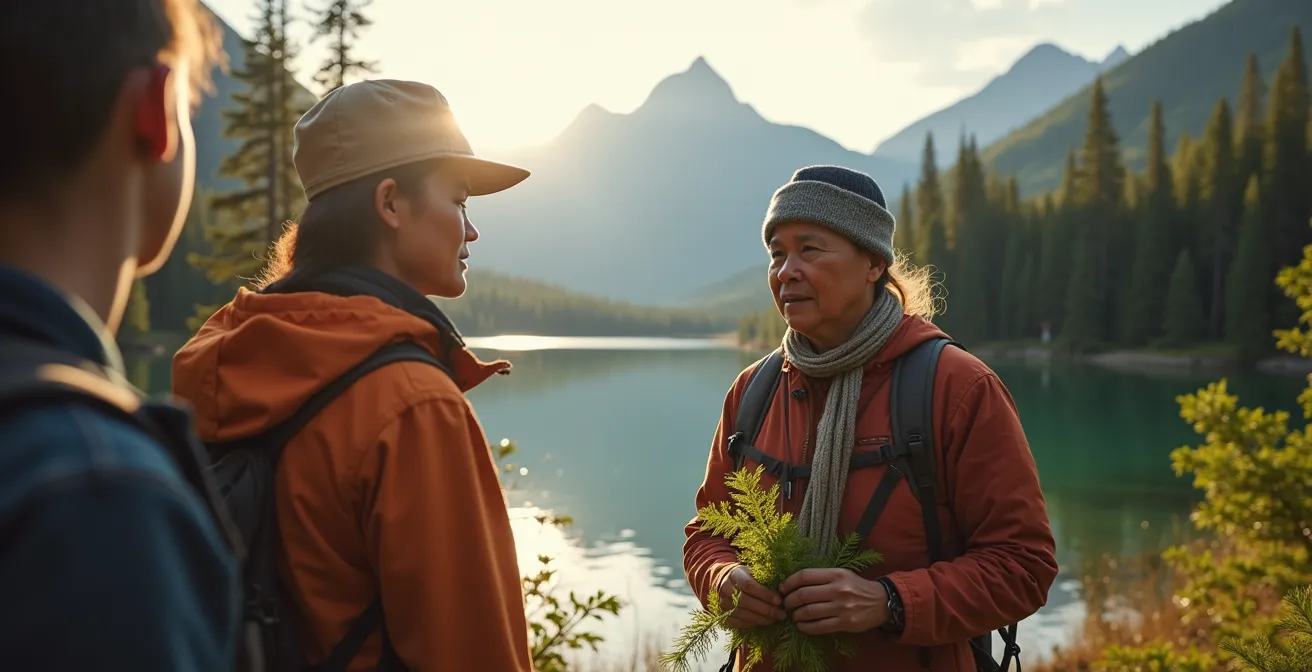
True Indigenous tourism is not about what you see, but how you participate; it’s an act of economic and cultural partnership, not consumption.
- Authenticity is guaranteed by tangible markers like ITAC’s “The Original Original” accreditation, which confirms majority Indigenous ownership and community-endorsed standards.
- Meaningful experiences prioritize reciprocal exchange—where you gain wisdom from a guide’s living stories—over the one-way data extraction of a self-guided app.
Recommendation: Prioritize spending your time and money with accredited, Indigenous-owned businesses to ensure your travel is a respectful contribution to cultural revitalization and economic sovereignty.
For the socially conscious traveller in Canada, the desire to engage with Indigenous cultures is strong, but so is the fear of stumbling into a “tourist trap”—an experience that commercializes or misrepresents culture for profit. Many travellers believe the solution is simply to “do your research” or “buy from Indigenous artists.” While well-intentioned, this advice is incomplete. It overlooks the deeper mechanisms of what makes a tourism experience genuinely supportive and respectful.
The common approach focuses on avoiding negatives, like cultural appropriation, but fails to provide a clear path toward positive impact. The real distinction between an authentic experience and an exploitative one lies not in the aesthetics or the location, but in the flow of benefits. Who owns the business? Who is employed? Where does the money you spend ultimately go? Is the interaction a one-way spectacle or a two-way exchange?
This guide reframes the challenge. The key is not just to identify authenticity for your own enrichment, but to actively participate in a system of economic and cultural empowerment. We will explore the practical tools and protocols that transform you from a passive tourist into a respectful ally. By understanding the meaning behind certifications, the value of guided knowledge, and the importance of specific protocols, you can ensure your journey contributes directly to the resilience and sovereignty of Indigenous communities across Canada.
To help you navigate these choices, this article breaks down the essential signals of authenticity, from financial transparency to land-use protocols. Discover the concrete steps you can take to make your travel a meaningful act of reconciliation.
Table of Contents: How to Be a Respectful Ally in Indigenous Tourism
- What the “Original Original” Mark Means for Your Travel Budget?
- Why a $150 Guided Heritage Tour Offers More Value Than Self-Guided Apps?
- How to Prepare Children for a Visit to Residential School Memorial Sites?
- The Logistics of Visiting Haida Gwaii: Why You Must Book 6 Months Ahead?
- Cash or Card: How to Ensure Your Spending Stays Within the Community?
- What Does the “Igloo Tag” Guarantee About Your Sculpture?
- How to Find Indigenous-Owned Businesses to Support During Your Road Trip?
- How to Obtain Permission to Visit Protected Indigenous Lands in BC?
What the “Original Original” Mark Means for Your Travel Budget?
When you see a business displaying The Original Original logo, it’s more than a marketing badge; it’s a guarantee of economic and cultural integrity. This mark, developed by the Indigenous Tourism Association of Canada (ITAC), certifies that the business is at least 51% Indigenous-owned and has passed a rigorous evaluation. This isn’t a vague promise of “authenticity”—it’s a structural commitment. It ensures that the majority of the revenue you generate stays within Indigenous hands, fostering economic self-determination.
Choosing an accredited business means your travel budget is working as a tool for community empowerment. The Original Original accreditation program sets its standards by Indigenous tourism operators for Indigenous tourism operators, ensuring the criteria are fair and relevant. This system is designed to build a sustainable industry where 57% of employees in the Indigenous tourism sector are Indigenous. Your spending directly supports jobs, preserves cultural practices, and builds pride.
So, when you’re deciding between two operators, consider the mark a direct indicator of where your money is going. A slightly higher price for an accredited tour isn’t just for a “better” experience; it’s an investment in a business model that values cultural revitalization and community well-being over external profit. It transforms your expenditure from a simple transaction into a meaningful act of support.
Why a $150 Guided Heritage Tour Offers More Value Than Self-Guided Apps?
In an age of digital convenience, a free or low-cost self-guided app might seem like a budget-friendly way to explore a heritage site. However, this approach fundamentally misses the core of Indigenous knowledge: it is a living, breathing entity passed through relationships, not a static database. A $150 guided tour with an Indigenous storyteller offers value that an app can never replicate by fostering a reciprocal relationship rather than a one-way extraction of information.
With an app, you consume pre-recorded facts. With a guide, you participate in a cultural exchange. As Destination Indigenous puts it, the goal is to “Join Indigenous guides on a transformative journey on their traditional territories, and enjoy the wit and wisdom of storytelling handed down through generations.” This living knowledge includes real-time context, safety protocols for wildlife encounters, and the nuanced understanding of cultural etiquette—things an app cannot provide. Most importantly, your investment directly supports the guide, their family, and the community’s effort to keep their stories alive.
The distinction becomes clear when comparing the core features of each approach. A guided tour is an investment in human connection and the preservation of culture, where profits are reinvested locally. An app often sends profits to a tech company far from the community whose stories it monetizes.
| Feature | Indigenous Guided Tour | Self-Guided App |
|---|---|---|
| Cultural Knowledge | Living stories passed through generations | Static database information |
| Safety Protocols | Real-time wildlife and cultural protocol guidance | Pre-recorded general warnings |
| Economic Impact | Direct support to Indigenous communities | Profits leave the community |
| Personal Connection | Reciprocal relationship and cultural exchange | One-way information extraction |
How to Prepare Children for a Visit to Residential School Memorial Sites?
Visiting a former Residential School site or a related memorial is a profound act of witness and reconciliation, but it requires careful emotional and educational preparation, especially for children. This is not a typical historical tourist site; it is a place of deep sorrow and powerful resilience. Your role as a visitor, and as a parent, is to approach it with the utmost respect and solemnity. Before you go, it is essential to have an age-appropriate conversation with your children about the history of Residential Schools in Canada. Explain that these were places where Indigenous children were forcibly taken from their families and that it caused great harm.
Frame the visit not as a dark tourism excursion but as a way to honour the Survivors and the children who never came home. Focus on the theme of resilience and remembrance. Many sites are presented with this intent: “Walk along with us as we share stories of resilience and will to survive in the face of atrocities. Visit sites of former ‘Indian’ Residential Schools where thousands of our Peoples were abused, yet hear heartwarming stories of perseverance and find hope for the future.” Use simple, honest language. For younger children, you might say, “We are going to a quiet place to remember children who were very brave during a sad time in our country’s history.”

Upon arrival, model quiet behaviour. Encourage observation and reflection rather than play. Follow all posted signs and stay on designated paths. The purpose of these spaces is contemplation, and your family’s conduct should reflect that. After the visit, create space for your children to ask questions and share their feelings. This visit can be a foundational moment in their understanding of Canadian history and the importance of reconciliation.
The Logistics of Visiting Haida Gwaii: Why You Must Book 6 Months Ahead?
Planning a trip to the breathtaking archipelago of Haida Gwaii requires a shift in mindset from typical travel logistics. The need to book accommodations, ferries, and tours up to six months in advance, especially for the peak season, is not a matter of inconvenience; it is a fundamental principle of respect for the land and the Haida Nation. This practice is rooted in the Haida principle of ‘Yah’guudang’—respect for all things. The islands’ fragile ecosystem and limited infrastructure cannot support unlimited, last-minute tourism.
Capacity limits are a deliberate form of stewardship. For example, Parks Canada notes that the limited capacity at Gwaii Haanas National Park Reserve requires advance booking to protect its natural and cultural heritage. By planning far ahead, you are not just securing a spot; you are actively participating in the preservation of the islands. You are demonstrating your understanding that you are a guest in a homeland, not a consumer in a resort destination. This advance planning allows local, often family-run, Indigenous tourism businesses to manage their resources sustainably and provide a far richer, less crowded experience for those who visit.
Upon arrival, visitors are asked to take the Haida Gwaii Pledge, a commitment to walk softly and act with respect. Adhering to the booking logistics is the first step in honouring that pledge before you even set foot on the islands.
Your Action Plan for a Respectful Haida Gwaii Visit
- Book accommodations, ferries, and tours at least 6 months in advance for summer travel.
- Research the Haida cultural calendar and seasonal tour availability to align your visit respectfully.
- Understand that capacity limits are a tool to protect the islands’ unique and fragile ecosystem.
- Familiarize yourself with the Haida principle of ‘Yah’guudang’ (respect for all things) to guide your conduct.
- Be prepared to read and voluntarily take the Haida Gwaii Pledge upon arrival to formalize your commitment.
Cash or Card: How to Ensure Your Spending Stays Within the Community?
In the context of supporting Indigenous communities, how you pay can be as important as what you buy. While credit and debit cards are convenient, they often come with transaction fees for small business owners, slightly reducing the revenue that stays in their pocket. To maximize your positive economic impact, the most direct approach is to ask a simple, respectful question: “What payment method benefits you the most?” This small act shows you are a conscious ally, not just a consumer.
In many remote communities or when buying directly from an artist at a market, cash is king. It eliminates processing fees and ensures 100% of the money goes to the vendor. Carrying a reasonable amount of cash is a practical way to support the smallest operators. For independent artists or guides who are digitally connected, an Interac e-Transfer is often an excellent alternative, as it provides a direct, low-fee transfer of funds into their account. This method is increasingly common and is a great way to support economic sovereignty directly.
When shopping, look for businesses that are part of Indigenous-owned cooperatives like Arctic Co-operatives Limited in the north, or those displaying The Original Original mark. These structures are designed to keep wealth circulating within the community. As The Original Original initiative states, your choice has a profound ripple effect.
When you join an experience that displays The Original Original mark, you are directly supporting Indigenous owned businesses, helping to build economic independence and pride in culture.
– The Original Original
What Does the “Igloo Tag” Guarantee About Your Sculpture?
When purchasing Inuit art, particularly sculptures, the “Igloo Tag” is your single most important guarantee of authenticity and ethical sourcing. This trademark of the Canadian government, managed by the Inuit Art Foundation (IAF), certifies that the work was handmade by an Inuk artist in Canada. It’s a powerful tool to combat the flood of mass-produced, imitation carvings that appropriate Inuit styles but send no benefits to the artists or their communities. The tag is a direct link between the art, the artist, and their culture.
Each tag features the artist’s name, their home community, and a unique tracking number, ensuring full traceability and provenance. By choosing a piece with this tag, you are not just buying a beautiful object; you are investing in the livelihood of an artist and contributing to the economic fabric of a Northern community. It ensures the story told by the piece remains connected to the person who created it. This is crucial because, as supporters of Indigenous art emphasize, “Every piece tells a story that transcends generations. Every purchase helps keep those stories alive.”

An authentic hand-carved piece will show the unique marks of the artist’s tools and the natural texture of the stone, qualities that are absent in molded fakes. The Igloo Tag is the formal confirmation of this craftsmanship. Refusing to buy any Inuit-style art without this tag is the most effective way to ensure you are a patron, not a party to appropriation.
Key Takeaways
- Authenticity is verified: Look for ITAC’s “The Original Original” mark and the Inuit Art Foundation’s “Igloo Tag” to guarantee Indigenous ownership and ethical sourcing.
- Prioritize people over platforms: Choose guided tours with Indigenous storytellers over self-guided apps for a genuine cultural exchange that directly supports the community.
- Respect is procedural: Adhere to local protocols, whether it’s booking months in advance for sensitive ecosystems like Haida Gwaii or asking for permission before entering protected lands.
How to Find Indigenous-Owned Businesses to Support During Your Road Trip?
A Canadian road trip offers a fantastic opportunity to support Indigenous economies, but finding these businesses requires moving beyond a standard Google Maps search. Fortunately, a growing ecosystem of digital tools and real-world cues makes it easier than ever. With nearly 3,000 Indigenous organizations and entrepreneurs across Canada, opportunities are abundant if you know where to look.
Your first step should be to download the Destination Indigenous app from ITAC, which provides a comprehensive, nationwide map of accredited experiences and businesses. For more regional focus, consult provincial directories like Indigenous Tourism BC, Tourisme Autochtone Québec, or Indigenous Tourism Alberta. Online resources like the ‘Shop First Nations’ interactive map are also invaluable for planning your stops.
While on the road, keep your eyes open for visual cues. Nation flags proudly displayed on buildings are a clear sign. Signage in Indigenous languages or the presence of The Original Original certification mark in a window are also strong indicators. Proactively planning your route to pass through or near First Nations communities that have invested in tourism infrastructure, such as Membertou in Nova Scotia or Wendake in Quebec, can lead to discovering incredible galleries, restaurants, and cultural sites you might otherwise miss. Being intentional with your route and your research is the key to turning a simple drive into a journey of meaningful support.
How to Obtain Permission to Visit Protected Indigenous Lands in BC?
British Columbia’s vast and beautiful landscape is a mosaic of Indigenous territories, many of which are unceded. For a respectful traveller, understanding that you are a guest on these lands is paramount. The question of “permission” is complex, as protocols vary significantly depending on the legal status of the land and the specific Nation whose territory you are on. With 204 distinct Indigenous communities in BC, there is no one-size-fits-all answer; research and respect are your essential guides.
The first step is to identify whose land you are on using resources like the Native-Land.ca map. From there, the protocol diverges. For designated Tribal Parks, access is often formalized through visitor fees that fund Indigenous Guardian programs. For Reserve lands, you must contact the Band Office directly for guidance and respect all posted regulations. On lands subject to modern treaties, specific protocols outlined in the treaty will apply. For the vast areas of unceded territory, the Nation’s official website is the primary source of information; many require or strongly recommend hiring an Indigenous guide for access to culturally significant or sensitive areas.
Assuming you can enter freely is a mistake. The process of seeking permission, or at the very least understanding and abiding by the established protocols, is a fundamental act of recognizing Indigenous sovereignty and law. The following table provides a general framework for navigating these different contexts.
| Territory Type | Permission Process | Visitor Requirements |
|---|---|---|
| Treaty Land | Follow specific treaty protocols | May require formal permits |
| Reserve Land | Contact Band office directly | Respect posted regulations |
| Unceded Territory | Check Nation’s official website | Hire Indigenous guides when required |
| Tribal Parks | Pay visitor fees at entrance | Fees fund Guardian programs |
By shifting your perspective from that of a consumer to that of a respectful guest, you transform your travel. Each decision—from the tour you book to the art you buy to the land you walk upon—becomes an opportunity to be an ally. Your journey can be a genuine contribution to reconciliation, supporting the vibrant, resilient, and sovereign Indigenous cultures that are the heart of this land.