
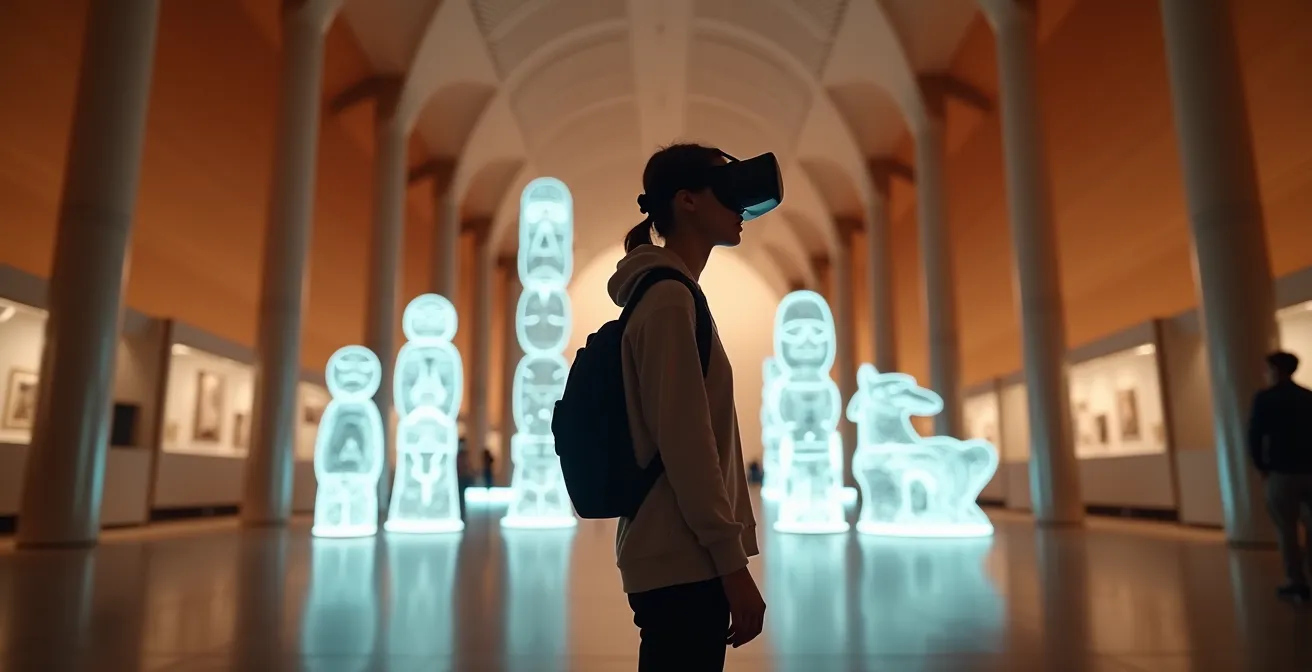
Virtual Reality isn’t just about seeing Canadian museums from afar; it’s about unlocking a hidden layer of stories and context that brings artifacts to life.
- Modern headsets like the Meta Quest 3 make these experiences accessible and cost-effective compared to physical travel or high-end alternatives.
- Immersive tech is crucial for preserving and sharing Indigenous oral traditions, offering a new medium for spatial storytelling.
Recommendation: Focus on experiences that offer narrative depth, not just 360-degree views, to truly connect with Canada’s culture.
For many Canadians living in remote areas or facing mobility challenges, the idea of strolling through the Royal Ontario Museum or standing before the monumental art of the First Peoples Hall can feel like a distant dream. The digital age promised a solution with virtual tours, but often these have been little more than clickable photo galleries, offering a flat glimpse of a dynamic space. You can see the artifacts, but can you feel their stories? Can you understand their place in the vast tapestry of Canadian culture?
This is where the conversation often stalls. We accept that a virtual visit is a compromise, a lesser version of the real thing. But what if this perspective is wrong? What if immersive technologies like Virtual and Augmented Reality (VR/AR) are not just about replicating a physical visit, but about offering an entirely new, and in some ways deeper, form of cultural engagement? The true magic of VR isn’t just about seeing a dinosaur skeleton; it’s about having a paleontologist’s notes appear in front of you, or watching the creature walk the halls.
This guide moves beyond the simple “virtual tour” to explore how you can become a digital curator of your own cultural experiences. We’re not just looking at digital replicas; we’re diving into the narrative layers that immersive tech can unfold. We’ll explore the right hardware for your budget, see how this tech is revitalizing ancient storytelling traditions, and discover how artists and institutions across Canada are using it to create unforgettable encounters with history and art. It’s time to transform your living room into the most exclusive gallery in the country.
As a starting point for your journey, the following video offers a wonderful virtual tour of the Canadian Museum of History. Consider it a gateway experience, demonstrating the high-quality access now available before we delve into the more interactive and story-driven possibilities that await.
To help you navigate the exciting landscape of at-home museum experiences, this guide is structured to answer your most pressing questions. From choosing the right technology to understanding its profound cultural impact, each section will equip you with the knowledge to begin your journey as a digital culture curator.
Table of Contents: A Curator’s Guide to Canada’s Virtual Museums
- Quest 3 vs. Apple Vision Pro: Is the Price Difference Worth It for Travel Apps?
- Why Immersive Storytelling Is Revitalizing Indigenous Oral Traditions?
- How to Build Your First AR Art Installation with No Code Tools?
- The Motion Sickness Fix That Allows You to Enjoy VR for Hours?
- When Will Holographic Displays Replace Your Living Room TV?
- Is the Extra $10 for the AR Experience at the ROM Worth It?
- Why Flying Staff to Calgary for Training Costs 3x More Than VR Simulations?
- How Interactive Storytelling Apps Are Making Canadian Museums Fun for Gen Z?
Quest 3 vs. Apple Vision Pro: Is the Price Difference Worth It for Travel Apps?
Your first step into the world of virtual museums is choosing the right portal: the headset. The current market presents two major contenders at opposite ends of the price spectrum: the accessible Meta Quest 3 and the premium Apple Vision Pro. For a Canadian culture enthusiast, the choice isn’t just about technical specifications, but about access to relevant content and overall value. The Vision Pro boasts incredible resolution, but its staggering price and limited library of dedicated Canadian museum apps make it a future prospect rather than a current reality.
The Meta Quest 3, on the other hand, represents a much more practical entry point. With its strong support for WebXR, it can smoothly run a growing number of browser-based virtual tours from Canadian institutions. Its cost-effectiveness is a major factor; for the price of a single Vision Pro, a family or even a small community centre could be equipped with multiple Quest 3 headsets. This isn’t just a technical detail; it’s a fundamental question of accessibility to culture.
To put this in perspective, consider the return on investment. A Quest 3 can pay for itself in saved admission fees and travel costs after about 40 to 65 virtual visits to paid experiences. The Vision Pro would require over 300 such visits to break even. This stark difference is why the Quest platform, with its mature developer community in Canada and proven track record, is currently the de facto choice for at-home museum exploration.
The following table breaks down the key considerations for a Canadian user, based on an analysis of the current VR landscape for museums.
| Feature | Meta Quest 3 | Apple Vision Pro | Canadian Content Advantage |
|---|---|---|---|
| Price (CAD) | $649-$949 | $4,999+ | Quest 3 offers 5x lower entry cost |
| Canadian Museum Apps | Limited native apps, strong WebXR support | No dedicated apps yet | Quest 3 currently ahead |
| Matterport Tours Performance | Smooth 90Hz experience | Higher resolution but limited testing | Quest 3 proven reliable |
| Battery Life for Museum Tours | 2-3 hours continuous | 2 hours mixed use | Comparable for typical sessions |
| Canadian Developer Support | Strong indie dev community | Limited but growing | Quest ecosystem more mature |
Why Immersive Storytelling Is Revitalizing Indigenous Oral Traditions?
Perhaps the most profound application of immersive technology in Canada is its role in the preservation and revitalization of Indigenous oral traditions. For centuries, these stories, histories, and worldviews have been passed down through generations in a spatial, embodied way—around a fire, within a longhouse, on the land itself. Print and video can capture the words, but they often lose this crucial context of spatial storytelling. VR and AR are changing that.
Immersive media allows for the creation of “sensory archives,” where a story is not just told but felt. Imagine standing in a virtual representation of a Haida Gwaii coastal village, hearing the words of an Elder as the story unfolds around you, projected onto the very structures they describe. This technology provides a medium that aligns with the holistic nature of oral traditions, combining voice, environment, and presence in a way that a flat screen cannot. It creates a space for intergenerational knowledge transfer that is both deeply traditional in spirit and radically modern in form.
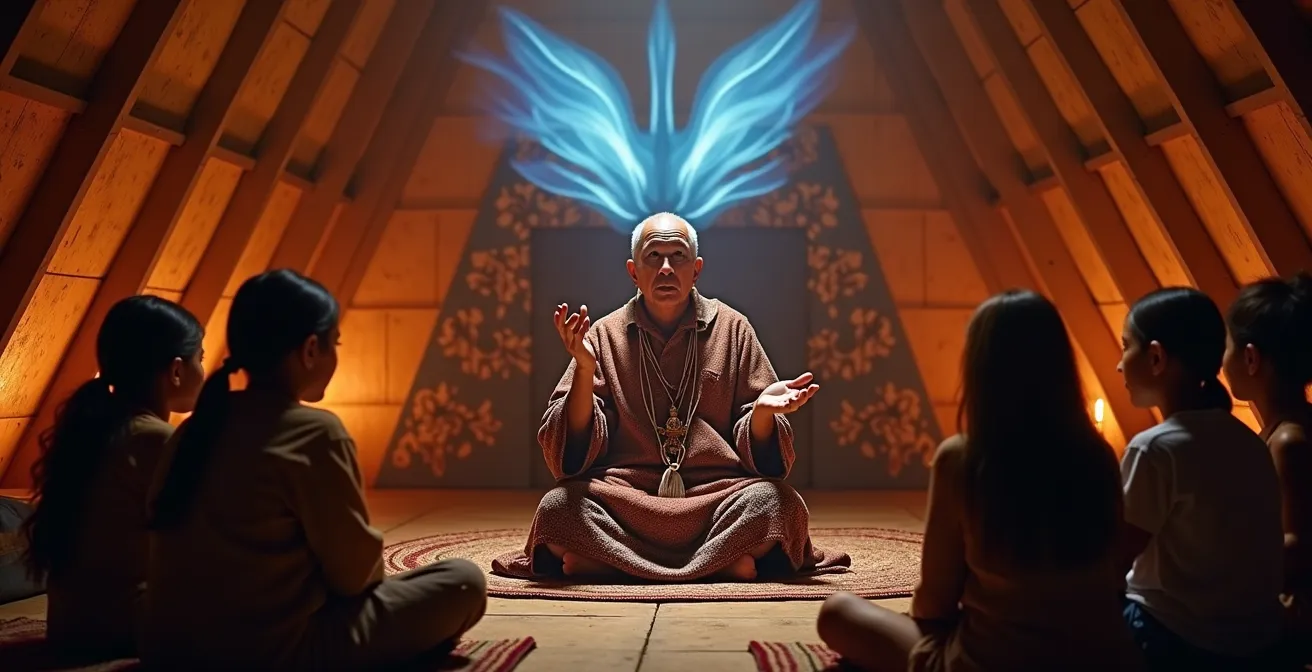
A leading example is the virtual tour of the First Peoples Hall at the Canadian Museum of History. Developed in collaboration with Indigenous communities, it allows users from anywhere in the world to explore the diversity of First Nations, Métis, and Inuit cultures through objects and stories presented in their architectural context. This isn’t just about accessibility; it’s about cultural continuity. The demand is clearly there, with one study showing that 79% of museum visitors want to use digital technology to explore collections. For Indigenous communities, it’s a powerful tool for self-representation, ensuring their narratives are shared with authenticity and respect for a global audience.
How to Build Your First AR Art Installation with No Code Tools?
The beauty of immersive technology is that it’s not just for consumption; it’s a powerful medium for creation. You don’t need to be a professional developer to start adding your own digital layers to the world. No-code Augmented Reality (AR) platforms like Adobe Aero and Artivive have democratized the creation process, allowing anyone with a smartphone and an idea to build their own AR art installation. This opens up incredible possibilities for community storytelling and personal expression, right in your own neighbourhood.
Imagine transforming a local landmark or a plain wall into a dynamic digital canvas. The process is surprisingly straightforward. It starts with choosing a physical location and an “anchor”—a real-world object or image that will trigger your AR experience. You then use a no-code tool to overlay your digital content, which could be anything from a 3D model or animation to a video or piece of audio. You can set it to appear when a user points their phone at the anchor, or even use GPS to make it a location-based discovery.
This is precisely how many Canadian artists are beginning their journey. For example, a creator could design an AR experience for Toronto’s famous Graffiti Alley. Here’s a simple plan they might follow:
- Scout the Location: Photograph anchor points in Graffiti Alley on Queen St. West.
- Choose a Platform: Use a free tool like Adobe Aero.
- Design the Digital Layer: Create a short animation that interacts with a piece of existing street art.
- Set the Trigger: Program the animation to play when a phone is pointed at the mural.
- Share and Test: Share the experience with the local community for feedback before submitting it to a festival like Nuit Blanche.
This DIY spirit is fueling a vibrant ecosystem. Canadian VR artist Nick Ladd, featured in the Museum of Other Realities (MOR), began by creating immersive worlds with intuitive tools. The MOR itself serves as a virtual venue where artists from around the world can showcase their work, proving that powerful creative platforms are no longer confined to physical galleries.
The Motion Sickness Fix That Allows You to Enjoy VR for Hours?
For many newcomers to VR, the single biggest barrier to enjoyment is motion sickness, or “cybersickness.” The feeling of nausea or disorientation occurs when your eyes perceive motion that your inner ear doesn’t. This sensory mismatch can quickly turn a fascinating virtual tour into an uncomfortable experience. Fortunately, developers have created a suite of comfort settings that, when properly adjusted, can virtually eliminate the problem for most users, allowing for hours of comfortable exploration.
The key is to take control of your virtual movement. Instead of “smooth” locomotion where you glide forward like in a video game (a major trigger for sickness), opt for “teleportation.” This allows you to point to a spot and instantly appear there, eliminating any sense of artificial movement. Another crucial setting is “snap turning,” which rotates your view in discrete increments (e.g., 30 degrees at a time) rather than a smooth, continuous pan. Finally, “vignetting” narrows your field of view during movement, which tricks your brain into focusing on a stable reference point, dramatically reducing discomfort.
These settings are not just technical tweaks; they are essential accessibility features. Making VR comfortable is part of a larger push to make digital cultural spaces inclusive for everyone. True accessibility means considering all users, which is why research into features like audio descriptions for blind and partially sighted users is so vital. It’s about ensuring the digital door to our museums is open as wide as possible. Before you begin your next virtual tour, take a moment to calibrate your experience for maximum comfort.
Your Essential Comfort Checklist: Calibrating for Canadian Museum Tours
- Vignetting: Enable vignetting at 60% intensity for navigating the narrow corridors common in Canadian heritage buildings.
- Turning: Use snap-turn at 30-degree increments instead of smooth turning when moving between exhibits.
- Movement: Set movement speed to 50% for close, detailed examination of artifacts.
- Teleportation: Activate comfort mode teleportation for exploring multi-floor museums like the ROM.
- Breaks: Take a 5-minute break away from the headset every 20 minutes, especially when viewing high-detail collections.
When Will Holographic Displays Replace Your Living Room TV?
The dream of a “Star Trek” holodeck or a holographic display in our living room feels like the ultimate form of immersive media. While consumer-grade holographic displays are still years away from replacing our TVs, the foundational technology is being built and refined today in virtual reality. VR is the crucial stepping stone, teaching us how to create, interact with, and tell stories in three-dimensional digital space. Every virtual museum tour is, in essence, a training ground for the holographic future.
Institutions are already using VR to make the non-existent tangible. For instance, museums use VR to create detailed, walkable previews of exhibits that haven’t been built yet. This allows funders and curators to “walk through” the layout, assess accessibility, and grasp the educational flow before a single wall is constructed. This practice of visualizing and interacting with digital 3D spaces is precisely what will be needed to create compelling content for future holographic displays.
The goal is to achieve a true sense of presence and bring history to life in a way that feels completely natural. As Ailsa Barry, VP of Experience and Engagement at the Canadian Museum of Nature, eloquently puts it:
VR is a way to literally do a deep dive into the natural world and bring history to life
– Ailsa Barry, VP of Experience and Engagement, Canadian Museum of Nature
This vision of a “deep dive” is what drives the technology forward. The lessons learned from creating an engaging VR experience of a prehistoric ocean or a detailed AR overlay of a historical document are directly applicable to the holographic content of tomorrow. So, while you might not be buying a holographic TV next year, every time you use a VR headset to explore a Canadian museum, you are participating in the quiet revolution that will eventually bring that technology into your home.
Is the Extra $10 for the AR Experience at the ROM Worth It?
For those who can visit in person, museums are increasingly offering paid digital add-ons. The Royal Ontario Museum (ROM), for example, offers an Augmented Reality experience for an extra $10. This raises a practical question for families and culture lovers on a budget: is it worth it? The answer largely depends on your goal. If you have young children, the AR experience can be a fantastic way to keep them engaged, transforming a passive visit into an interactive treasure hunt. Seeing a dinosaur skeleton come to life on a tablet can be the spark that ignites a lifelong love of history.
However, when viewed in the broader context of digital offerings from Canadian museums, the value proposition becomes more nuanced. Many institutions, like the Canadian Museum of Nature and the Canadian War Museum, offer extensive virtual tours and digital collections for free online. These experiences provide incredible educational value and accessibility to all, regardless of their ability to pay or visit in person. The key is to match the experience to your needs. The ROM’s AR is about enhancing a physical visit, while free online tours are about providing universal access.
Ultimately, technology in museums is most successful when it makes the institution feel more welcoming and accessible. A study at the Cleveland Museum of Art’s ArtLens Gallery found that 78% of visitors felt technology made the museum more welcoming. The $10 fee at the ROM can absolutely be worth it if it achieves that goal for your family. The comparative table below, based on information from a survey of Ontario attractions, helps place its value in context.
| Museum | AR/VR Offering | Cost | Value Rating |
|---|---|---|---|
| Royal Ontario Museum | AR artifact enhancement | $10 extra | 4/5 – Strong for families |
| Canadian Museum of Nature | 3D virtual tour included | Free with admission | 5/5 – Excellent value |
| Canadian War Museum | Virtual tours online | Free | 5/5 – Accessible to all |
| Hockey Hall of Fame | 3D tour experience | Included | 4/5 – Sports fans love it |
Why Flying Staff to Calgary for Training Costs 3x More Than VR Simulations?
While our focus is on cultural enjoyment, it’s illuminating to look at how corporations are using VR. The business case for VR training provides a powerful argument for the technology’s effectiveness and quality. Consider the cost of flying an employee from Toronto to Calgary for a training seminar: flights, hotels, and daily expenses can easily exceed $1,800. A company can purchase several VR headsets for the same price and train dozens of employees repeatedly, with no additional travel costs. After training just four employees, the VR setup becomes more cost-effective.
What does this mean for the at-home museum enthusiast? It’s a testament to the quality and realism of modern simulations. If VR is sophisticated enough to effectively train pilots, surgeons, and engineers in complex, high-stakes tasks, its ability to create a convincing and immersive cultural experience is undeniable. The technology has moved far beyond simple 360-degree videos into the realm of true interactive simulation. This corporate adoption is driving down hardware costs and pushing software innovation, directly benefiting consumers.
The economic engine behind this shift is massive. The global virtual tourism market alone is a significant indicator of the investment pouring into these experiences. When a technology proves to be so economically disruptive in the corporate world, its ripple effects in the consumer space are profound. It guarantees a future of more affordable hardware, more sophisticated software, and a greater number of high-quality virtual experiences for everyone to enjoy.
Key Takeaways
- VR offers more than virtual tourism; it provides deep, narrative-driven cultural engagement that can even surpass a physical visit.
- Affordable hardware like the Meta Quest 3 is the primary gateway to rich Canadian content, especially for groundbreaking Indigenous storytelling projects.
- AR and interactive apps are successfully transforming the museum experience for younger, digitally-native audiences by making culture an interactive experience.
How Interactive Storytelling Apps Are Making Canadian Museums Fun for Gen Z?
For a generation raised on interactive entertainment and social media, the traditional, quiet museum experience can sometimes feel static. To capture the attention of Gen Z, Canadian museums and art platforms are embracing interactive storytelling, transforming passive viewing into active participation. This isn’t about “gamifying” history, but about using the language of digital natives to foster a genuine connection with culture. The key is interactivity and social experience.
Platforms like the Museum of Other Realities (MOR) are designed not as games, but as social art spaces. They are built to feel like real-world galleries where visitors can meet, talk, and experience incredible VR art together. As one visitor noted, it’s a venue for the best VR artists to “show off amazing VR art.” This social dimension is critical for Gen Z, who value shared experiences. Exploring a virtual exhibit with friends, no matter where they are in the world, makes the experience more memorable and meaningful.
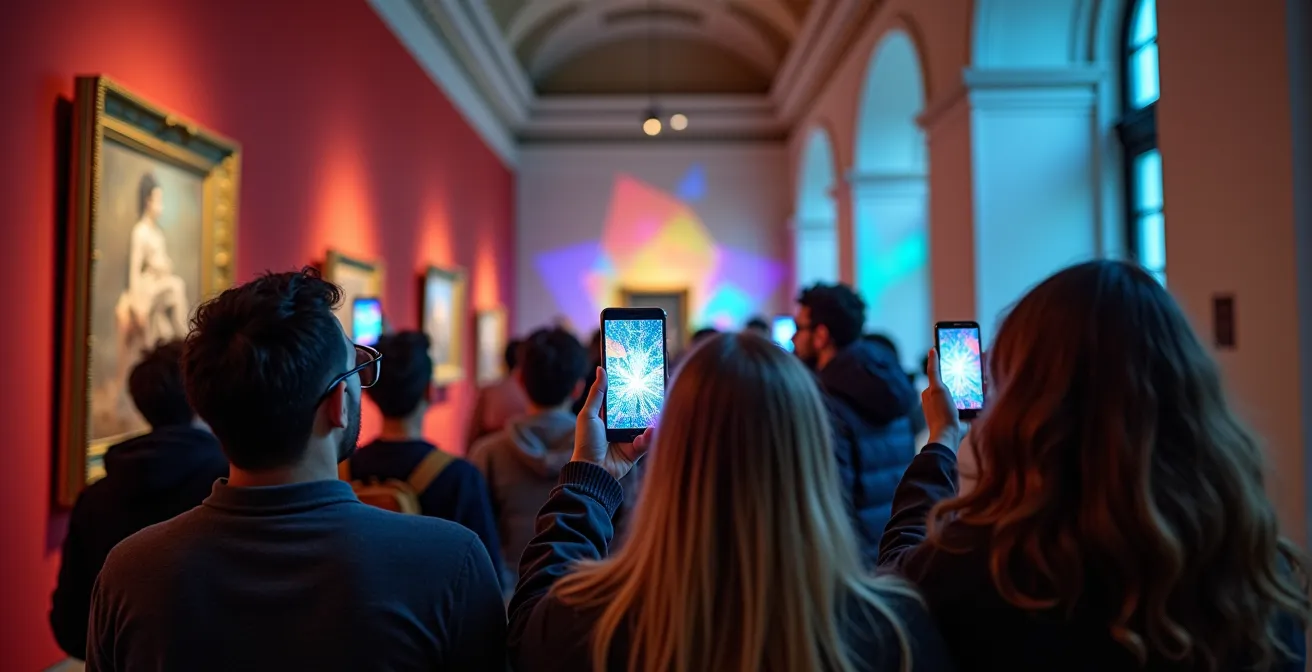
Augmented Reality apps also play a huge role by layering digital information and interactivity onto the physical world. A simple AR app can turn a museum visit into a “behind-the-scenes” tour, with curators popping up on-screen to share secrets about an artifact, or animations revealing how an ancient tool was used. This approach meets young audiences where they are—on their smartphones—and uses a familiar interface to deliver rich, contextual information. It bridges the gap between the physical object and its digital story, making the entire museum feel alive and responsive. By embracing these tools, museums are not just preserving the past; they are ensuring it has a vibrant future with the next generation.
Your journey as a digital curator starts now. Begin by exploring one of the virtual tours mentioned, adjust your comfort settings, and see for yourself how technology can bring you closer than ever to the heart of Canadian culture.