
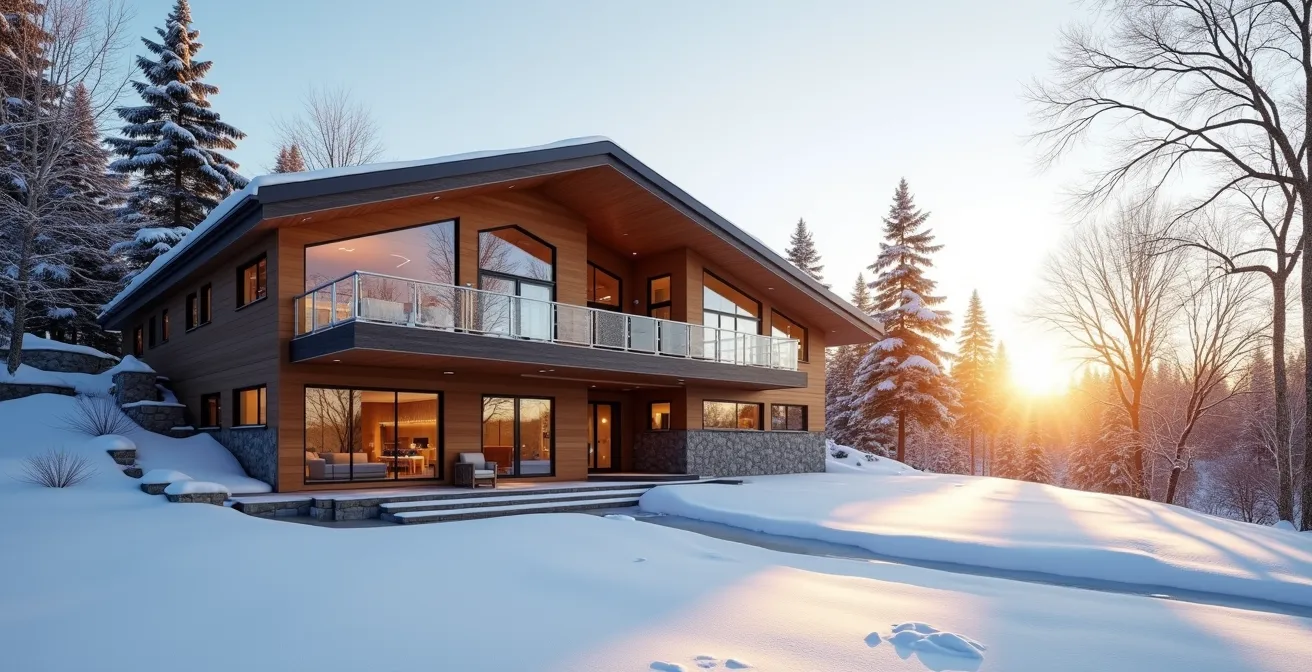
Fighting winter darkness is less about the size of your windows and more about the intelligence of your home’s entire engineered system.
- A high-performance thermal envelope is the non-negotiable foundation that allows for expansive, light-gathering glass without compromising comfort.
- Strategic material choices and climate-specific details—from rainscreens in British Columbia to snow-load engineering in Ottawa—are critical for longevity and performance.
Recommendation: Shift your focus from individual features to a holistic design where light, heat, and structure work in harmony to create a resilient and therapeutic living space.
For many Canadians, the arrival of winter brings with it a familiar, oppressive weight. The 4 PM sunset, the relentless grey skies, and the deep, chilling cold can take a toll on mental and physical well-being. For those who experience Seasonal Affective Disorder (SAD), this is more than a minor inconvenience; it’s a profound challenge. The conventional wisdom for brighter interiors is often a simplistic prescription of “add bigger windows” or “paint the walls white.” While not wrong, these tips barely scratch the surface of a much deeper, more elegant solution.
But what if the answer isn’t just about adding more light, but about engineering the home itself as a finely tuned instrument for well-being? This is the promise of modern Canadian architecture. It moves beyond simple aesthetics to embrace a philosophy where light is treated as a fundamental building material, as essential as concrete or cedar. This approach acknowledges that in a country of climatic extremes, a home must be more than a shelter; it must be a responsive, resilient, and restorative environment. It’s about creating a structure that not only withstands the -30°C cold but actively channels every precious photon of winter sun to uplift the human spirit.
This guide explores the engineering secrets, material science, and design philosophies that allow contemporary Canadian homes to achieve this synthesis of beauty, resilience, and light. We will deconstruct the key decisions that transform a house from a mere container into a dynamic filter for natural light, creating spaces that feel expansive, warm, and deeply connected to the outdoors, even on the shortest day of the year.
Summary: Designing for Light and Resilience in Canadian Climates
- Stucco vs. Cedar: Which Siding Rots Faster in Coastal BC Humidity?
- The Engineering Secret Behind Flat Roofs That Don’t Collapse in Ottawa?
- How to Have Floor-to-Ceiling Windows Without Living in a Fishbowl?
- Why More Public Buildings Are Adopting Indigenous Roundhouse Concepts?
- The Asbestos Risk Hidden in Your 1960s Modernist Bungalow Renovation?
- Argon vs. Krypton: Is the Extra Gas Cost Worth the Marginal Heat Gain?
- Air Source vs. Geothermal: Which Heat Pump Survives a -30°C Prairie Winter?
- ICF vs. Traditional Framing: Which Material Cuts Heating Costs by 40%?
Stucco vs. Cedar: Which Siding Rots Faster in Coastal BC Humidity?
On Canada’s West Coast, the persistent damp and driving rain create a unique challenge for a building’s exterior. The choice of siding is not just an aesthetic decision; it’s the first line of defense in a constant battle against moisture intrusion and rot. While cedar offers natural resistance due to its inherent oils, and stucco provides a seamless modern look, both are vulnerable if installed improperly. The secret to longevity in this humid, climatic vernacular isn’t the material itself, but the system behind it: the rainscreen.
A rainscreen creates an air gap between the siding and the home’s weather-resistant barrier. This space allows any water that penetrates the cladding to drain away harmlessly and, just as importantly, promotes airflow that dries the back of the siding. This small detail is so critical that, according to BC Building Code regulations, a 10mm minimum cavity depth is required to ensure effectiveness. This engineered gap is what prevents the unseen build-up of moisture that leads to catastrophic rot, regardless of whether you choose cedar or stucco.
When considering costs and maintenance, the decision becomes a balance of upfront investment versus long-term upkeep. The following table provides a snapshot of what homeowners in a coastal climate can expect.
| Material | Initial Cost/sq ft | Annual Maintenance | Lifespan (years) | Rot Resistance |
|---|---|---|---|---|
| Western Red Cedar | $8-12 | $500-800 | 30-40 | Natural oils provide protection |
| Acrylic Stucco | $6-9 | $200-400 | 20-30 | Requires proper drainage system |
Ultimately, a properly detailed rainscreen system transforms the siding from a potential liability into a durable, protective element of the home’s overall thermal envelope integrity. It is the invisible engineering that ensures the visible beauty endures.
The Engineering Secret Behind Flat Roofs That Don’t Collapse in Ottawa?
The sleek, minimalist lines of a flat roof are a hallmark of modern architecture, but in a city like Ottawa, which faces heavy winter snowfall, they present a significant engineering puzzle. Unlike a sloped roof that sheds snow naturally, a flat roof must bear the entire accumulated weight. The secret to their survival isn’t brute strength alone, but a meticulous calculation of potential loads combined with intelligent water management. The structure is engineered to handle not just a single heavy snowfall, but the worst-case scenario over a 50-year period.
Engineers and architects work with specific regional data to ensure safety and integrity. For example, Ottawa’s building code requires structures to handle a ground snow load of 2.0 kPa (kilopascals), which translates to a significant weight that the roof assembly must support without failure. This calculation also considers factors like wind exposure, which can cause snow to drift and accumulate in certain areas, and the potential for rain to fall on existing snow, dramatically increasing the load.
Beyond structural strength, the key is a slight, almost imperceptible slope—typically a minimum of 2%—directing water to strategically placed drains. These drains are often heated to prevent ice damming, which could block drainage and lead to pooling water. The roofing membrane itself is a continuous, waterproof layer, meticulously sealed at every seam and penetration. It is this combination of robust structural design and flawless waterproofing that allows for the clean aesthetic of a flat roof without risking the catastrophic consequences of a Canadian winter.
How to Have Floor-to-Ceiling Windows Without Living in a Fishbowl?
Floor-to-ceiling windows are the most powerful tool for dissolving the barrier between inside and out, flooding a home with natural light and forging a vital biophilic connection with the landscape. For someone battling SAD, this visual link to the outdoors is therapeutic. However, the dream of a light-filled sanctuary can quickly turn into a nightmare of zero privacy. The architectural solution lies in treating the view as a deliberately composed element, a concept of “engineered transparency,” where the site, building orientation, and landscape design work together to control what is seen and what remains private.
The first step is strategic orientation. By angling the home’s primary glass facades towards a private rear yard, a forested view, or a distant landscape, you can open up the interior without exposing it to the street or neighbours. Inside the home, a split-level design or carefully placed interior walls can create private zones and block direct sightlines from the entrance to the main living areas. As noted in a Canadian window design study, tall windows allow sunlight to reach further into Canadian homes, especially useful during low winter sun angles, while expansive windows distribute light horizontally to reduce dark corners. This dual strategy maximizes light while allowing for more targeted placement.
Perhaps the most elegant solution is integrating layered landscaping as a living privacy screen. Using native Canadian plants of varying heights—like a foreground of low-lying dogwood shrubs, a mid-ground of serviceberry trees, and a background of taller evergreens—creates a soft, natural barrier that filters views without completely blocking light. This approach provides privacy, adds seasonal beauty, and enhances the feeling of being immersed in nature.
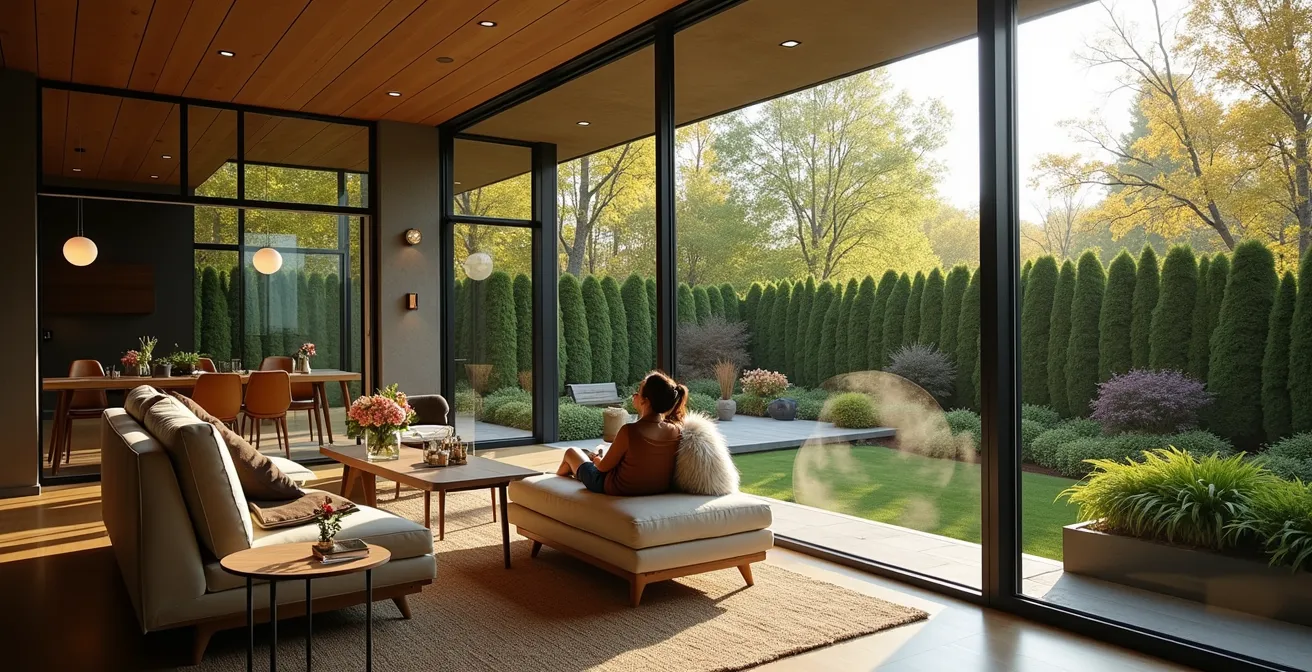
As this image demonstrates, the result is a space where one can feel both completely open to the light and perfectly secure. The interior is bathed in daylight, yet the view is of curated nature, not the world outside. This is how light as a material is shaped to create both openness and sanctuary.
Why More Public Buildings Are Adopting Indigenous Roundhouse Concepts?
In the search for more human-centric and sustainable architectural forms, a growing number of Canadian architects are drawing inspiration from an ancient source: the Indigenous roundhouse. This architectural typology, traditionally used for ceremony and community gathering, is being reinterpreted in modern public buildings for its profound social and environmental benefits. The move away from rectilinear, hierarchical forms towards circular designs fosters a powerful sense of community, equality, and connection that resonates deeply in spaces like libraries, schools, and cultural centres.
The genius of the roundhouse lies in its inherent lack of hierarchy. With no head of the table and no corners to hide in, a circular space encourages face-to-face interaction and a feeling of shared purpose. This geometry naturally draws people’s focus to the centre, creating an ideal environment for storytelling, learning, and collaborative work. It’s a spatial arrangement that intrinsically supports the well-being of the community it serves. The late, celebrated Indigenous architect Douglas Cardinal, who masterfully used curvilinear forms in projects like the Canadian Museum of History, articulated this philosophy perfectly.
The circular form creates non-hierarchical community spaces while providing surprising practical benefits for natural ventilation and energy efficiency.
– Douglas Cardinal, Canadian Museum of History Design Philosophy
Beyond its social advantages, the circular form offers surprising functional benefits. The shape can improve natural ventilation patterns and structural efficiency. When combined with a central oculus or clerestory windows, it allows for natural light to penetrate deep into the building’s core, reducing the need for artificial lighting. This return to an ancient, nature-inspired form is not a nostalgic gesture; it is a sophisticated architectural strategy for creating more inclusive, sustainable, and spiritually nourishing public spaces for all Canadians.
The Asbestos Risk Hidden in Your 1960s Modernist Bungalow Renovation?
The clean lines and open layouts of mid-century modernist bungalows, popular across Canada from the 1950s to the 1970s, make them prime candidates for contemporary renovations. However, lurking behind their charming simplicity is a significant health hazard: asbestos. This once-lauded “miracle material” for its fire-resistant and insulating properties was used extensively in everything from vinyl floor tiles and ceiling textures to pipe insulation and window glazing putty. For any homeowner planning a renovation, ignoring this hidden risk is not an option.
Disturbing asbestos-containing materials (ACMs) through demolition, cutting, or sanding can release microscopic fibres into the air, which, if inhaled, can lead to serious and fatal lung diseases years later. The danger is that these materials are often indistinguishable from their non-hazardous modern counterparts. Identifying them requires professional testing before any renovation work begins. Different provinces have strict, specific regulations governing the assessment and removal of asbestos, making it a legal and safety imperative.
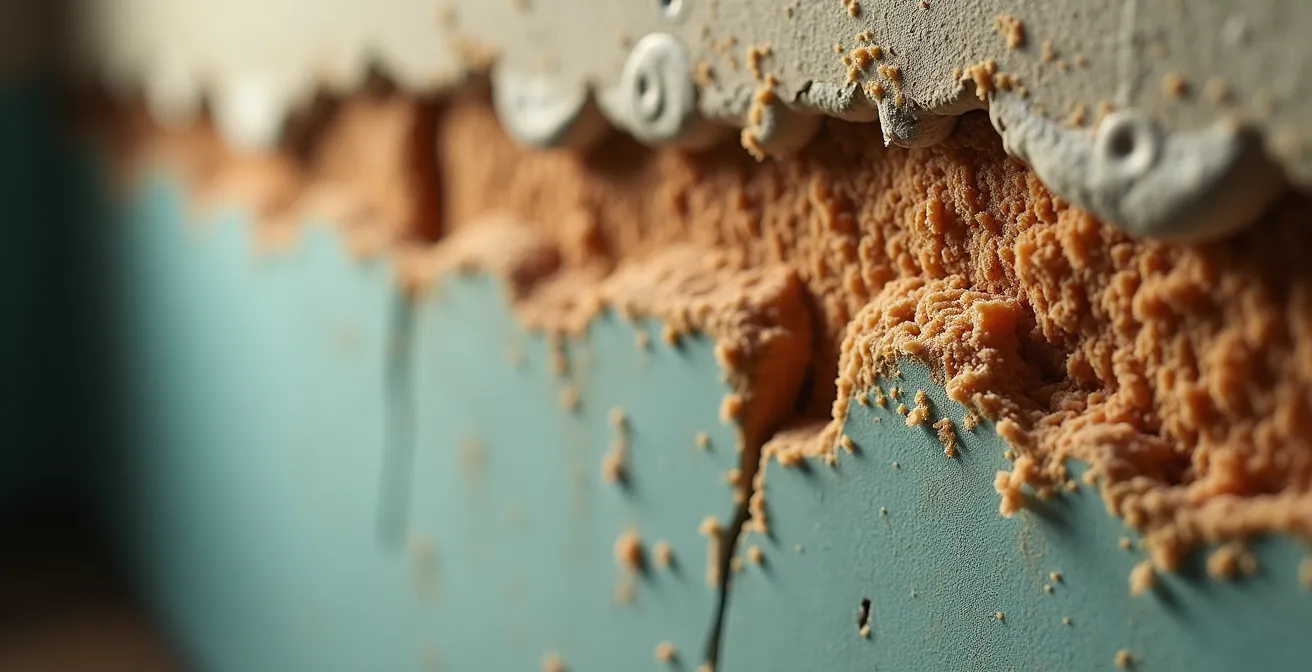
This cross-section highlights just a few of the common areas where asbestos-containing materials might be found. A comprehensive assessment is the only way to ensure a safe renovation project. The following checklist outlines the critical first steps for any homeowner approaching the renovation of a home built before 1980.
Your Pre-Renovation Asbestos Audit Checklist
- Assume asbestos is present in any home built before 1980. Do not start demolition.
- Contact a certified professional to conduct a hazardous materials assessment and take samples for lab testing.
- Review your provincial regulations (e.g., WorkSafeBC, Ontario Ministry of Labour, Quebec CNESST) to understand legal requirements.
- If asbestos is found, hire a qualified and licensed asbestos abatement contractor for removal. Never attempt to remove friable asbestos yourself.
- Budget an additional 10-15% of your total renovation cost as a contingency for potential assessment and abatement procedures.
Argon vs. Krypton: Is the Extra Gas Cost Worth the Marginal Heat Gain?
In the quest to create a perfectly insulated home that allows for vast expanses of glass, the space between the window panes becomes a critical battleground against heat loss. Modern high-performance windows are not filled with air, but with inert, invisible gases that are denser than air and thus slow the transfer of heat. The two most common options are Argon and Krypton. While both dramatically improve a window’s performance, the choice between them involves a trade-off between cost and marginal gains, a decision that is highly dependent on your specific Canadian climate.
The performance of a window is measured by its U-Factor; the lower the number, the better it is at preventing heat from escaping. Filling a double-glazed window with Argon gas is now the industry standard, offering a significant improvement over air-filled units. Krypton is even denser and a better insulator, but it comes at a substantially higher cost. The key question is whether the incremental improvement in U-Factor justifies the price premium. For many homeowners in milder climates like Vancouver, the payback period can be quite long.
However, for a homeowner in a city with extreme winters like Winnipeg, the math changes. The extra energy savings each winter can shorten the payback period considerably, making Krypton a worthwhile investment in the long-term performance of the thermal envelope integrity. It is part of a system where every component contributes to efficiency. Indeed, modern triple-glazed windows with advanced coatings can provide a 22% heat retention improvement over older models. The following table breaks down the performance and cost implications.
| Gas Type | U-Factor Improvement | Cost Premium | Payback Period (Vancouver) | Payback Period (Winnipeg) |
|---|---|---|---|---|
| Argon (90% fill) | 0.28 W/m²K | Base cost | N/A | N/A |
| Krypton (90% fill) | 0.23 W/m²K | +$15-20/sq ft | 12-15 years | 7-9 years |
Air Source vs. Geothermal: Which Heat Pump Survives a -30°C Prairie Winter?
For a home on the Canadian Prairies, where winter temperatures can plummet to -30°C and below, heating is not just about comfort—it’s about survival. Traditional furnaces are reliable but rely on fossil fuels. Heat pumps, which work by moving heat rather than creating it, offer a highly efficient alternative. The primary debate is between an Air Source Heat Pump (ASHP), which extracts heat from the outside air, and a Geothermal system, which draws it from the stable temperature of the earth. The question is, can an ASHP truly handle the extreme cold of a prairie winter?
Until recently, the answer was no. Standard ASHPs lose their efficiency dramatically as the temperature drops, requiring a backup heat source to kick in. However, new “cold climate” ASHP models have been engineered to operate effectively in much lower temperatures. As demonstrated by pilot projects in Saskatoon, some cold climate models can maintain a Coefficient of Performance (COP) of 1.5 even at -25°C, meaning they still produce 1.5 units of heat for every 1 unit of electricity consumed. While a supplemental heat source is still essential for the most extreme cold snaps, this technology makes ASHPs a viable primary heating system in the Prairies.
Geothermal systems, by contrast, are unaffected by air temperature, drawing consistent heat from the ground year-round, making them exceptionally reliable and efficient. Their major drawback is the high upfront installation cost, which involves extensive drilling or excavation. Federal and provincial rebates can significantly offset these costs for both systems, but the initial capital outlay for geothermal remains much higher, as outlined below.
| System Type | Installation Cost | Federal Grant | Provincial Rebates | Net Cost |
|---|---|---|---|---|
| Cold Climate ASHP | $15,000-20,000 | $5,000 | $2,000-4,000 | $8,000-11,000 |
| Geothermal | $30,000-45,000 | $5,000 | $3,000-7,000 | $22,000-33,000 |
Key Takeaways
- A home’s performance in the Canadian winter is dictated by its building envelope; a continuous layer of insulation and airtightness is the foundation of all light-filled, comfortable design.
- Maximizing natural light is about strategic engineering—orientation, window placement, and landscape integration—more than it is about the sheer size of the glass.
- Material science is not an abstract concept; it is the practical toolkit for balancing the desire for light with the necessity of thermal efficiency, from siding choices to the gas inside your windows.
ICF vs. Traditional Framing: Which Material Cuts Heating Costs by 40%?
The foundation of a light-filled winter home is a supremely well-insulated and airtight structure. This is what allows an architect to design with vast expanses of glass without creating a cold, drafty, and expensive-to-heat environment. Two primary construction methods compete in this arena: traditional wood framing and Insulated Concrete Forms (ICF). While marketing for ICF often boasts heating cost reductions of 40% or more, a more realistic look at the data reveals a more nuanced, though still impressive, picture.
ICF construction involves stacking hollow foam blocks, which are then reinforced with steel rebar and filled with concrete. This creates a monolithic, continuous wall system with a high thermal mass and virtually no air leakage. Traditional wood framing, by contrast, creates a wall cavity that is filled with insulation, but is subject to thermal bridging (heat loss through the wood studs) and potential air gaps. The primary advantage of ICF is its superior airtightness and continuous insulation, forming an almost perfect thermal envelope.
While the 40% savings figure is optimistic, real-world data and energy modeling provide a more sober estimate. According to industry analysis, HOT2000 modeling shows ICF homes typically achieve a 20-25% heating cost reduction over standard wood-framed homes. While less than the marketing claim, this is still a very significant, permanent reduction in energy consumption. The airtightness of an ICF home is where its true value lies. In one case study of a superinsulated Ontario home, the structure was so efficient that modest window area could provide a significant percentage of the heat load. This level of performance is the ultimate enabler of the light-centric design that is so beneficial for combating winter blues.
To truly bring these principles to life, the next logical step is to work with a design professional who understands how to weave these technical elements into a cohesive, beautiful, and therapeutic whole. An architect specializing in climate-responsive and light-focused design can translate these concepts into a home tailored specifically to your site, your needs, and your well-being.