
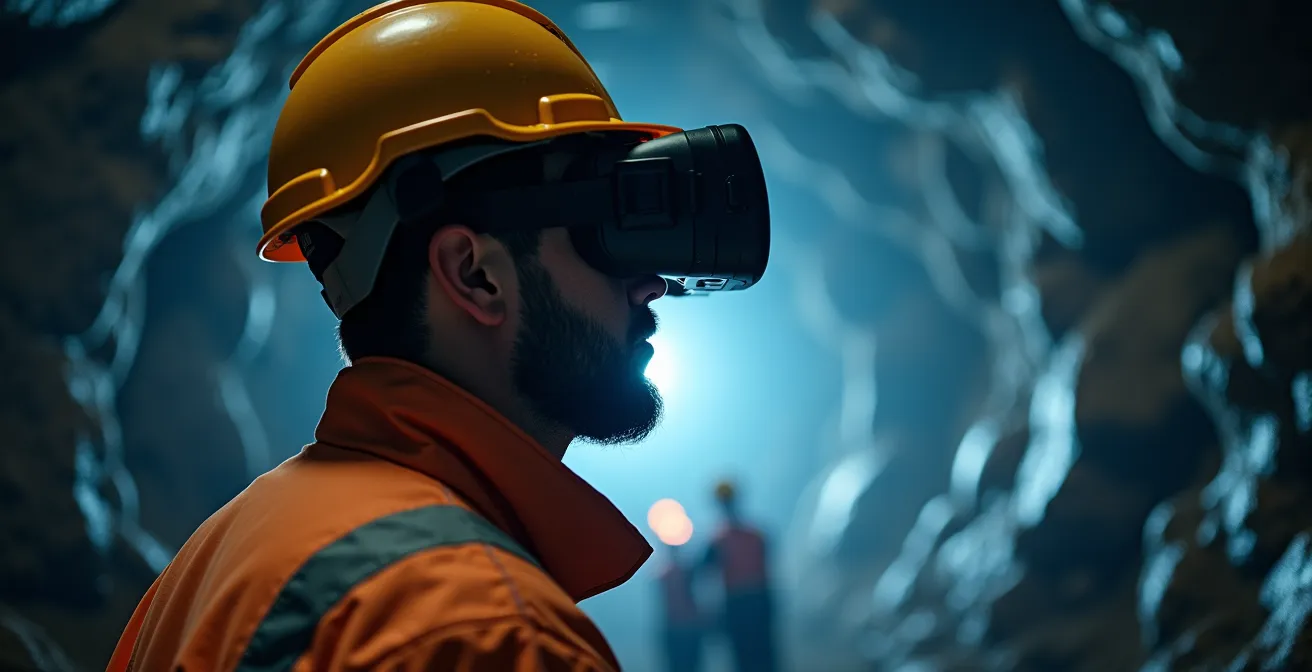
Virtual Reality training is proving to be the single most effective lever for reducing accidents in Canadian mines, delivering a measurable ROI that extends far beyond travel savings.
- Achieves significantly higher knowledge retention and confidence scores (up to 96%) post-training.
- Leads to a drastic reduction in lost-time injuries (up to 43%) by building procedural muscle memory.
Recommendation: Focus on data-driven implementation and confidence-building for veteran workers to maximize safety outcomes.
For any safety manager in Canadian heavy industry, the ultimate goal is zero harm. Yet, traditional training methods—classroom sessions, PowerPoint presentations, and theoretical manuals—often fall short of preparing workers for the high-stakes reality of a mine environment. The cost of an incident is never just financial; it’s measured in lives, team morale, and operational downtime. For years, the industry has relied on sending personnel across the country for hands-on training, a costly and logistically complex exercise.
The conversation around training is often dominated by these direct expenses. But what if the true cost of inadequate training is hidden in the accident reports? What if the key to unlocking a new level of safety isn’t just about showing procedures, but about building procedural muscle memory that workers can rely on under extreme pressure? This is where Virtual Reality (VR) is fundamentally changing the equation. It moves beyond passive learning to create active, repeatable, and hyper-realistic scenarios without exposing anyone to real-world risk.
This article moves past the hype to provide a data-backed analysis for Canadian safety managers. We will dissect how VR training delivers a quantifiable operational ROI by drastically reducing accident rates, examine strategies to ensure adoption among all workers, and explore the underlying reasons for its superior effectiveness in knowledge retention. We will provide a clear framework for evaluating and implementing this transformative technology within the unique context of Canadian mining operations.
This comprehensive guide breaks down the critical aspects of implementing VR training in the Canadian mining sector, moving from financial justification to practical execution and long-term strategy. The following sections will provide a detailed roadmap for any safety manager looking to leverage this technology for measurable safety improvements.
Summary: A Deep Dive into VR Safety Training for Canadian Mining
- Why Flying Staff to Calgary for Training Costs 3x More Than VR Simulations
- The Onboarding Strategy That Gets Older Workers Excited About VR Training
- Do Employees Actually Remember Procedures Better After VR Training?
- How to Simulate High-Conflict Customer Service Scenarios in VR
- Unity or Unreal Engine: Which Platform Builds Better Industrial Simulations?
- The Motion Sickness Fix That Allows You to Enjoy VR for Hours
- What Happens to Your Tesla Battery When It Dies in Canada?
- How to Integrate Generative AI into a Small Canadian Retail Business?
Why Flying Staff to Calgary for Training Costs 3x More Than VR Simulations
The direct cost of flying teams to a central training hub like Calgary—encompassing flights, hotels, and daily allowances—is the most visible expense of traditional training. However, this figure represents only a fraction of the total cost. The real, and often overlooked, expense lies in operational inefficiency and, most critically, the cost of accidents that outdated training methods fail to prevent. An effective training program’s ROI should be measured not just in travel budgets saved, but in accidents avoided and productivity gained.
Virtual Reality training fundamentally redefines this calculation. Firstly, it drastically reduces the time required to achieve proficiency. By allowing for repeated, on-demand practice of complex procedures, VR can shorten a learning curve that would otherwise take weeks in the field. Secondly, and more importantly, it directly impacts the bottom line by improving safety outcomes. Immersive simulations that replicate hazardous scenarios allow workers to make mistakes and learn from them in a zero-risk environment. This hands-on experience translates into superior performance in the real world.
The data from the Canadian mining industry and related sectors is compelling. VR training has been directly correlated with a dramatic decrease in safety incidents. For example, some programs have demonstrated a 76% reduction in worksite accidents after workers completed VR modules. This isn’t just a marginal improvement; it’s a transformational shift in safety culture. When considering that Canada’s mining sector will need over 100,000 new workers by 2029, implementing scalable and effective training is not just an option, but a strategic necessity. The true cost of sticking to traditional methods is the preventable accidents that will inevitably occur.
The Onboarding Strategy That Gets Older Workers Excited About VR Training
A common concern for safety managers is how veteran miners, with decades of hands-on experience, will react to a technology like VR. The assumption is often that there will be resistance or skepticism. However, successful implementation hinges not on forcing technology, but on demonstrating its tangible value in a way that resonates with experienced professionals: building confidence and validating their expertise. The key is to frame VR not as a replacement for their experience, but as a tool to enhance it and transfer it safely.
This section is illustrated by a veteran miner guiding a younger colleague through a VR training session, symbolizing the transfer of knowledge.
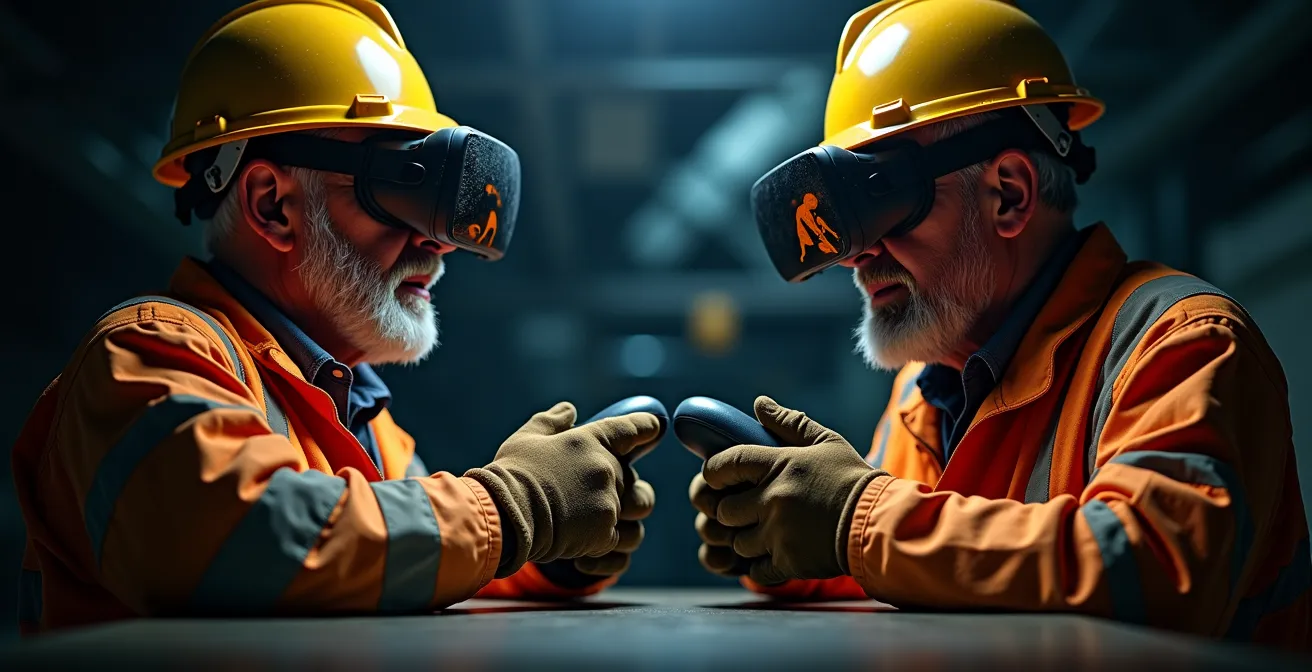
A successful strategy starts with building a “confidence capital.” Instead of throwing workers into complex simulations, begin with simple, task-oriented modules that allow them to quickly succeed. The NORCAT’s program in Canada provides a powerful case study: trainees in a VR pre-operational check program saw their confidence and know-how scores jump from a baseline of 41% to a post-training score of 96%. According to a PwC study, this is a common outcome, with VR trainees being 275% more confident to apply their skills after training. This newfound confidence is the most powerful driver of adoption among seasoned workers, who value practical competence above all else.
Case Study: NORCAT’s Pre-Operational Check Success
In a targeted program, trainees at NORCAT in Ontario participated in a VR pre-operational circle check simulation. The results were measured and definitive. Before the VR training, the group’s average score in correctly and confidently completing the check was just 41%. After completing the immersive VR module, that score soared to an impressive 96%. This demonstrates VR’s ability to rapidly build both competence and confidence in critical safety procedures, a key factor in winning over an experienced workforce.
Action Plan: Onboarding Veteran Workers to VR Training
- Focus on Confidence: Begin with simple modules that guarantee early success to build initial trust in the technology.
- Highlight Efficiency: Demonstrate how VR allows them to learn and practice procedures four times faster than in a classroom, respecting their valuable time.
- Connect to Career Value: Frame VR skills as a crucial part of modern career development, addressing concerns that nearly 50% of mining employees consider leaving due to a lack of such opportunities.
- Emphasize Practicality: Position VR as a tool, much like any other piece of equipment, that makes their job safer and more effective.
- Foster Mentorship: Encourage veteran miners to act as mentors during VR sessions, leveraging their experience to guide newer trainees through the simulations.
Do Employees Actually Remember Procedures Better After VR Training?
The core value of any training program is not what employees learn, but what they remember and can apply under pressure. Traditional classroom learning often struggles with retention, as theoretical knowledge fades without practical application. Virtual Reality training overcomes this by creating a powerful link between knowledge and action, a concept best described as procedural muscle memory. It’s the difference between reading a manual on how to extinguish a fire and actually grabbing the virtual extinguisher, pulling the pin, and aiming at the base of the flames.
This active participation engages the brain on a much deeper level. The immersive nature of VR means the user is not a passive observer but an active participant. Their brain processes the simulated environment as real, encoding the sequence of actions—the “procedure”—into long-term memory more effectively. This is because learning becomes experiential. When a worker has to physically walk through an emergency escape route in VR or perform a lockout-tagout sequence with their own hands, the memory of that action is far more durable than a checklist on a slide.
The ultimate proof of this enhanced retention is found in safety statistics. Better memory of procedures directly leads to fewer errors in the field. Data from the Minesafe International Conference confirms this, showing a 43% reduction in lost time injuries in mining operations that have integrated VR safety training. This figure is not a measure of enjoyment or engagement; it is a hard metric demonstrating that what is learned in VR is retained and correctly applied when it matters most, directly preventing accidents and injuries.
How to Simulate High-Conflict Customer Service Scenarios in VR
While the title mentions “customer service,” in the context of heavy industry like mining, “high-conflict” translates to high-stakes crisis scenarios. These are not arguments over a product, but life-or-death situations requiring flawless communication, rapid decision-making, and perfect team collaboration under immense pressure. Simulating these events—such as a mine fire, a structural collapse, or a medical emergency—is where VR offers unparalleled value. It provides a safe space to practice for the worst-case scenario.
This image depicts a manager in a VR headset, alone in a large space, practicing their response to a complex scenario, highlighting the focused nature of crisis simulation.

High-fidelity simulations can recreate these environments with stunning accuracy, from the visual and auditory chaos of an emergency to the specific equipment involved. The University of Utah’s collaboration with Minverso provides an excellent example. They developed an immersive mine rescue simulation where a team must work together to neutralize a fire in a load-haul-dump machine. The scenario forces workers to think critically and collaborate to perform tasks in the correct sequence: de-energizing the equipment, extinguishing the fire, and managing the ventilation system. This is not a single-player task; it is a direct test of a team’s ability to communicate and execute a plan under duress.
These simulations allow safety managers to assess and train critical soft skills that are impossible to measure in a classroom. How does a team leader communicate orders when alarms are blaring? How do team members coordinate their actions in a smoke-filled tunnel? VR makes it possible to run these drills repeatedly, identify weak points in communication protocols, and build a cohesive, resilient team response. It is the closest thing to real-world experience, without the real-world consequences, transforming a reactive team into a proactive, prepared emergency response unit.
Unity or Unreal Engine: Which Platform Builds Better Industrial Simulations?
Once the decision to invest in VR training is made, a critical technical question arises for the safety manager or their development partners: which game engine, Unity or Unreal Engine (UE), is the right choice for building industrial simulations? Both are powerful platforms, but they have distinct strengths that make them better suited for different priorities. The choice is not about which is “better” overall, but which is the best fit for the specific needs of a mining simulation project.
Unreal Engine is widely praised for its ability to deliver photo-realistic, high-fidelity graphics out of the box. Its advanced rendering technologies, like Lumen for real-time global illumination and Nanite for handling massive geometric detail, make it an ideal choice for simulations where visual realism is paramount. If the goal is to create an environment that is visually indistinguishable from the real mine, UE often provides a more direct path. Unity, on the other hand, is known for its flexibility, accessibility, and vast cross-platform support. While achieving the same level of visual fidelity as Unreal might require more effort and specific expertise, Unity’s user-friendly interface and extensive asset store can accelerate development, especially for deploying on a wide range of devices, including mobile.
For industrial applications, both engines offer robust solutions for importing CAD data—a critical workflow for creating accurate digital twins of machinery and environments. Unity uses the PixYZ plugin, while Unreal has its Datasmith toolkit. The following table, based on an analysis of industrial simulation development, summarizes the key considerations:
| Feature | Unity | Unreal Engine |
|---|---|---|
| Visual Quality for Industrial Use | Good rendering capabilities, may require more effort for high-fidelity visuals | Praised for realistic rendering capabilities, easier to achieve high-fidelity visuals |
| CAD Data Import | Seamless import using PixYZ plugin | Seamless import using Datasmith |
| Platform Deployment | Easy deployment to Windows, mobile apps (iOS/Android) | Easy deployment to various platforms like Unity |
| Developer Interface | User-friendly interface, extensive asset store | Focus on high-fidelity graphics and realistic rendering |
| Cross-platform Compatibility | Extensive cross-platform compatibility | Equally attractive for photorealistic simulations |
The Motion Sickness Fix That Allows You to Enjoy VR for Hours
One of the most significant barriers to widespread VR adoption has been cybersickness, or motion sickness. For a safety manager, this is a critical issue; a training tool is useless if it makes employees feel ill. Fortunately, this is a largely solved problem, with a combination of hardware advancements, smart software design, and user acclimatization techniques allowing for comfortable, hours-long sessions. Understanding these solutions is key to deploying a successful VR program.
The primary cause of cybersickness is a vestibulo-ocular mismatch. This occurs when your eyes tell your brain you’re moving (e.g., in a virtual vehicle), but your inner ear’s vestibular system, which governs balance, reports that you are stationary. This sensory conflict can trigger nausea and disorientation. Modern solutions attack this problem from three angles:
- Hardware Solutions: Modern VR headsets have significantly reduced this issue with high refresh rates (90Hz to 120Hz) and low-latency, high-precision “inside-out” tracking. This ensures that when you move your head in the real world, the view in the virtual world updates almost instantaneously, keeping the senses in sync.
- Software and Design Solutions: Developers now use proven techniques to design comfortable experiences. The most common is avoiding artificial camera movements that the user doesn’t control. Instead of smooth walking with a joystick, many applications use “teleportation” (point to a spot and instantly appear there) or “snap-turning” (rotating the view in discrete increments). These methods prevent the sensory mismatch that causes sickness.
- Human Factors: For sensitive individuals, gradual acclimatization is effective. Starting with short, 10-15 minute sessions and slowly increasing the duration allows the brain to adapt. Simple remedies like ensuring good ventilation, aiming a fan at the user, or even chewing ginger gum have also been shown to help mitigate mild symptoms.
Key Takeaways
- The true ROI of VR is operational (accident reduction) and not just financial (travel savings).
- Adoption by veteran workers depends on building a measurable “confidence capital” rather than forcing technology.
- Enhanced knowledge retention is a form of “procedural muscle memory” that translates directly into fewer on-site injuries.
What Happens to Your Tesla Battery When It Dies in Canada?
This question, seemingly about electric vehicles, provides a powerful metaphor for implementing any advanced technology, including a VR training system. Just like a high-performance Tesla, a VR program is much more than its initial purchase price. Its long-term value depends entirely on its “battery”—its lifecycle management, maintenance, and upgrade path. A safety manager who invests in VR headsets without a plan for their operational life risks ending up with expensive, “dead” equipment in a storage closet.
The “battery life” of a VR system can be broken down into three key areas. First is the hardware lifecycle. VR headsets and the powerful PCs required to run them are evolving rapidly. A strategic plan must account for a refresh cycle of 3-5 years to keep the technology effective and avoid obsolescence. Second is the software maintenance. The training modules themselves are not static. They must be updated to reflect new procedures, new equipment, or new safety regulations. An ongoing support and content update plan is as crucial as the initial software development.
Finally, there’s the user support and system health. What happens when a headset needs recalibration, a controller fails, or a software update causes a glitch? A successful deployment includes a plan for technical support and regular system health checks to ensure the training program is always ready and reliable. Just as a Tesla owner in Canada needs to think about battery degradation in the cold and access to a charging network, a safety manager must plan for the entire ecosystem supporting their VR training. Neglecting the “battery” is a surefire way to ensure the investment fails to deliver its long-term safety promise.
How to Integrate Generative AI into a Small Canadian Retail Business?
At first glance, integrating Generative AI into retail seems worlds away from deploying VR in mining. However, the core principles of successfully introducing a disruptive technology into a traditional environment are universal. The challenges faced by a small Canadian retailer adopting AI offer a valuable analogue for a safety manager implementing VR. Success in both cases depends less on the technology itself and more on the strategic approach to integration.
Drawing parallels from the challenges of AI in retail, we can distill a clear framework for VR integration in mining:
- Start with a Specific, High-Value Problem: A retailer wouldn’t implement a generic AI chatbot; they’d target a specific issue like personalizing marketing emails or automating inventory descriptions. Similarly, don’t start with a vague “VR for safety” project. Target a single, high-risk procedure where accidents are common or training is notoriously difficult, like lockout-tagout or confined space entry. Prove the value there first.
- Secure Buy-In from the Ground Up: For AI to work in retail, cashiers and store managers must see how it helps them, not just how it serves corporate. In mining, involve veteran miners and supervisors in the design process. Ask them: “What is the most dangerous or difficult task to teach?” When they help build the solution, they become its biggest advocates.
- Measure Everything and Define Clear KPIs: A retailer tracks click-through rates and conversion from their AI-powered campaigns. A safety manager must define the metrics for VR success before starting. Is it a reduction in near-miss reports for a specific task? An improvement in procedure completion times? A quantifiable increase in post-training confidence scores? Without a baseline and a target, you cannot prove ROI.
To translate these insights into action, the next logical step is to conduct a pilot program targeting a specific, high-risk procedure within your operations. By measuring baseline performance, deploying a targeted VR module, and analyzing the results, you can build an undeniable, data-driven business case for a full-scale rollout that will fundamentally enhance the safety and competence of your entire workforce.