
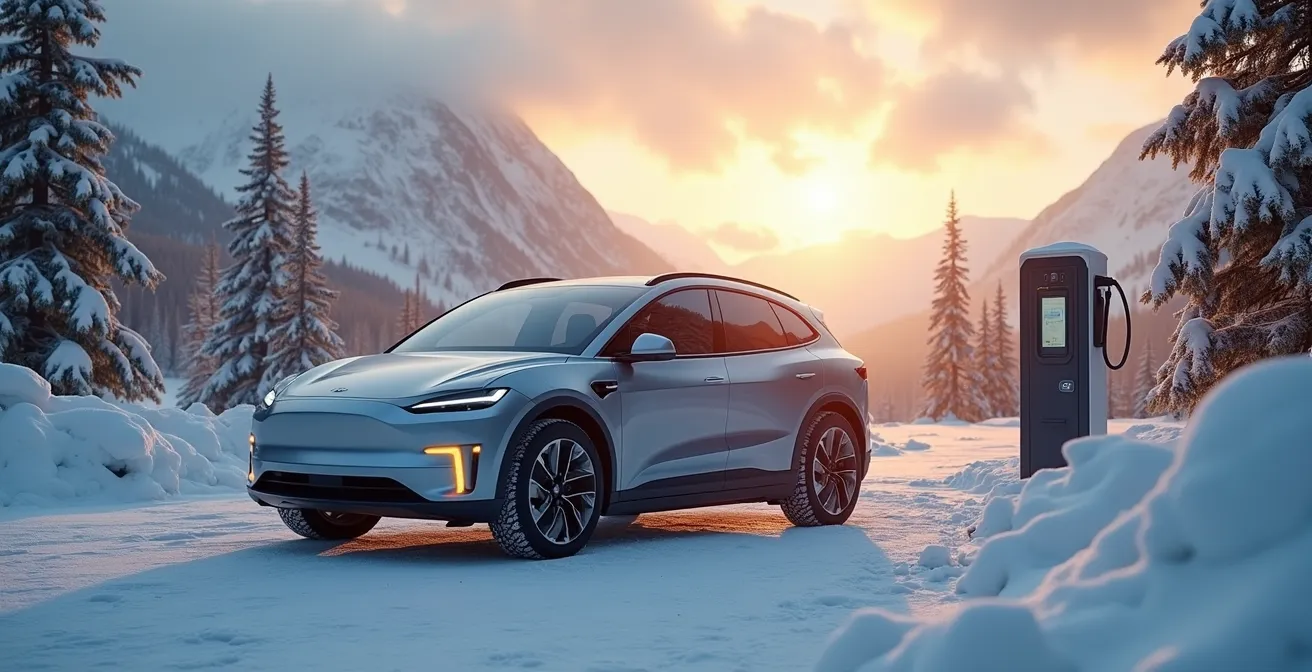
Your electric vehicle’s winter performance is defined by its thermal management system, not just its battery size or drivetrain.
- A heat pump is critical for efficiency in mild cold, but its advantage diminishes dramatically in deep freeze conditions below -15°C.
- For city driving, premium winter tires on a FWD vehicle often provide better value and safety than upgrading to an AWD model.
- Short trips are the biggest range killers, as repeatedly heating a cold-soaked cabin carries a massive energy penalty.
Recommendation: Prioritize an EV with a modern, cold-climate heat pump, but invest the money you save by forgoing AWD into the best set of winter tires you can afford.
The first deep freeze of a Canadian winter always brings a familiar wave of anxiety for electric vehicle owners. You wake up to a world encased in ice, the thermometer mocking you with a reading of -25°C, and your primary thought is not about the beauty of the frost, but about your car’s range meter. Will the number you saw last night be slashed in half? Will you even make it to work and back? The common advice is predictable: pre-heat your cabin while plugged in, use your heated seats, and drive gently. These are valid tips, but they only scratch the surface of a much more complex engineering reality.
The truth is that surviving, and even thriving, with an EV in a Canadian winter isn’t about a single magic feature. It’s about understanding the vehicle as a complete thermal system. The debate between a heat pump and a simple resistive heater is central, but it’s only one part of the equation. Factors like battery chemistry, drivetrain configuration, tire selection, and even your daily travel patterns play an equally crucial role in what I call the “winter energy penalty.” The real key is not just to fear range loss, but to understand precisely where every kilowatt-hour is going when the temperature plummets.
This guide moves beyond the surface-level advice. We will dissect the technical realities of EV performance in the cold, from the physics of battery drain at the airport to the surprising inefficiency of short city commutes. We will analyze why dual motors might be overkill for your needs and how to navigate the legal landscape of installing a charger in your condo. By understanding these interconnected systems, you can make an informed choice for your next EV and operate it with the confidence of a seasoned winter driver, no matter what the forecast holds.
To navigate these critical considerations, this article breaks down the essential topics every prospective Canadian EV buyer must understand. From core performance metrics in a deep freeze to the practicalities of charging and urban commuting, here is your comprehensive guide.
Contents: The Complete Guide to EV Ownership in a Canadian Winter
- The “Minus 30 Rule”: How Much Range Will Your EV Lose in Deep Freeze?
- FWD vs. AWD Electric: Do You Need Dual Motors for City Driving?
- How Towing a Boat Reduces Your F-150 Lightning’s Range on the Highway?
- Why Your EV Loses Charge While Parked at the Airport in Winter?
- Why Leasing an EV Might Be Safer Than Buying Given Tech Advances?
- Air Source vs. Geothermal: Which Heat Pump Survives a -30°C Prairie Winter?
- TTC Streetcars vs. Walking: Which Is Faster for a 2km Commute in Winter?
- How to Legally Force Your Condo Board to Approve an EV Charger Installation?
The “Minus 30 Rule”: How Much Range Will Your EV Lose in Deep Freeze?
The most pressing question for any Canadian EV driver is the “Minus 30 Rule”—the colloquial term for the drastic range reduction experienced in extreme cold. It’s not a myth; the loss is real, but its severity depends heavily on your vehicle’s technology. The primary culprit is battery chemistry. Lithium-ion batteries function through chemical reactions, which slow down dramatically as temperatures drop. This increases internal resistance, making it harder to both extract and store energy. A cold battery is an inefficient battery, and your car must expend precious energy just to warm its own power source to an operational temperature before it can effectively power your drive.
The second major drain is cabin heating. A traditional resistive heater, like the glowing coils in a toaster, is simple but brutally inefficient. It draws a constant, heavy load directly from the high-voltage battery, which can single-handedly slash your range. This is where a thermal management system, especially one with a heat pump, becomes critical. Comprehensive Canadian testing provides a clear picture of this impact. Real-world road tests have found that EVs lose between 14% to 39% of their range in winter conditions. This variance isn’t random; it directly correlates to the sophistication of the car’s heating and battery management technology.
For instance, an EV with a simple resistive heater and a poorly insulated battery will always be on the higher end of that range loss spectrum. In contrast, models like the Chevrolet Silverado EV and Polestar 2, which feature more advanced systems, have demonstrated losses on the lower end, around 14%. The difference between a 14% and a 39% range loss is the difference between a minor inconvenience and being stranded on the side of the Trans-Canada Highway. Understanding where a specific model falls on this spectrum is the single most important piece of research for a Canadian buyer.
FWD vs. AWD Electric: Do You Need Dual Motors for City Driving?
The debate between front-wheel drive (FWD) and all-wheel drive (AWD) is a classic Canadian car-buying dilemma, and it takes on a new dimension with EVs. The marketing is compelling: a dual-motor AWD setup offers superior traction and instant torque to all four wheels, promising unbeatable grip on icy city streets. While this is technically true—AWD provides a clear advantage when accelerating from a standstill on a slippery surface—its necessity for urban winter driving is often overstated and comes with significant trade-offs.
The primary downside is the energy penalty. Powering a second motor, even when it’s not under heavy load, consumes more electricity. This contributes to a lower overall range compared to an equivalent FWD model, a penalty that is magnified in cold weather when every kilowatt-hour counts. Furthermore, the most critical element for winter safety isn’t accelerating; it’s steering and braking. An AWD system offers no inherent advantage in stopping distance or cornering grip. These crucial safety aspects are almost entirely dictated by your tires.

For a typical city driver in places like Toronto or Montreal, a FWD electric vehicle equipped with a set of high-quality winter tires often represents a smarter, safer, and more cost-effective choice. The grip provided by a proper winter tire compound and tread design on snow and ice far outweighs the marginal acceleration benefits of AWD in most daily driving scenarios. The money saved by forgoing the AWD option—often a $5,000+ premium—can be invested in a top-tier set of winter tires and dedicated rims, with plenty left over. This strategy not only improves your vehicle’s most critical safety functions (braking and turning) but also maximizes its potential winter range.
Your Action Plan: Winter Tire Strategy for an Urban EV
- Install premium winter tires bearing the Three-Peak Mountain Snowflake (3PMSF) symbol, rated for extreme cold.
- Check and maintain proper tire pressure monthly; cold air is denser and pressure drops, impacting both safety and efficiency.
- Consider a dedicated set of steel or cheaper alloy wheels for your winter tires to protect your primary rims from salt corrosion and damage.
- Budget between $1,200 and $1,800 CAD for a quality winter tire package, a fraction of the cost of an AWD upgrade.
- Ensure tires are rotated every 10,000 km to promote even wear, which is especially important given the instant torque of an EV.
How Towing a Boat Reduces Your F-150 Lightning’s Range on the Highway?
Towing has always been a challenge for vehicle efficiency, and for electric trucks, this reality is amplified, especially in winter. An electric truck like the Ford F-150 Lightning is an engineering marvel, but its impressive EPA-rated range is calculated under ideal, load-free conditions. When you attach a 7,000-pound boat or a camper trailer, you introduce two massive efficiency killers: weight and aerodynamic drag. The powertrain must work significantly harder to overcome the inertia of the added mass, and the trailer’s blocky shape destroys the truck’s carefully designed aerodynamics, creating immense wind resistance at highway speeds.
In a Canadian winter, this challenge is compounded. The baseline range is already reduced due to the cold’s effect on the battery and the need for cabin heating. Adding a heavy, non-aerodynamic trailer can easily cut the remaining range in half, or even more. A truck that might offer 400 km of range in the summer could struggle to achieve 150 km while towing in a -20°C blizzard. This is a critical consideration for anyone planning to use an electric truck for quintessential Canadian activities like hauling a snowmobile trailer up to the cottage or taking a camper out in the shoulder seasons.
Furthermore, the infrastructure for charging while towing is still nascent. Many charging stations are designed like traditional gas pumps, requiring you to back in—a maneuver that is difficult or impossible with a trailer attached. This can force you to unhitch your trailer to charge, adding significant time and hassle to your journey. While some models show impressive winter capability—the Chevrolet Silverado EV achieved a notable 456 km in one winter test—this was without a load. As a case study, testers have noted the Ford F-150 Lightning sometimes struggles to even reach a full 100% state of charge in extreme cold, starting a towing test at only 89% and highlighting the stacked challenges of cold, charging, and heavy loads.
Why Your EV Loses Charge While Parked at the Airport in Winter?
One of the most unsettling experiences for a new EV owner is returning from a week-long trip to find their car’s battery significantly lower than when they left it. This phenomenon, known as “vampire drain” or phantom drain, is the steady loss of charge while the vehicle is parked and turned off. In a warm climate, this loss is often negligible, perhaps 1% over several days. In a Canadian winter, however, it can become a serious concern, with some owners reporting losses of 2-3% or more per day in sub-zero temperatures.

The primary culprit is the vehicle’s own self-preservation instinct: the Battery Thermal Management System. To prevent the battery cells from freezing and sustaining permanent damage, the car will periodically use its own energy to warm the battery pack, keeping it above a critical low-temperature threshold. This is a non-negotiable safety feature, but it consumes power. Each time the system kicks in to circulate warm fluid or energize a heating element, it sips away at your state of charge. This is why data often shows an average range reduction of 27-30% in cold weather, a figure that accounts for both driving and these passive losses.
Other systems can also contribute to vampire drain. Sentry modes or other security systems that keep cameras and sensors active are a major power draw. Even the constant readiness to receive a signal from your smartphone app requires a small but continuous amount of energy. When planning to leave an EV parked for an extended period in the Canadian cold—for instance, at an airport parking lot—strategic preparation is key. Disabling non-essential features and ensuring you have an adequate charge buffer can prevent an unpleasant surprise upon your return.
Why Leasing an EV Might Be Safer Than Buying Given Tech Advances?
The decision to buy or lease a vehicle is always complex, but the rapid evolution of electric vehicle technology adds a compelling argument in favor of leasing. The pace of innovation in battery chemistry, software, and particularly in thermal management systems is staggering. An EV that is state-of-the-art today could be technologically surpassed in just three to four years, directly impacting its long-term value and winter performance. This is especially true regarding the shift from resistive heaters to heat pumps.
As an industry analysis points out, heat pumps are quickly becoming a standard feature rather than a premium add-on. According to a report on EV technology:
As production costs drop and manufacturers compete on range and efficiency, heat pumps are moving from being a premium feature to standard equipment in more EV models. This trend signals a future where efficient electric car heating systems will be a core part of every electric vehicle.
– North York Chrysler Analysis, Electric Vehicle Heat Pump Technology Report
This transition is critical for Canadian buyers. As we’ve seen, the efficiency of the heating system is a primary determinant of winter range. Modern heat pumps are 3-4x more efficient than resistive heaters in mild cold, and the technology continues to improve for better performance in deep-freeze conditions. By purchasing an EV today, you risk owning a vehicle with a less efficient, soon-to-be-outdated heating system, which could significantly affect its resale value in a market where buyers are increasingly educated about winter performance.
Leasing mitigates this risk of technological obsolescence. A typical three or four-year lease allows you to benefit from the current technology without being financially tied to it long-term. At the end of the lease, you can simply return the vehicle and upgrade to a new model that incorporates the latest advancements in battery and heating technology. In a rapidly changing landscape, leasing offers a strategic way to always have a vehicle with competitive winter performance, protecting you from the steep depreciation that can affect early-generation technology.
Air Source vs. Geothermal: Which Heat Pump Survives a -30°C Prairie Winter?
When we discuss heat pumps in electric vehicles, we are talking about air-source heat pumps. They function like a reversible air conditioner, extracting heat from the outside air and concentrating it to warm the cabin. This process is remarkably efficient in cool or mild-cold temperatures, but it has a fundamental limitation rooted in physics: as the outside air gets colder, there is less heat to extract. The pump must work harder and harder for diminishing returns, a concept measured by its Coefficient of Performance (COP).
The COP is a ratio of the heat produced to the electrical energy consumed. A COP of 3.0 means the pump is producing 3 units of heat for every 1 unit of electricity it uses. As a benchmark, a simple resistive heater always has a COP of 1.0. An EV’s heat pump may achieve a COP of 3.0 or even 4.0 at +5°C, providing a massive efficiency gain. However, this performance degrades linearly with temperature. Data shows that a typical heat pump coefficient of performance drops from 3.0 at +5°C to 1.2 at -20°C. At this point, it is only marginally better than a resistive heater. Below -20°C, the COP can approach 1.0, at which point the system effectively switches over to using a supplemental resistive heater anyway, erasing the efficiency advantage entirely.
This is why the promise of a “heat pump” isn’t a silver bullet for a Prairie winter in Calgary or Winnipeg, where temperatures frequently plunge below -25°C. While it offers significant range savings during the majority of the winter, its benefit disappears during the most extreme cold snaps. This is in contrast to geothermal heat pumps used in homes, which draw heat from the stable temperature of the earth and can maintain high efficiency even in extreme cold. Automakers are constantly improving the low-temperature performance of their air-source systems, but the physical limitations remain. Even so, having one is a net positive; an Alberta case study showed a home heat pump system continuing to function at -40°C with only occasional backup, proving the technology’s resilience.
TTC Streetcars vs. Walking: Which Is Faster for a 2km Commute in Winter?
The “energy penalty” of winter driving is most acute during short city trips. Imagine you need to run a 2 km errand in downtown Toronto in January. Your EV is cold-soaked, having sat outside in -15°C temperatures. When you start the car, its first priority is not to move you, but to heat two things: its battery and its cabin. Heating the massive battery pack from a sub-zero temperature to its optimal operating range and simultaneously blasting the heater to make the cabin tolerable for a human can consume an enormous burst of energy, often several kilowatt-hours.
This initial heating phase is where the most energy is wasted. If your trip is only a few minutes long, you may find that the energy used to simply “get ready” is more than the energy used for propulsion. As one analysis notes, the impact is severe:
If you’re making short trips with frequent stops in the cold, range loss can climb to nearly 50%, as the cabin has to be reheated multiple times.
– North York Chrysler, EV Winter Efficiency Analysis
This reality forces a pragmatic, and perhaps counter-intuitive, question: is it even worth taking the car? The table below breaks down the true cost of a short winter trip, considering the high energy cost of heating a cold EV for a brief journey.
| Transport Mode | Energy Cost | Time to Heat/Ready | Environmental Impact |
|---|---|---|---|
| Cold EV (no preheat) | ~2-3 kWh | 5-10 minutes | High for short trip |
| Preheated EV | ~0.5-1 kWh | Instant | Moderate |
| TTC Streetcar | $3.35 fare | Wait time varies | Shared resource |
| Walking | Zero | Instant | None |
When factoring in the time to warm up the car and the high energy consumption, taking the TTC or even walking can emerge as a more efficient option in terms of both time and energy for very short commutes. This isn’t an argument against EVs, but a testament to the physics of thermal dynamics. It highlights the importance of pre-heating while plugged in whenever possible, which allows the energy-intensive warm-up phase to be powered by the grid, not your battery.
Key Takeaways
- An EV’s winter range is primarily determined by its thermal management system; a heat pump is crucial but loses its edge in deep-freeze conditions below -20°C.
- For urban driving, investing in high-quality winter tires provides a greater safety and performance benefit than upgrading to an all-wheel-drive system.
- The highest energy consumption occurs during short trips, where the power needed to repeatedly heat a cold-soaked battery and cabin can reduce effective range by up to 50%.
How to Legally Force Your Condo Board to Approve an EV Charger Installation?
For many urban Canadians, the single biggest barrier to EV adoption isn’t range or winter performance—it’s the ability to charge at home. If you live in a condominium, you can’t simply install a Level 2 charger in your parking spot. You are at the mercy of your condo corporation’s board of directors, who may be hesitant due to concerns about cost, electrical capacity, or liability. Fortunately, in provinces like Ontario, the law is increasingly on the side of the EV owner, establishing a “Right to Charge” framework that condo boards cannot easily ignore.
The process is not about “forcing” the board in an adversarial sense, but about following a defined legal procedure that compels them to engage in good faith. The Condominium Authority of Ontario (CAO) outlines a clear, multi-step process. It begins with the owner submitting a detailed application that includes professional electrical assessments, installation plans, and quotes from certified electricians. This shifts the burden from the board to the owner to do the necessary due diligence. Once a complete application is submitted, the clock starts ticking.
The condo board has a strict 60-day window to respond. Crucially, they cannot reject the application for arbitrary reasons. The law specifies the only valid grounds for rejection, as stated by the CAO:
The corporation can only reject the request for installation if, based on the opinion or report of a qualified professional: The installation would be in violation of the Condo Act, or any other legislation; The installation would adversely affect the structural integrity of the property; The installation poses a health and safety risk to the property and its occupants.
– Condominium Authority of Ontario, Electric Vehicle Charging Systems Guide
This is a very high bar for the board to meet. If they cannot provide a professional report citing one of these specific risks, they are legally obligated to approve the installation. Following approval, the owner and board have 90 days to negotiate a detailed agreement covering all responsibilities, from electricity costs to maintenance. This agreement is then registered on the title of the unit, ensuring it is transparent and transferable to future owners. While the process requires preparation and diligence, the legal framework provides a clear pathway to securing at-home charging, the final and most critical piece of the urban EV puzzle.
Now equipped with a technical understanding of winter performance and the practical knowledge of urban ownership, you can assess potential electric vehicles not just on their sticker price, but on their true suitability for the rigors of a Canadian climate.