

The harsh reality is your vehicle’s advanced driver-assistance systems (ADAS) are dangerously unreliable in a Canadian winter, and trusting them blindly is a setup for accidents and expensive repairs.
- Winter conditions like slush, ice, and salt spray effectively blind the cameras and radar sensors that ADAS relies on, leading to system failure.
- In Canada, the legal responsibility for a crash almost always falls on the driver, not the manufacturer, even if an “autopilot” system was engaged.
Recommendation: Treat ADAS as a fair-weather tool only. In winter, your primary safety system is your own vigilance, skill, and a vehicle properly equipped with winter tires.
You’re driving down a snow-dusted Highway 401. The lane markings are faint, and a mix of slush and salt coats the road. Yet, you feel a gentle nudge on the steering wheel as your car’s Lane Keep Assist tries to “help.” It feels reassuring, like a technological safety net. Many drivers believe this is the future, and the common advice is simple: just keep your sensors clean and let the tech do its job. But this thinking is a dangerous trap.
The truth is far more complex and critical. These systems, designed in the perfect conditions of California or Germany, have a fundamental weakness: they were not born in the chaos of a Canadian winter. Their “eyes” and “ears”—the cameras and radar sensors—are easily blinded by the very conditions we face for months on end. Relying on them is not just a gamble on your safety; it’s an open invitation to legal battles and repair bills that can run into the thousands.
This isn’t about rejecting technology. It’s about developing a healthy, expert skepticism. It’s about understanding the precise breaking points of your vehicle’s systems before they break on you. This guide moves beyond the owner’s manual to reveal the harsh realities of ADAS in winter, from the hidden “calibration tax” on simple repairs to the legal grey zones of autonomous tech on icy roads. It’s time to shift from being a passive user to an active, informed system manager of your own vehicle.
To navigate this complex topic, we will break down the critical failure points and hidden costs associated with using ADAS in Canadian winters. The following sections will equip you with the expert knowledge needed to make safe decisions when the weather turns.
Summary: A Canadian Driver’s Guide to ADAS, Winter, and Reality
- Why a Windshield Replacement Costs $1,000 More on a Car with ADAS?
- If Autopilot Crashes, Is It Your Fault or the Manufacturer’s in Canada?
- The “Slush Blindness”: How to Keep Radar Sensors Working in Sleet?
- How to Turn Off Start-Stop Systems Permanently Without Voiding Warranty?
- Does Auto-Park Actually Work in Tight Downtown Toronto Spots?
- What the Proposed AIDA Legislation Means for Your AI Startup?
- Why Flying Staff to Calgary for Training Costs 3x More Than VR Simulations?
- The 7-Degree Rule: Why You Need Winter Tires Before the First Snow Falls?
Why a Windshield Replacement Costs $1,000 More on a Car with ADAS?
That small rock chip on your windshield used to be an inexpensive fix. On a modern vehicle equipped with Advanced Driver-Assistance Systems (ADAS), it’s the start of a multi-thousand-dollar repair. The reason is simple: you’re no longer just replacing glass. You’re servicing a critical component of your car’s brain. The forward-facing camera mounted to your windshield is the primary eye for systems like lane-keeping assist, adaptive cruise control, and automatic emergency braking.
When a new windshield is installed, this camera must be meticulously recalibrated to ensure it sees the world exactly as the manufacturer intended. Even a millimeter of deviation can cause the system to misjudge distances or lane positions, leading to erratic behavior or complete failure when you need it most. This process is not optional; it’s a fundamental safety requirement. Think of it as a hidden “calibration tax” on modern vehicles.
The cost of this procedure alone can be significant. According to industry data, the specialized process of camera calibration costs can range from $150 to $600 in Canada. This is on top of the price of the specialized OEM (Original Equipment Manufacturer) glass required for ADAS systems. For luxury or specialty vehicles, the situation is even more stark. As some Canadian auto glass specialists note, the cost of a new windshield can exceed $2,000 when factoring in the complex glass and extensive recalibration. That rock chip just became a major financial decision, highlighting the steep, often overlooked, cost of a technology that is itself vulnerable to the harshness of Canadian roads.
If Autopilot Crashes, Is It Your Fault or the Manufacturer’s in Canada?
In the marketing materials, systems like “Autopilot” or “ProPILOT” sound like your personal chauffeur. On an icy stretch of Canadian highway, that illusion can shatter, leaving you in a legal and financial nightmare. Let’s be unequivocally clear: in Canada, if your car crashes while an assistance system is active, the legal responsibility almost certainly falls on you, the driver. This is a critical point that many drivers misunderstand through technological over-reliance.
The key is in the name: “driver-assistance.” These are Level 2 or Level 3 autonomous systems, meaning they require constant human supervision. You are not a passenger; you are the system manager, expected to take over at a moment’s notice. Transport Canada is explicit in its guidance for drivers, a warning that should be memorized by every Canadian with an ADAS-equipped vehicle.
Don’t rely on other driver assistance technologies, like blind spot monitoring or lane keeping assistance, as they may not work in bad weather. Review your owner’s manual to understand the systems’ abilities and limits.
– Transport Canada, Winter Driving Safety Guidelines
This creates a dangerous liability grey zone where a driver’s trust in technology can lead directly to fault in an accident. Arguing that “the car was driving” is not a valid legal defense. To protect yourself, you must shift your mindset from trusting the system to actively managing its limitations, especially in winter. The first step is a pre-season audit of your own vehicle and habits.
Your Pre-Winter ADAS Audit Checklist: 5 Steps to Reclaim Control
- Manual Review: Locate the specific section in your owner’s manual detailing ADAS limitations in snow, ice, and cold temperatures. Highlight the operating temperature range and weather warnings.
- Insurance Policy Check: Contact your insurance provider and ask if there are any specific clauses or requirements related to the use of ADAS, particularly in at-fault accident determinations.
- Sensor Inventory: Physically locate every camera, radar, and ultrasonic sensor on your vehicle. Understand which systems depend on which sensors so you know what is compromised when one is blocked.
- Practice Disengagement: In a safe, clear environment, practice manually overriding the lane-keep assist and adaptive cruise control. Your muscle memory for taking back control must be instant.
- Mental Rehearsal: Before a winter drive, consciously decide on your “red line” conditions (e.g., heavy slush, freezing rain) where you will proactively disable all assistance features before they have a chance to fail.
The “Slush Blindness”: How to Keep Radar Sensors Working in Sleet?
Your car’s ADAS sees the world through a network of sensors, primarily cameras on the windshield and radar units often hidden behind the grille or bumper. In a Canadian winter, these sensors suffer from a condition we can call “Slush Blindness.” A coating of road salt, ice, and grime is all it takes to render a multi-thousand-dollar safety system completely useless. When the system can’t see, it can’t function, often deactivating with a sudden, unhelpful “Sensor Blocked” warning—or worse, providing no warning at all.
The problem is most acute with the radar sensors responsible for adaptive cruise control and forward-collision warnings. Unlike a camera that might be cleared by your wipers, these units are exposed to direct impact from road spray. A layer of frozen slush is opaque to radar waves, effectively making your car blind to the traffic ahead.
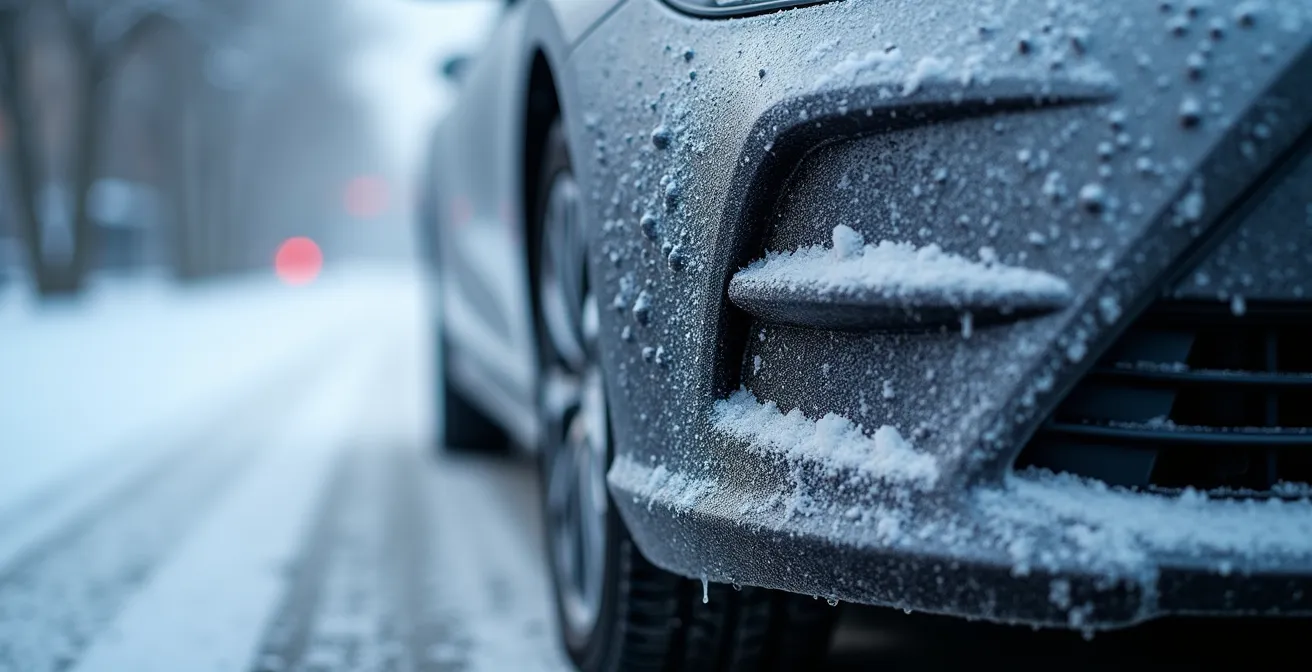
As the image above illustrates, the buildup isn’t just loose snow; it’s a dense, often frozen mixture that adheres firmly to the vehicle’s surfaces. Relying on these systems in sleet or slushy conditions is a fool’s errand. The question isn’t *if* they will fail, but *when*. The only effective countermeasure is manual intervention. You, the driver, must become part of the car’s maintenance routine, not just before you drive, but potentially during the trip itself.
Keeping sensors functional requires constant vigilance. Here are the practical, non-negotiable steps:
- Pre-trip Inspection: Before every winter drive, make it a habit to gently wipe every sensor. This includes the front grille radar, cameras in the windshield housing, and ultrasonic sensors on the bumpers.
- Carry a Soft Cloth: Keep a microfiber cloth in your car. If you get a sensor-blocked warning on the highway, you’ll need to pull over safely and physically clean the sensor.
- Avoid High-Pressure Washes: Never aim a high-pressure car wash wand directly at sensor areas. This can damage the sensitive electronics or force water into sealed units.
- Use De-icer Sparingly: While a de-icer spray can help, use it cautiously around sensor housings. Some chemicals can damage plastic lenses or coatings over time.
How to Turn Off Start-Stop Systems Permanently Without Voiding Warranty?
The automatic start-stop system, designed to save a few drops of fuel at traffic lights, is one of the most complained-about features in modern cars. In a Canadian winter, it can be more than an annoyance; it can feel like a direct conflict with comfort and common sense. When you’re trying to get the cabin heater working on a frigid morning, the last thing you want is for the engine to shut off. Likewise, it puts extra strain on the battery, which is already working harder in the cold.
Fortunately, automotive engineers are aware of this. Most start-stop systems are programmed with self-preservation logic. In extreme cold, they will automatically disable themselves to protect the engine and battery. For many Canadian-market vehicles, this threshold is set quite low; it’s not uncommon for most start-stop systems to automatically disable below -20°C. However, on a merely cold -5°C day, the system will likely remain active, much to the driver’s chagrin.
This leads many owners to ask: can I turn it off for good? The internet is full of “solutions,” from aftermarket electronic modules that trick the car’s computer to complex coding changes. Here’s the blunt truth: any attempt to permanently disable the start-stop system using an unauthorized method is a significant risk to your vehicle’s warranty. If an electrical issue arises later, the manufacturer can and will point to your modification as the cause, voiding your claim.
The only 100% warranty-safe way to manage the system is the one the manufacturer provides: the “off” button. It’s a frustrating extra step to press it every time you start the car, but it’s the only method that guarantees you won’t face a massive, uncovered repair bill down the line. Treat it as part of your startup sequence: seatbelt on, start engine, disable start-stop. It’s a small price to pay for peace of mind.
Does Auto-Park Actually Work in Tight Downtown Toronto Spots?
In theory, an automatic parking system is a dream come true for navigating the notoriously tight parking spots of downtown Toronto. The system promises a perfect parallel park every time, saving you from stressful maneuvering and potential bumper scrapes. In summer, on a clearly marked street, it can work surprisingly well. In winter, however, that dream often becomes a nightmare.
The problem is that auto-park technology relies on a perfect, data-rich environment. Its ultrasonic sensors need to detect the hard, clean edge of a curb and the well-defined shape of the cars in front and behind. A Toronto winter provides the exact opposite. Curbs disappear under massive, misshapen snowbanks. The space you’re trying to park in might have an invisible layer of black ice, dramatically changing your car’s braking distance. The lines marking the parking space are a distant memory under a layer of slush and salt.

The system, faced with this chaotic and incomplete data, becomes hesitant, confused, or simply refuses to engage. It can’t “see” the curb hidden by the snow, so it doesn’t know its spatial limits. It might mistake a hard chunk of frozen slush for the car behind it, stopping the maneuver prematurely. As any Canadian driver knows, it’s far harder to stop your car in snow and icy conditions. Your car can easily lose traction when braking, a variable the auto-park system is often not sophisticated enough to handle in real-time. It’s designed for grip, not for slip.
Relying on auto-park in these conditions is asking for trouble. The system might steer your wheel directly into a jagged ice bank you could have easily avoided, or misjudge the space and give up halfway through, leaving you in a worse position than when you started. In a Canadian winter, particularly in a dense urban environment, the most reliable parking sensor is still the driver’s own judgment, experience, and a healthy dose of caution.
What the Proposed AIDA Legislation Means for Your AI Startup?
While the immediate focus for drivers is on safety and performance, the Canadian government is already looking years ahead at the legal landscape of artificial intelligence. This might seem irrelevant to your daily commute, but it’s not. The proposed Artificial Intelligence and Data Act (AIDA) is Canada’s first major step toward regulating AI systems, and it has direct implications for the very automotive technology in your driveway.
The legislation aims to classify AI systems based on their potential impact. A “high-impact system” is one that could cause significant harm to individuals or their interests. It’s a category that almost certainly includes autonomous and semi-autonomous driving software. AIDA is about creating accountability. It’s about forcing companies to be transparent about how their AI works, what data it uses, and, most importantly, what its limitations are.
High-impact systems classification in Canada’s AIDA could apply to autonomous driving software, potentially forcing automakers to be more transparent about their systems’ limitations in Canadian weather.
– Legal Analysis, AIDA Legislation Impact Assessment
For you, the driver, this is a double-edged sword. In the future, AIDA could provide a stronger legal basis for holding a manufacturer accountable if their system fails. It might force them to be more honest in their marketing and provide clearer warnings about winter performance. However, in the present, the very existence of this proposed legislation is a clear signal: the government recognizes that these AI systems are not infallible. They are building a framework to manage the inevitable failures. This reinforces the core message that today, in the absence of full regulation, the ultimate legal and safety responsibility rests squarely on the driver.
Why Flying Staff to Calgary for Training Costs 3x More Than VR Simulations?
Automakers invest hundreds of millions of dollars in sophisticated testing. They use climate-controlled wind tunnels, sprawling test tracks in places like Area X.O. in Ottawa, and advanced virtual reality (VR) simulations to push their vehicles to the limit. They know that to build a reliable system, they need a controlled, repeatable environment where they can test for every conceivable edge case. They need a four-season test environment to develop technologies ready for global markets.
This stands in stark contrast to the reality of the average driver. While engineers benefit from extensive training and perfect data, the driver is given the keys with little more than a brief mention in the owner’s manual. There is a massive gap between the idealized world where your car’s ADAS was developed and the chaotic, unpredictable reality of a blizzard on the Coquihalla Highway or a flash freeze in Montreal.
The fact that innovators require such extensive, controlled testing highlights the fundamental weakness of these systems in the wild. A simulation can be programmed with a thousand variables; the real world presents a million. The automaker’s reliance on controlled environments is an implicit admission that their systems are not yet ready for the full spectrum of real-world chaos, especially the kind unique to a Canadian winter. They are testing in a lab, while you are the unknowing beta tester on public roads.
This is why a driver’s skepticism is so critical. You are the final, most important sensor in the system. You are the only one capable of processing the unique combination of visual cues, physical feedback, and environmental conditions that signal danger. Until the day cars are trained in the same messy, unpredictable conditions we drive in, the human driver remains the only truly reliable “all-weather” package.
Key Takeaways
- Your car’s “smart” features are not built for the reality of Canadian winters; their sensors are easily blinded by snow, ice, and slush.
- In the event of a crash, Canadian law holds the driver responsible, not the technology. “The car was driving” is not a legal defense.
- The hidden costs of ADAS are significant, from thousand-dollar windshield replacements to the risk of voiding your warranty with modifications.
The 7-Degree Rule: Why You Need Winter Tires Before the First Snow Falls?
The single most important decision you can make to improve your vehicle’s safety in winter—both for manual driving and for ADAS performance—is installing proper winter tires. Many drivers wait for the first snowfall, but this is a critical mistake. The key isn’t snow; it’s temperature. The “7-Degree Rule” is the golden standard promoted by safety experts and automotive associations across the country.
The science is simple. The rubber compound in all-season tires begins to harden as the temperature drops. Below 7°C, they lose their pliability and their ability to grip the road, even if the pavement is dry. Winter tires use a specialized rubber compound that stays soft and flexible in the cold, allowing them to maintain traction. According to the Canadian Automobile Association, you should switch to winter tires as soon as the temperature is consistently below 7 degrees Celsius.
This isn’t just about preventing skids. It’s about providing your car’s computer with reliable data. Your vehicle’s Electronic Stability Control (ESC) and traction control systems are constantly making micro-adjustments based on how the tires are responding. When these systems are paired with hard, ineffective all-season tires in the cold, they are working with bad information. The computer commands a certain braking or steering response, but the tire can’t execute it. This can confuse the system, leading to poor performance or unpredictable behavior.
By switching to winter tires at the 7-degree mark, you are ensuring the foundation of your car’s safety pyramid is solid. You are giving your brakes, your steering, and critically, your ADAS the best possible chance to function as intended. A lane-keeping system can’t keep you in your lane if the tires can’t grip the road to follow its commands. Winter tires are not an optional upgrade in Canada; they are the essential first step to managing your vehicle safely through the long winter months.
Taking back control of your vehicle this winter starts with the basics. Don’t wait for the first snowflake to become a statistic. Check the forecast, and when you see the temperature consistently dropping toward 7°C, make the appointment to have your winter tires installed. It is the most important safety decision you will make all year.